
Glomerella acutata
Glomerella acutata
Description
How to identify
Glomerella acutata is an ascomycete fungus and the sexual stage (teleomorph) of the widely known pathogen Colletotrichum acutatum. As a significant phytopathogen, it is responsible for severe outbreaks of anthracnose across numerous agricultural crops.
The fungus produces both asexual conidia and sexual ascospores (within perithecia), allowing it to persist in the soil and on crop debris for extended periods. This dual reproductive cycle contributes to its high environmental persistence.
Identification typically involves microscopic examination of conidia, which are usually fusiform or cylindrical with rounded ends. The pathogen's growth on culture media often presents as a distinct dark or pinkish mycelial mat.
Systemically, the organism is highly adaptable and genetically diverse, complicating efforts to breed resistant cultivars. Its ability to mutate makes continuous monitoring and strategy adjustment essential for agricultural stability.
Spread occurs primarily through rain splashes, wind, and contaminated tools or nursery stock. Understanding this dissemination pattern is crucial for implementing effective quarantine and sanitation practices in both greenhouses and open fields.
What it damages
This pathogen has a vast host range, infecting over 40 species of plants. It causes significant economic damage to strawberry crops, stone fruits such as cherries and peaches, and various decorative flowering plants.
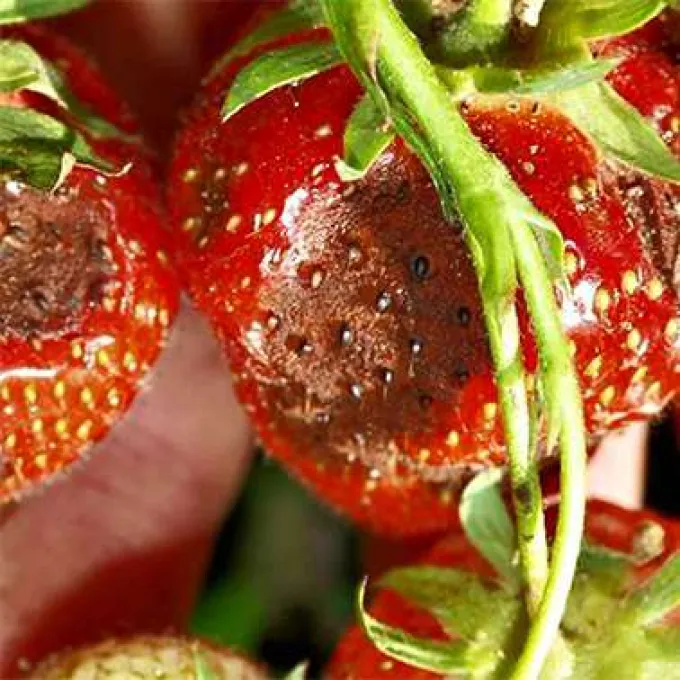
On strawberries, it targets fruits, stems, and crowns, often leading to fruit rot and the total collapse of the plant. In orchards, it causes twig blight and fruit rot, which can lead to rapid post-harvest decay.
The damage is not limited to surface tissue; the fungus can systemically colonize the plant, leading to stunted growth, wilting, and eventually plant death. These systemic infections are particularly difficult to manage.
Economic losses are exacerbated by the reduction in shelf life of produce, as infected fruits may appear healthy at harvest but develop rotting lesions during storage and transport due to latent infections.
The loss of marketability and the cost of repeated fungicide applications significantly impact the profit margins for growers, especially in regions with high precipitation during the growing season.
When it appears
Disease development begins in the spring, triggered by moderate temperatures ranging from 15°C to 25°C and high humidity levels. These environmental conditions favor the activation of dormant spores.
The summer months, particularly during periods of heavy rain or high moisture, represent the peak period for pathogen spread. Rain splashes move spores from infected tissues to healthy leaves and fruits, facilitating rapid outbreaks.
While the fungus can survive a broad temperature range, its sporulation is highest during wet conditions. Extended periods of rainfall are the most critical factor for widespread transmission across a field.
Autumn marks the transition to the survival stage. The fungus persists in soil debris and mummy fruits in the form of perithecia, which are resilient structures capable of enduring cold winter temperatures.
Early spring marks the start of the new infection cycle when the primary inoculum is released from overwintering structures. Preventive measures during this time are essential to manage future seasonal spread.
Signs of infestation
Common symptoms include sunken, dark-colored lesions on fruits, which eventually enlarge and become covered in a slimy mass of pink or orange spores during high humidity.
Stems and leaf petioles often show elongated necrotic stripes or ulcers. Severe infections cause sudden wilting of branches, which can be mistaken for other environmental stressors or nutrient deficiencies.
Floral infection leads to the browning and necrosis of blossoms, resulting in total crop loss before fruit formation even begins. This is particularly devastating for strawberry production.
Root systems may also be affected, showing symptoms of decay, browning, and reduced vigor. This internal infection prevents proper nutrient and water uptake, leading to chlorosis and slow decline of the host.
A reliable diagnostic indicator is the presence of fungal spore masses within the lesion centers, often visible under moderate magnification. These lesions generally exhibit a sharp margin between healthy and diseased tissue.
Control measures
The primary control strategy is the use of disease-free, certified plant material. Ensuring that nursery stock is clean is the most effective way to prevent the initial introduction of the pathogen into a farm.
Agrotechnical practices include the strict removal and destruction of crop debris and infected plants. Reducing density in plantings improves air circulation and lowers humidity, making the environment less favorable for the fungus.
Sanitation of farming tools and equipment is necessary to prevent cross-contamination between different fields or blocks within the same orchard or greenhouse facility.
Chemical control relies on a scheduled fungicide program, ideally starting before the onset of the disease. Fungicides from the triazole and strobilurin classes are commonly employed for suppression.
It is vital to rotate fungicides with different modes of action to prevent the development of resistant fungal populations, a common issue with Glomerella acutata management programs.
Causes diseases · 1
Discussion
No discussions yet — be the first.