
Cucumber mosaic virus
Cucurbit leaf
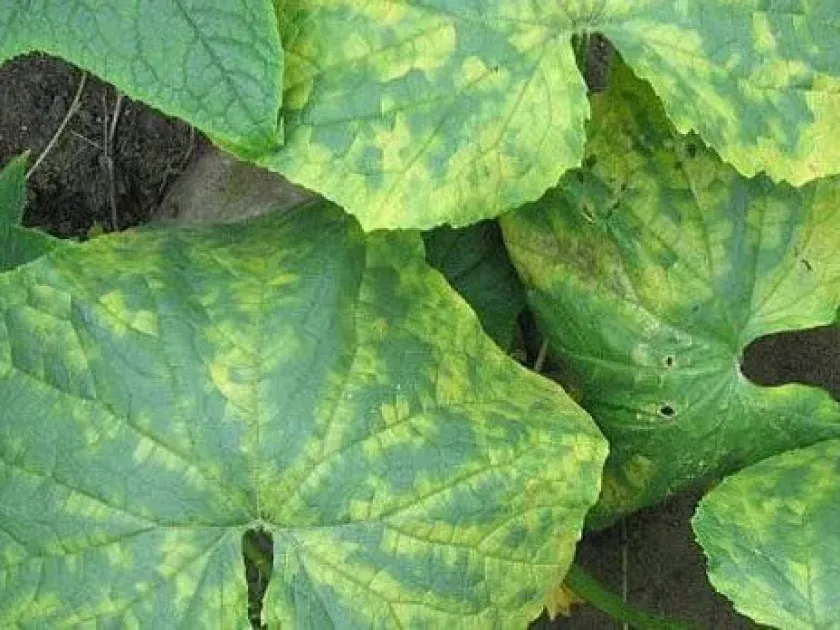
Description
How to identify
Cucumber mosaic virus (CMV) is a plant pathogenic virus in the genus Cucumovirus, family Bromoviridae. It has one of the broadest host ranges of any known plant virus, affecting over 1,200 species of both crops and wild plants.
The virus particles are spherical and contain a single-stranded RNA genome. It is highly unstable outside of the host plant, being sensitive to heat, desiccation, and common chemical disinfectants.
Transmission occurs primarily through aphid vectors (over 80 species) in a non-persistent manner. This means that aphids pick up the virus from an infected plant through their mouthparts and can immediately transmit it to the next healthy plant they feed on.
Human activity is another significant vector. Mechanical transmission occurs through contaminated gardening tools, handling of plants during pruning, harvesting, or even through simple leaf-to-leaf contact in windy conditions.
Perennial weeds serve as the primary reservoirs for the virus, harboring it throughout the winter and providing a source for early-season infections when aphid populations begin to migrate.
What it damages
CMV affects virtually all cucurbits, including cucumbers, zucchini, squash, melons, and watermelons. Infection leads to severe stunting, leaf deformation, and a dramatic reduction in marketable yield.
Plants infected early in the growing season often fail to develop properly. The systemic spread of the virus disrupts normal metabolic processes, preventing the plant from producing sufficient energy for fruit development.
Fruit quality is severely compromised; infected fruits exhibit mosaic patterns, deformities, and a warty texture, rendering them unsellable. In many cases, the fruit also develops a bitter taste, making it inedible.
In intensive cultivation systems, such as greenhouses or large-scale fields, an outbreak of CMV can result in near-total crop loss due to the rapid spread of the pathogen by insect vectors.
The economic impact involves not only the loss of harvest but also the significant costs associated with pest control and the labor required to rogue out infected plants to prevent further spread.
Signs of infestation
The most characteristic symptom is a mosaic-like pattern on the leaves, featuring a mix of dark green and light yellow or white chlorotic spots. Leaves often become wrinkled or blistered.
Infected plants show signs of severe stunting. Internodes become shortened, and the overall plant architecture becomes bushy, with new growth appearing stunted and deformed.
Fruit symptoms include mottling, yellowing, and severe distortion. The fruits often look "knobby" or "bumpy," losing their uniform shape and appealing green or yellow color.
Advanced stages of the disease may show necrotic spotting on leaves and stems. These necrotic tissues eventually turn brown and die, further weakening the structural integrity of the plant.
Root systems may also be compromised, resulting in less efficient water and nutrient uptake, which leaves the plant even more vulnerable to other opportunistic pathogens and environmental stressors.
Control measures
Management of Cucumber Mosaic Virus is entirely focused on prevention, as there is no chemical or biological cure once the plant is systemically infected.
- Choose resistant or tolerant varieties of cucumbers and squashes, which are now widely available for commercial growers.
- Implement rigorous weed control in and around the field to eliminate alternate hosts of the virus and the aphid vectors.
- Control aphid populations early using systemic insecticides or insecticidal soaps to limit the spread of the virus within the field.
- Practice strict sanitation by disinfecting pruning tools and washing hands/gloves between handling different plants.
- Use physical barriers like row covers or fine insect netting on young seedlings to prevent early-season colonization by aphids.
Causes diseases · 1
Discussion
No discussions yet — be the first.