
Sunflower rust
Coleosporium helianthi
Description
How to identify
The causative agent of sunflower rust is the fungus Puccinia helianthi, an obligate parasite belonging to the order Pucciniales. It is essential to distinguish this pathogen from others, as it is highly specialized and infects only specific sunflower varieties.
The fungus exhibits a macrocyclic life cycle, producing up to five different spore stages, which contributes to its high adaptability and rapid proliferation.
Genetic variability of the pathogen allows it to evolve into new physiological races, creating constant challenges for breeding programs globally.
Dissemination occurs primarily via windborne urediniospores, which can travel across vast distances, facilitating regional outbreaks.
The pathogen overwinters as teliospores on crop debris or in the soil, serving as the primary inoculum source for the subsequent planting season.
What it damages
The primary damage caused by sunflower rust is the destruction of photosynthetic tissue, leading to significant yield losses in terms of seed weight.
The infection disrupts the plant's metabolism, causing premature senescence of leaves and reducing the overall oil content of the seeds.
Heavy infection leads to an increased rate of transpiration through pustules, which can lead to rapid wilting during periods of drought stress.
The reduction in green leaf area directly limits the plant's ability to fill the head properly, resulting in poor grain quality and unfilled seeds.
In severe cases, yield losses can range from 30% to 50%, depending on the timing of the infection and the susceptibility of the hybrid planted.
When it appears
Symptoms typically begin appearing in early summer, often coinciding with the vegetative stages of sunflower growth (V6 to V10 stages).
Optimal development occurs in warm, humid conditions with temperatures between 18°C and 25°C, favored by frequent dew or light rainfall.
Late-season outbreaks are common when prolonged humidity and warm nights provide a perfect environment for secondary cycles of urediniospore production.
The transition from urediniospores to teliospores usually occurs toward the end of the season as the plants approach physiological maturity.
Temperature fluctuations and moisture availability are the main drivers that determine whether the disease reaches epidemic proportions in a given year.
Signs of infestation
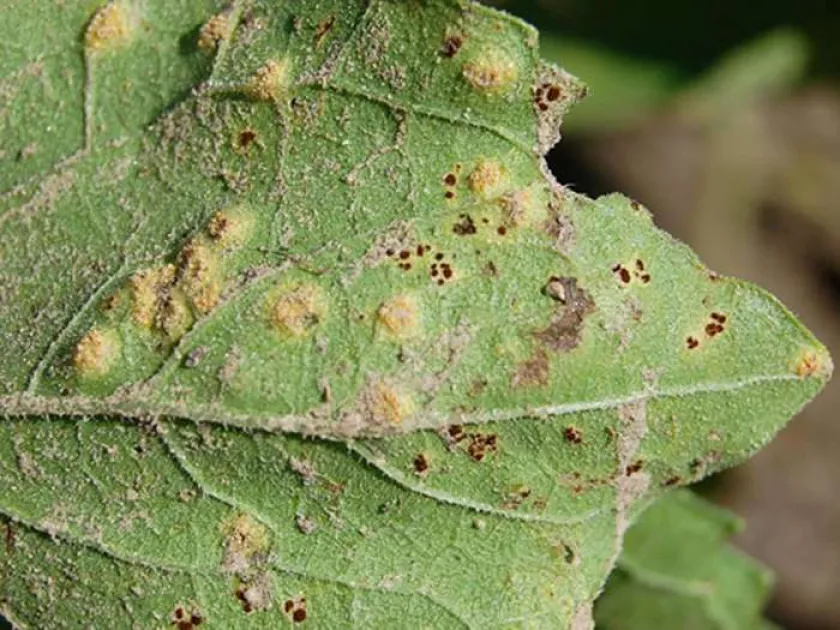
Initial infection signs appear as small, bright yellow or orange pustules on the underside of the leaves, corresponding to the uredinial stage.
As the infection progresses, these pustules release masses of reddish-brown spores that can easily rub off on clothing or equipment.
Extensive pustule formation causes leaves to yellow, curl, and eventually necrotize, which starts from the lower canopy upwards.
- Bright orange spots on the lower leaf surface.
- Dark brown or black streaks on stems and petioles in late stages.
- Progressive leaf chlorosis and premature defoliation.
By the end of the season, the pustules turn dark brown to black as the fungus shifts to the telial stage for overwintering purposes.
Control measures
The use of resistant sunflower hybrids is the most sustainable and efficient strategy for managing sunflower rust in commercial fields.
Implementing a long-term crop rotation strategy of at least 3-4 years helps to significantly reduce the inoculum load in the soil.
Effective weed control and the elimination of volunteer sunflowers are critical to removing alternative hosts that support the pathogen.
Foliar application of fungicides, specifically triazoles and strobilurins, is recommended when environmental conditions favor disease development.
Deep tillage to bury crop residues helps accelerate the decomposition of infected plant parts, reducing the primary source of infection for the next crop.
Causes diseases · 1
Discussion
No discussions yet — be the first.