
Cercospora leaf blight of soybean
Cercospora sojina
Description
How to identify
The causative agent of Cercospora leaf blight is the fungus Cercospora sojina Hara. It belongs to the kingdom Fungi, phylum Ascomycota, class Dothideomycetes, order Capnodiales, and family Mycosphaerellaceae.
The fungus overwinters as mycelium or stroma on crop residues in the field and is also seed-borne. In the spring, under favorable conditions, it produces conidia which are spread by wind, rain splashes, and insects to healthy plant tissues.
The disease development is heavily dependent on moisture. The pathogen enters the plant through stomata or directly through the epidermis. It requires a period of leaf wetness and high relative humidity to initiate infection.
Optimal conditions for pathogen development include temperatures between 20°C and 30°C and frequent rain or prolonged dew. These conditions favor rapid conidial germination and secondary cycles of infection throughout the growing season.
Identification in the laboratory is achieved by observing dark olive-colored clusters of conidiophores and characteristic colorless, needle-shaped, multicelled conidia under a microscope.
What it damages
This pathogen primarily infects soybean crops, although other legumes may occasionally be hosts. The disease affects all aerial parts of the plant, including leaves, stems, pods, and seeds.
The main impact of the disease is the reduction of the photosynthetic area due to premature leaf chlorosis and necrosis, leading to leaf drop. This significantly reduces the plant's ability to fill pods, resulting in lower yields.
In addition to yield loss, grain quality is compromised. Infected seeds often show discoloration, reduced germination rates, and poor vigor, making them unsuitable for high-quality seed production.
Severe infestations can lead to stunted pod development and lower oil and protein content in the harvested grain, impacting the economic value for producers and processors.
Yield losses can range from 10% to 30% depending on the severity of the outbreak, the susceptibility of the cultivar, and the timing of the infection during the crop's development stages.
Signs of infestation
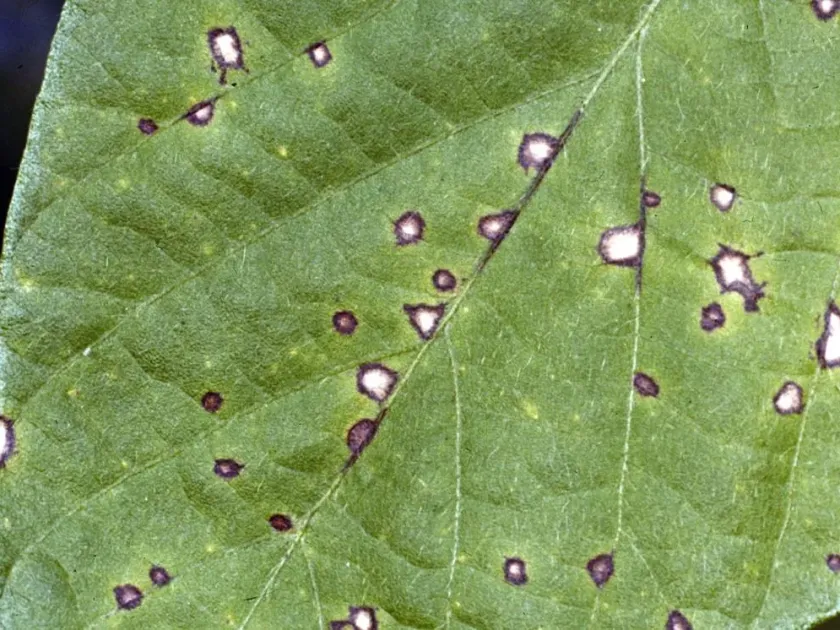
Symptoms typically appear in the middle of the growing season. Early signs include angular spots on the leaves, delimited by leaf veins, starting as dark brown or reddish-brown lesions.
As the lesions mature, the centers turn gray or ash-colored, surrounded by a dark purple or reddish-brown margin. Multiple spots can coalesce to cover large areas of the leaf lamina.
On stems and petioles, lesions are elongated and darker in color, which can lead to localized necrosis. Under humid conditions, a sparse, olive-gray fungal growth may be visible on the lesions.
Advanced infection causes premature leaf yellowing and defoliation. This often forces the plant to mature earlier than normal, which negatively impacts seed filling and final grain weight.
On pods, the fungus causes brown to black spots. If the infection reaches the seeds, they may exhibit gray or brown discoloration, indicating the presence of the pathogen on the seed coat.
Control measures
Fungicide application using triazoles and strobilurins is the primary chemical control method. Optimal timing is usually between the beginning of flowering and the pod-filling stage when initial symptoms are observed.
Crop rotation is a fundamental cultural practice. Avoiding soybean cultivation on the same field for at least 2–3 years helps to significantly reduce the inoculum levels in the soil.
Deep plowing and proper residue management after harvest are essential to encourage the decomposition of plant debris, where the fungus survives during the off-season.
The use of resistant or tolerant soybean cultivars is the most effective and sustainable long-term solution to mitigate losses caused by Cercospora sojina.
Seed treatment with systemic fungicides is recommended to protect seedlings from early-season infection, ensuring a uniform plant stand and reducing the risk of primary disease outbreaks.
Causes diseases · 1
Discussion
No discussions yet — be the first.