
San Jose scale
California
The San Jose scale (Latin: Quadraspidiotus perniciosus) is a highly destructive insect pest from the family Diaspididae that represents a major threat to orchard health.
What the section contains
San Jose scale
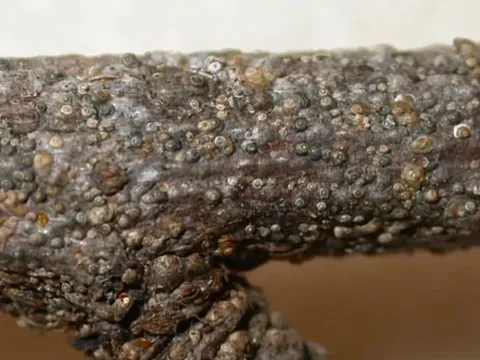
Adult females are sedentary, possessing a small, circular, grey-brown armor or scale that covers their soft bodies, rendering them immobile throughout their lives.
The mobile stage of the pest is the first-instar larva, known as a "crawler." These tiny, yellow insects are the primary means of infestation as they move to new areas.
Males are winged and capable of flight, but they are transient in nature and serve primarily to locate and fertilize the sessile females.
This species is viviparous, meaning females give birth to living crawlers rather than laying eggs, which significantly contributes to their rapid population expansion.
San Jose scale infests a wide variety of woody plants, particularly pome fruits like apples and pears, as well as stone fruits like peaches and plums.
By inserting their mouthparts into the bark, leaves, and fruit, they extract plant sap, which weakens the entire tree and disrupts nutrient transport.
Heavy infestations can result in the death of individual branches or even the complete collapse of young trees, as the layer of scales blocks the bark's physiological functions.
Fruit quality is significantly degraded by the presence of red spots with light centers, which are caused by the injection of toxins during the feeding process.
The presence of this pest poses a significant trade barrier, as it is classified as a regulated quarantine pest in many countries globally.
The insect typically overwinters in the nymphal stage (first instar) under their protective scale covers on the twigs and limbs of the host plant.
As spring temperatures rise above the threshold of approximately 10 degrees Celsius, the nymphs resume their development and reach maturity.
During the summer months, the pest produces multiple overlapping generations, with peaks of crawler activity depending on local climate conditions.
Dry and warm weather conditions are highly favorable for population growth, enabling the insects to cover entire branches within a single season.
Growth continues until late autumn, after which the surviving nymphs enter a period of dormancy to survive the winter months.
Early warning signs include the appearance of a dusty or scurfy grey-to-black coating on the surface of the bark, which is actually a cluster of scale covers.
On green fruit and young twigs, feeding creates characteristic red or purple-tinted halos, which serve as a very distinct diagnostic marker for this pest.
Weakened trees often display stunted growth, sparse foliage, and yellowing leaves that may drop prematurely due to the persistent removal of nutrients.
Extensive infestations lead to the cracking of bark and the weeping of sap, creating entry points for secondary infections like fungal pathogens.
A closer inspection with a magnifying lens reveals the presence of small circular scales with a raised center, often grouped in dense colonies.
Integrated pest management starts with the use of certified, scale-free nursery stock to prevent the introduction of the pest into new orchards.
Dormant season sprays using horticultural oils are highly effective, as they suffocate the overwintering nymphs before they start their spring cycle.
During the growing season, systemic or contact insecticides are applied, but timing is critical; treatments must coincide with the peak crawler emergence.
Cultural practices, such as proper pruning, ensure better penetration of insecticides and improve overall tree vigor, making them more resilient to attack.
Biological control agents, such as predatory beetles or parasitic wasps, are encouraged in sustainable systems to naturally manage scale populations.