
Chocolate spot
Broad bean
Description
How to identify
The causal agent of this disease is the fungus Botrytis fabae, which belongs to the kingdom Fungi, phylum Ascomycota, and order Helotiales. It is a highly host-specific pathogen that primarily affects the genus Vicia.
The fungus develops as both a saprotroph and a parasite, producing grey-colored conidiophores bearing hyaline conidia. The life cycle also involves the formation of sclerotia, which allow the pathogen to persist in the soil and on crop debris for several years.
The fungal mycelium invades plant tissues through stomata or mechanical wounds. Once infection occurs, the fungus secretes toxic enzymes that lead to cell necrosis, causing the characteristic spotting of leaves and stems.
Conidia are dispersed by wind over large distances. Under favorable environmental conditions, the development cycle from spore germination to the production of new conidia is completed in just a few days, enabling rapid epidemic spread.
Visual identification is based on the characteristic greyish fungal growth in the center of lesions under high humidity. In laboratory settings, the pathogen is diagnosed by isolating it from infected tissue onto standard culture media.
What it damages
The primary host for this pathogen is the faba bean (Vicia faba). The disease causes significant economic losses in regions with temperate climates where cool, wet conditions prevail during the growing season.
Apart from faba beans, the fungus can infect some wild legumes, which serve as inoculum reservoirs between growing seasons. The pathogen attacks all aerial plant parts, including leaves, stems, flowers, and pods.
Heavy infection causes premature leaf drop, which severely limits the photosynthetic capacity of the plant. This leads to stunted pod development and a significant reduction in seed weight and quality.
Infection of reproductive organs, such as flowers and developing pods, leads to flower abortion and premature pod abscission. In extremely wet conditions, the pods may rot completely on the stem.
The damage is not limited to yield quantity; infected seeds may harbor the fungus, serving as a primary source of inoculum for subsequent seasons and reducing the overall germination potential.
When it appears
Disease development is triggered in early spring when weather conditions become consistently moist. The optimal temperature for fungal growth ranges from 15–22 °C, with high relative humidity being a key requirement.
Primary infection originates from soil-borne sclerotia or from infected seeds. Initial symptoms are typically found on the lower leaves, where the microclimate remains humid for longer periods.
During the flowering and pod-filling stages, frequent rains and fogs facilitate rapid fungal spread. During this period, the pathogen undergoes massive secondary spore production, causing widespread infection.
Dry and hot weather significantly inhibits the spread of Botrytis, although the pathogen can survive in a latent form until conditions improve. Dew formation overnight also supports spore germination on leaf surfaces.
Towards the end of the season, the fungus produces sclerotia on senescing plant tissues. These sclerotia fall into the soil and remain dormant, acting as the overwintering structure for the following year.
Signs of infestation
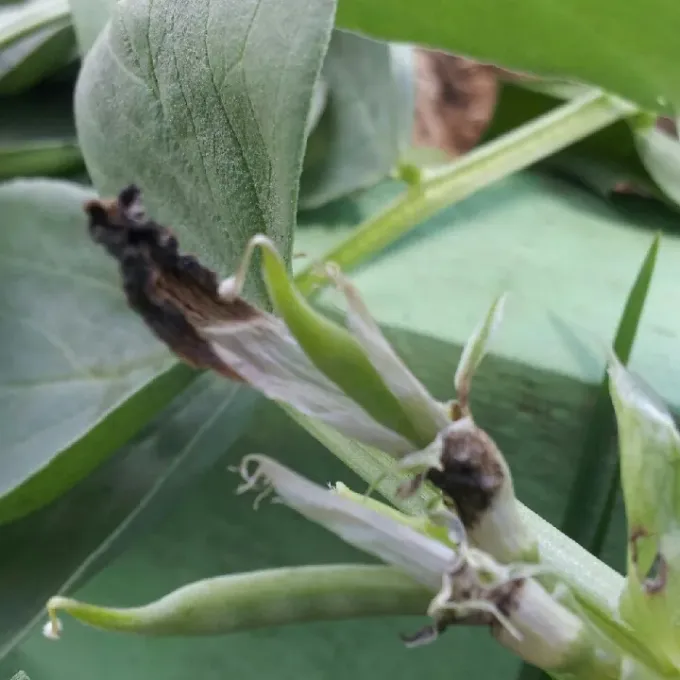
The first signs of the disease are the appearance of small, reddish-brown spots on the leaves, which gives the disease its common name, "chocolate spot." These lesions are often circular or oval with a distinct dark margin.
As the infection progresses, the spots expand and may coalesce. The necrotic tissue in the center of the lesion may become lighter in color or even tear, leading to a ragged appearance of the foliage.
On stems, the disease presents as elongated, dark-colored lesions. These can become deep enough to girdle the stem, causing the upper part of the plant to wilt and break off prematurely.
Infected flowers darken and dry out rapidly, becoming covered in a grey, fuzzy mass of fungal spores under humid conditions. Similar fungal growth is often observed on infected pods, which may shrivel and decay.
The disease frequently exhibits a patchy distribution within a field. Heavily affected plants look weak, withered, and exhibit severe necrosis of the entire leaf canopy, leading to significant yield loss.
Control measures
Agronomic management relies on strict crop rotation, ensuring a gap of at least 3–4 years before returning legumes to the same field. Using certified, disease-free seed is of paramount importance.
Deep plowing of crop residues is necessary to bury infected material, where sclerotia persist. This practice accelerates the biological degradation of the debris and reduces the inoculum load in the field.
Preventing high plant density is crucial to ensure adequate airflow within the canopy. Regular weed control also helps to reduce the relative humidity in the lower canopy, making conditions less favorable for the fungus.
- Application of foliar fungicides (triazoles or strobilurins) at the onset of flowering.
- Selection of bean varieties that demonstrate resistance or tolerance to chocolate spot.
- Optimized potassium fertilization to enhance plant vigor and resistance.
- Chemical seed treatment before sowing to eliminate surface-borne inoculum.
If symptoms appear and weather forecasts predict continued wet conditions, follow-up fungicide applications every 10–14 days are recommended to protect the developing pods until harvest.
Causes diseases · 2
Discussion
No discussions yet — be the first.