
Southern Corn Leaf Blight
Helminthosporium maydis
Description
How to identify
The causative agent of Southern Corn Leaf Blight (SCLB) is the fungus Bipolaris maydis (syn. Helminthosporium maydis). This pathogen belongs to the kingdom Fungi, specifically the class Ascomycetes, and is a major concern for corn producers globally.
The fungus overwinters as mycelium and conidia on infected corn debris left in the field. It remains viable in the soil for several seasons, providing a persistent source of infection for subsequent corn planting cycles.
Infection cycles are driven by warm and moist conditions, with temperatures ranging between 20 and 30 degrees Celsius. High humidity and leaf wetness are essential for the rapid germination of spores and successful colonization of plant tissues.
Dissemination occurs via wind, splashing rain, or insect activity, allowing the fungus to spread across fields and regions during the growing season. Multiple generations of conidia can be produced within a single season if environmental conditions are favorable.
The biology of Bipolaris maydis is marked by high adaptability and the evolution of new physiological races. These races can overcome the partial resistance of certain corn hybrids, necessitating ongoing breeding efforts.
What it damages
SCLB targets all above-ground parts of the corn plant, including leaves, stalks, leaf sheaths, and husks. The disease is particularly damaging when it reaches the ear-fill stage, leading to significant yield reductions.
Severe infections can reduce grain yield by up to 50 percent, particularly if the leaves are infected early in the season. The loss of leaf area significantly impairs the plant's photosynthetic capacity, resulting in poor grain development and lightweight ears.
The pathogen produces toxins that cause necrosis in the leaf tissues. Beyond direct yield losses, the disease weakens the stalks, leading to an increased risk of lodging and mechanical harvesting difficulties.
When the pathogen infects the ears, it causes rot and moldy grain, which lowers the quality and market value of the harvest. Contaminated grain may also carry mycotoxins, making it potentially unsuitable for feed or food processing.
Secondary infections often occur in plants weakened by SCLB, further compounding the damage. The cumulative impact on plant health significantly shortens the lifespan of the crop, forcing early harvesting or resulting in total crop failure.
Signs of infestation
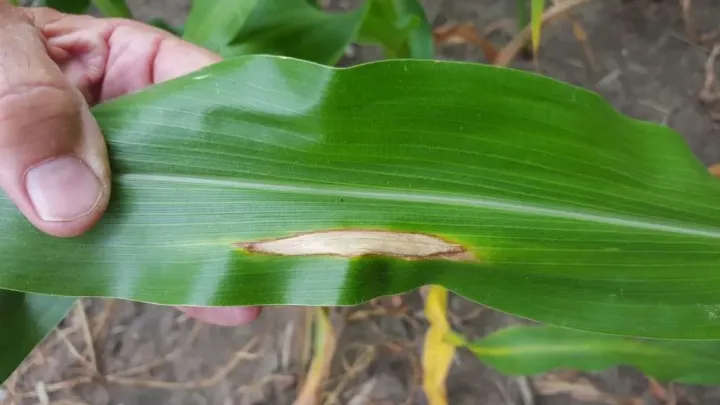
Early symptoms appear as small, tan, or brown lesions on the leaves. These spots are typically spindle-shaped and are restricted by the veins of the leaf, giving them a distinct appearance.
As the infection progresses, lesions enlarge and may coalesce, covering large areas of the leaf surface. In high humidity, the characteristic olive-green to black velvety fungal sporulation can be observed on the lesion surfaces.
Infection of the ears appears as blackish mold growth on the husks and between kernels. Severely infected ears may be stunted, with kernels showing discoloration and decay, which is highly visible at maturity.
- Spindle-shaped, tan-to-brown lesions on leaves.
- Olive-green fungal growth on lesions during wet weather.
- Premature yellowing and death of the leaf canopy.
- Black mold on ear husks and grain.
- Weakened stalks leading to plant lodging.
The diagnostic features of SCLB include the sharp margins of the lesions and the lack of a prominent yellow halo. Distinguishing these signs from other leaf diseases is critical for selecting the appropriate management strategy.
Control measures
The most fundamental control measure is the use of crop rotation, which breaks the survival cycle of the pathogen. Avoiding corn-on-corn planting reduces the inoculum potential in the field significantly.
Tillage practices that incorporate corn residue into the soil speed up the decay of infected tissues. Burying the debris minimizes the surface inoculum available for the next season's infection cycles.
Planting resistant corn hybrids remains the primary and most effective strategy for managing SCLB. Modern breeding programs offer varieties with high levels of field resistance, significantly reducing the reliance on chemical treatments.
Fungicide applications are recommended when disease pressure is high and environmental conditions favor rapid spread. Strobilurins and triazole-based fungicides provide good control if applied at the onset of symptoms.
Balanced crop nutrition, particularly adequate potassium and phosphorus levels, helps maintain plant vigor. Healthy plants are better able to tolerate and limit the impact of the infection compared to nutrient-deficient crops.
Causes diseases · 1
Discussion
No discussions yet — be the first.