
Cercospora leaf spot of legumes
Cercospora zonata
Description
How to identify
The causal agent of Cercospora leaf spot, Cercospora zonata, is a pathogenic fungus belonging to the Ascomycota phylum. It survives in the soil and on crop debris as mycelium and conidia, serving as a primary source of infection.
The fungus can persist within legume seeds, which facilitates its spread across different regions. Conidia are disseminated primarily by wind, rain splashes, and insects, allowing the pathogen to reach healthy plants easily.
The pathogen's life cycle is strictly regulated by environmental conditions, with optimal development occurring between 20°C and 28°C. High relative humidity is a critical factor for spore production and the rapid colonization of host tissues.
Once inside the plant, the fungal mycelium colonizes the epidermis and underlying tissues. The enzymatic activity of the fungus causes localized cell death, leading to the formation of characteristic necrotic spots.
The spread of the infection typically intensifies during the middle of the growing season when canopy density creates a humid microclimate. Continuous rainfall significantly accelerates the disease progression.
What it damages
Cercospora leaf spot primarily affects various legume species, such as fava beans and lupines. The disease impacts all aerial parts of the plant, significantly reducing the crop's physiological efficiency.
Damage is characterized by a reduction in photosynthetic surface area due to leaf necrosis and premature defoliation. This loss of foliage leads to stunted plant growth and reduced grain filling.
When the pods are infected, the seeds often become shriveled, discolored, or contaminated with the pathogen. This directly impacts the quality of the harvested produce and limits its commercial value.
In severe infestation cases, crop yields can be reduced by 15-30% or more, depending on the timing of the initial infection. The economic impact is particularly pronounced in wet years.
Additionally, damaged plants become more susceptible to secondary pathogens, which can exacerbate the decline of the crop and complicate the harvesting process.
Signs of infestation
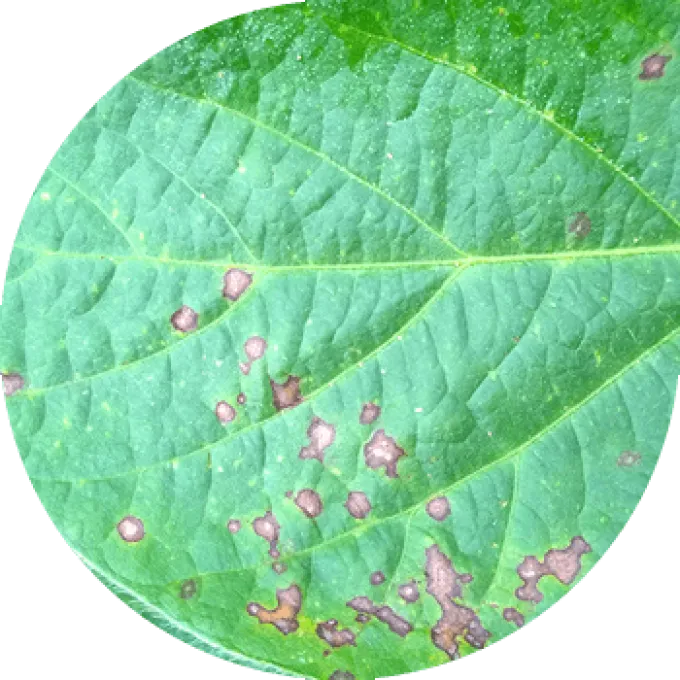
Early symptoms appear as small circular or irregular spots on the leaves. These spots gradually develop a distinct zonal pattern, typically featuring a light-colored center surrounded by a dark reddish-brown border.
Under humid conditions, a characteristic greyish or olive-colored fungal growth appears in the center of the lesions, representing the conidiophores and conidia. This diagnostic feature is essential for field identification.
Stems and petioles can also exhibit elongated necrotic lesions. As the disease advances, leaves may yellow, wither, and drop prematurely, leading to significant defoliation of the lower canopy.
Infected pods often show sunken spots and may become deformed. If the infection reaches the seeds, they may exhibit greyish mycelial growth or necrotic spotting, reducing their viability.
Field diagnosis relies on observing the distinct zonality of the leaf spots and the presence of the sporulating fungal mats. Correct identification is crucial for timing fungicide applications.
Control measures
An effective control program begins with long-term crop rotation, avoiding legumes in the same field for at least 3-4 years. This practice significantly reduces the pathogen pressure in the soil.
Sanitation practices, including the deep incorporation of crop residues, are vital to eliminate overwintering structures of the fungus. Utilizing certified, disease-free seed is a critical preventive measure.
Chemical control involves the use of systemic fungicides applied either as a seed treatment or as a foliar spray. Foliar applications should be timed to coincide with the onset of favorable weather conditions for the disease.
- Selection of resistant or tolerant cultivars.
- Managing plant density to improve aeration and reduce canopy humidity.
- Balanced fertilization to strengthen plant defense mechanisms.
Frequent field scouting during the flowering and pod-filling stages is necessary to detect early infections. Timely intervention with appropriate fungicides is essential to prevent major yield losses.
Causes diseases · 1
Discussion
No discussions yet — be the first.