
Beet curly top
Beet curly
Description
How to identify
Beet curly top is a viral disease caused by the Beet curly top virus (BCTV), a member of the genus Curtovirus within the family Geminiviridae. This pathogen is exclusively transmitted by the beet leafhopper, Circulifer tenellus, which acts as the primary vector.
The virus consists of a single-stranded DNA genome. It cannot be transmitted through soil, seeds, or mechanical contact. The life cycle of the pathogen depends entirely on the feeding behavior and movement of the insect vector within the agricultural landscape.
BCTV has an extremely broad host range, infecting hundreds of plant species, including various weeds and crops. In arid and semi-arid regions, the virus survives in perennial weeds, which serve as reservoirs during the winter months.
Leafhoppers acquire the virus after feeding on infected plants for a short period. Once infected, the insect remains a carrier for the remainder of its life, effectively spreading the virus as it migrates to new feeding sites, often driven by wind or the drying of its primary habitat.
The severity of the disease is intrinsically linked to the population dynamics of the leafhopper. Outbreaks typically occur following weather patterns that favor the migration of large numbers of vectors into cultivated areas.
What it damages
The virus inflicts major economic losses on sugar beets, tomatoes, beans, peppers, and various cucurbits. Infection in sugar beets results in reduced root weight, stunted development, and significantly lowered sucrose content, rendering the crop less profitable.
Early-stage infection of young plants is particularly devastating, often leading to total crop failure. This causes significant thinning of stands, which necessitates replanting or results in substantial reductions in yield across affected fields.
BCTV damages the phloem tissues of the plant, disrupting the translocation of nutrients. This physiological stress causes the plant to lose its vigor, resulting in chlorosis, reduced photosynthetic capacity, and ultimately, premature death of the affected specimens.
In vegetable crops like tomatoes, the impact is equally severe. Infected plants stop producing fruits, and any existing fruit becomes deformed and unmarketable. The cumulative impact of the disease can lead to complete destruction of entire field sectors.
The economic burden of the disease is compounded by the unpredictability of outbreaks. Farmers often struggle to mitigate losses because the virus can spread rapidly across a field if the leafhopper population is high during the critical early stages of crop growth.
Signs of infestation
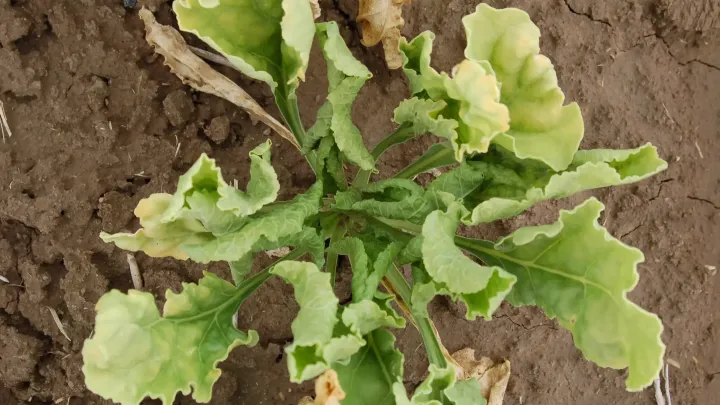
The diagnostic symptoms of Beet curly top include inward curling of the leaves, which become thick, brittle, and often develop a leathery texture. Leaves may also exhibit yellowing, particularly along the veins.
Stunting is a universal symptom across all susceptible hosts. The plants appear significantly smaller than healthy individuals, with shortened internodes and deformed, rosetted top leaves that stand in a rigid, upright position.
Sugar beet roots of infected plants often exhibit excessive hairy root development, commonly referred to as "bearding." Internal examination of the root frequently reveals necrotic darkening of the vascular bundles, indicating severe phloem damage.
In tomatoes, the curling leaves often turn dark green or purplish, and the entire plant takes on a stunted, stiff appearance. Flowers may abort, and the plant fails to reach its full vegetative potential, making it easily distinguishable from healthy plants.
Field observation shows that the disease often appears in patches or is concentrated along the field edges that interface with wildlands. This pattern reflects the initial invasion points of the leafhoppers as they move from non-crop host plants onto the field.
Control measures
Effective control focuses primarily on the management of the beet leafhopper population. Systemic insecticides are recommended to prevent the vector from successfully inoculating the plants with the virus.
Weed management is critical for reducing the virus reservoir. Eliminating host weeds in and around fields, as well as along irrigation ditches and roadsides, decreases the likelihood of early-season leafhopper infestation and subsequent virus transmission.
The use of resistant cultivars is the most sustainable approach to managing the disease. Breeding programs have made significant progress in developing sugar beet and vegetable varieties that can tolerate the virus and maintain high yields even under pressure.
Adjusting planting dates can help mitigate risks. By planting earlier, crops can reach a stage of development where they are less vulnerable to the devastating impacts of the virus before the peak migration period of the leafhoppers occurs.
For high-value vegetable crops, physical exclusion using row covers or insect-proof netting provides an excellent barrier against leafhoppers. This method is highly effective for small-scale and intensive farming operations, ensuring plants remain free from the vector during their most susceptible growth phases.
Causes diseases · 2
Discussion
No discussions yet — be the first.