
Apiospora montagnei
Apiospora montagnei
Description
How to identify
Apiospora montagnei is an ascomycete fungus belonging to the Apiosporaceae family. It is primarily a saprotroph but can behave as a facultative parasite under conditions that weaken the host plant, making it a significant subject in agricultural pathology.
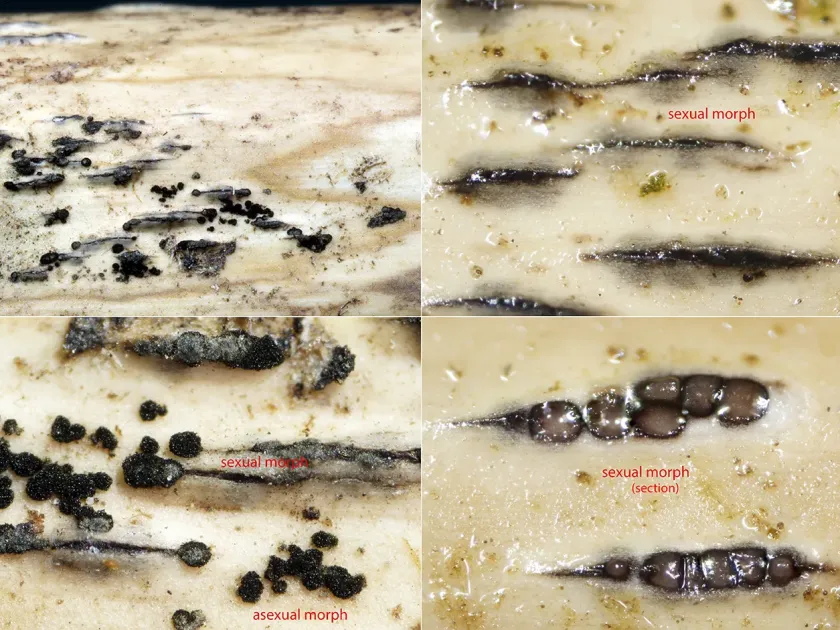
The fungus is characterized by the formation of small, black perithecia (fruiting bodies) that often appear in rows on decaying plant material. In field diagnostics, the presence of these structures, combined with microscopic examination of conidia, helps distinguish it from other pathogens.
Taxonomically, the species is classified within the order Xylariales. In modern field management, it is recognized as a complex agent that contributes to the necrosis of plant tissues and premature senescence of agricultural crops.
The mycelium exhibits rapid growth on organic substrates. Laboratory cultures often reveal dark olive or greyish colonies, providing a reliable diagnostic feature for mycologists studying this specific pathogen within the Apiospora genus.
The life cycle of this fungus is closely linked to plant debris, where it survives during unfavorable periods. The primary inoculum is formed by the development of ascospores and conidia during the spring and summer seasons.
What it damages
Apiospora montagnei affects a wide range of agricultural crops, including cereals, vegetables, and technical crops. Plants under abiotic stress or those weakened by poor agricultural practices are the most susceptible to infestation.
The pathogen attacks stems, leaves, and ears, resulting in localized necrotic spots. In wheat and barley fields, it often acts as a secondary pathogen that complicates the clinical presentation of primary diseases like fusarium or septoria.
The damage is primarily manifested as reduced photosynthetic capacity due to tissue destruction, leading to a significant decrease in biomass. Severe infections result in the premature drying of vegetative parts and reduced grain filling.
Infection of the generative organs is particularly damaging. It can lead to floret sterility or the production of shriveled, low-quality seeds, which significantly degrades the commercial and sowing value of the final harvest.
Beyond agricultural crops, the fungus colonizes various wild weeds. These serve as reservoirs for the pathogen, ensuring its survival and spread across the field throughout the entire growing season.
When it appears
The active development of the fungus occurs during periods of high humidity and moderate temperatures. The peak of sporulation typically aligns with the stem elongation and heading phases of cereal crops.
Optimal conditions for spore germination require leaf surface moisture for 6 to 12 hours. In contrast, periods of prolonged heat and drought significantly inhibit the fungal expansion and disease progression.
Primary infection is initiated by ascospores that overwinter on crop residues. Secondary infections are then spread by conidia, which are easily dispersed by wind and rain splashes throughout the summer months.
Maximum damage is reported in years with high rainfall during the second half of the growing season. High air humidity creates an ideal microclimate within dense crop canopies for the rapid spread of mycelium.
As the season ends, the fungus reverts to its saprotrophic phase, forming fruiting bodies on dying tissues. This adaptation ensures the pathogen survives the winter effectively within the soil and on stubble remnants.
Signs of infestation
The initial symptom of infection is the emergence of chlorotic spots, which eventually darken and turn necrotic. These spots may exhibit blurred margins and a darker peripheral ring.
During humid weather, a sparse growth of conidiophores may be visible on the necrotic spots. Eventually, small black dots—representing the fruiting bodies (perithecia)—become evident on the infected surfaces.
Stem infection leads to darkening of the basal tissues, which can result in lodging. Internal tissue examination often reveals the destruction of the parenchyma, caused by the enzymatic activity of the fungus.
On leaves, symptoms appear as linear necroses running parallel to the veins. In severe cases, the leaf blade curls and eventually withers entirely.
- Yellowing and premature wilting of lower leaves.
- Black fruiting bodies visible on dry plant remnants.
- Formation of empty ears or poorly developed grains.
- General growth retardation within disease hotspots.
Control measures
The primary management strategy involves implementing strict crop rotation to avoid planting susceptible species in the same soil for multiple consecutive years, thereby reducing the infection inoculum in the field.
Thorough soil cultivation, including deep plowing, is an effective method for burying infected plant residues. The use of stubble decomposers can accelerate the breakdown of organic matter and suppress the fungus.
Selecting resistant crop varieties and using high-quality, treated seed materials is essential for minimizing the risk of widespread infestation during the growing season.
Chemical control involves the application of systemic fungicides during periods of high risk. Treatments timed to coincide with stem elongation and heading are most effective at protecting the generative organs.
Integrated disease management also emphasizes balanced mineral nutrition. Avoiding excessive nitrogen fertilization is crucial, as it makes plant tissues more succulent and highly susceptible to fungal penetration.
Causes diseases · 1
Discussion
No discussions yet — be the first.