
Zinnia leaf blight
Alternaria zinniae
Description
How to identify
The causative agent of the disease is the imperfect fungus Alternaria zinniae, belonging to the kingdom Fungi, genus Alternaria. It is a highly specialized phytopathogen that primarily affects plants of the Asteraceae family.
The fungus survives in the soil on plant debris and can also be transmitted through infected seeds. The infection can remain viable for a long time, awaiting favorable conditions for active conidia germination.
The fungal mycelium develops within plant tissues, breaking down the cellular structure. Externally, this manifests as the formation of specific sporulation, which spreads by wind, rain splashes, or overhead irrigation.
To identify the pathogen in laboratory settings, researchers culture samples of infected tissue on growth media. Microscopic examination reveals characteristic club-shaped multicellular conidia with cross-walls.
The disease requires high air humidity and moderately warm temperatures to develop, making greenhouses and dense plantings the perfect environment for epidemic spread.
What it damages
The primary host is the common Zinnia (Zinnia elegans). The pathogen attacks all aerial parts of the plant: leaves, stems, flower stalks, and flower petals.
Seedlings are severely affected at early stages, often suffering from stem rot and damping-off, which significantly reduces the plant density in flowerbeds and commercial fields.
Stem infections lead to necrotic lesions that can girdle the stem, causing it to break or leading to the wilting of the entire upper portion of the plant due to disrupted tissue conductivity.
Flower heads lose their market value upon infection: petals become covered with dark spots, turn brown, and rot. Diseased flowers become a source of secondary infection for healthy neighbors.
Under high humidity, the disease can destroy up to 80-90% of seed crops or decorative plantings, making this pathogen highly dangerous for floriculture.
When it appears
Initial manifestations of Zinnia leaf blight are observed during the active seedling growth period, especially if ventilation is inadequate and irrigation is excessive.
In open fields, the disease peaks in the second half of summer when warm weather with frequent rain or heavy dew creates a thin film of water on the leaves.
The life cycle includes the formation of conidia, which, upon landing on susceptible tissue, germinate and penetrate through stomata or micro-injuries. This cycle can repeat multiple times throughout a season.
The optimal temperature for pathogen development is 20-25 degrees Celsius. However, spores can germinate across a wide temperature range as long as the plant surface remains wet for over 6-8 hours.
In autumn, the fungus enters a dormant state in the soil or on fallen leaves, forming chlamydospores, ensuring the infectious cycle resumes in the following growing season.
Signs of infestation
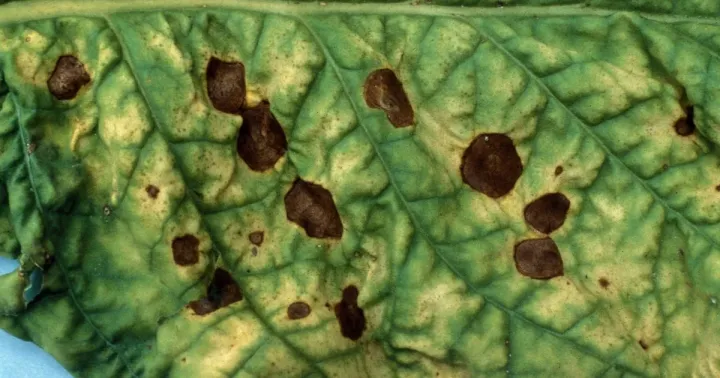
Leaves develop small red-brown spots with a lighter center. Over time, these enlarge and acquire a distinct concentric zonality (target-spot appearance).
Often, a yellow halo forms around necrotic spots, indicating the release of toxins by the pathogen that poison plant tissues and cause chlorosis of the leaf blade.
On stems, lesions are elongated, brown-gray, and gradually sink into the tissue. A gray or dark olive velvety coating of conidial sporulation often forms on these infected areas.
Leaves begin to yellow prematurely, curl, and dry out, starting from the lower levels of the plant. This leads to significant weakening and reduced aesthetic value of the bush.
On flower petals, the disease manifests as small black dots that quickly merge, leading to necrosis of individual parts or the entire flower head.
Control measures
The main preventive measure is proper crop rotation: do not replant Zinnias in the same spot for at least 3-4 years. It is also crucial to remove and destroy all plant debris after the season.
It is recommended to use only certified disease-free seeds. Treating seeds with fungicides before planting helps reduce the risk of primary seedling infection.
Avoid dense planting to ensure good air circulation. Water should be applied strictly at the base, avoiding splashing water onto leaves and flowers.
If the first signs of the disease appear, apply systemic and contact fungicides. Copper-based preparations and modern systemic anti-spotting agents are highly effective.
- Regular removal of infected leaves and entire plants.
- Optimization of greenhouse humidity levels.
- Timely plant fertilization to boost immunity.
- Use of mulch to prevent spore splash from the soil onto the foliage.
Causes diseases · 1
Discussion
No discussions yet — be the first.