
Alternaria sonchi
Alternaria sonchi
Description
How to identify
Alternaria sonchi is a plant pathogenic fungus belonging to the kingdom Fungi, phylum Ascomycota, and genus Alternaria. It is a specialized pathogen primarily affecting members of the Asteraceae family.
The fungus produces specific conidiophores and conidia, which serve as the primary means of spreading infection within agricultural ecosystems. The mycelium is septate and dark-pigmented, allowing the pathogen to survive in harsh environmental conditions.
Biologically, the species is adapted to parasitize sow thistles (Sonchus), but under favorable conditions, it can infect related cultivated crops. The pathogen is classified as a necrotroph, causing tissue death in host plants.
In field conditions, identification usually requires laboratory analysis, as symptoms can mimic other types of Alternaria blights. Morphological identification of spores under a microscope remains the gold standard.
While the taxonomy of the species continues to be refined, Alternaria sonchi is considered a significant target in integrated pest management programs to prevent yield losses.
What it damages
The primary hosts of this fungus are various species of sow thistle (Sonchus spp.), which often act as problematic weeds in agricultural fields.
Under high inoculum pressure, the fungus can spread to cultivated crops such as sunflowers, lettuce, chicory, or globe artichokes. Damage is characterized by a significant reduction in the photosynthetic surface area of the leaves.
Infection leads to premature senescence of leaves, which drastically reduces the yield of cereals and oilseeds growing in proximity to infected weed patches.
The pathogen also weakens the plant's overall immune system, creating entry points for secondary bacterial and fungal infections, further degrading crop health.
Economic losses are cumulative, arising from direct biomass reduction and the additional costs associated with fungicide applications to suppress the spreading disease.
When it appears
Development begins in the spring when moderately warm temperatures occur, allowing conidia to be dispersed by wind onto the foliage of host plants.
Disease severity usually peaks during the flowering period of sow thistle and the active growth phases of crops in mid-summer. High humidity is the primary driver for accelerating the fungal life cycle.
In the autumn, the fungus overwinters in plant debris, fallen leaves, and soil in the form of chlamydospores or dense mycelial mats, ensuring survival for the next season.
The life cycle involves repeated cycles of sporulation, allowing the infection to colonize new areas within a single growing season if conditions remain conducive.
Weather conditions involving frequent rainfall and nocturnal dew provide the ideal environment for spore germination, potentially triggering epiphytotic outbreaks.
Signs of infestation
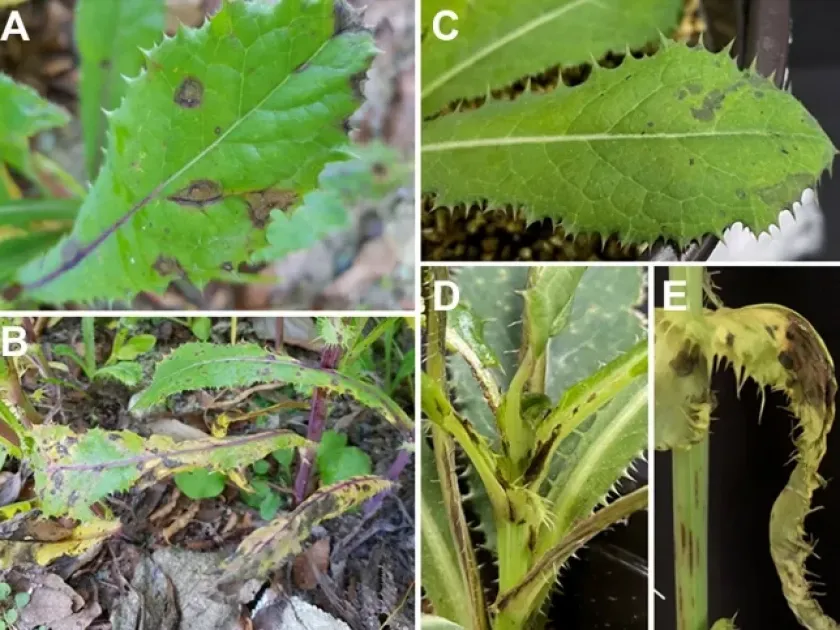
Initial signs of infection appear as small chlorotic spots that gradually increase in size and turn dark brown or black.
Often, a characteristic yellow halo forms around the spots, indicating the toxic effect of fungal metabolites on the plant tissue.
Over time, a subtle olive-black, velvety growth appears on the surface of the lesions, consisting of the pathogen's conidiophores and spores.
In cases of severe infestation, spots coalesce, causing tissue necrosis, shriveling, and premature leaf drop, which visually resembles advanced plant aging.
On stems, the infection manifests as elongated dark streaks, which can lead to deformation and the snapping of vegetative organs under stress.
Control measures
The primary control method is the adoption of agronomic practices, such as deep tillage to bury crop residues where the pathogen persists.
Timely weed management, specifically targeting sow thistles, is critical to reducing the inoculum reservoir and preventing transmission to crops.
Crop rotation that excludes host plants from the Asteraceae family is an effective way to break the pathogen's reproductive cycle and lower the soil's infection pressure.
Chemical control using fungicides from the strobilurin or triazole groups is effective if applied during the early stages of symptom development to inhibit spore formation.
The deployment of resistant crop cultivars is the most sustainable long-term strategy, significantly reducing the reliance on chemical inputs for disease control.
Causes diseases · 1
Discussion
No discussions yet — be the first.