
Onion purple blotch
Alternaria porri
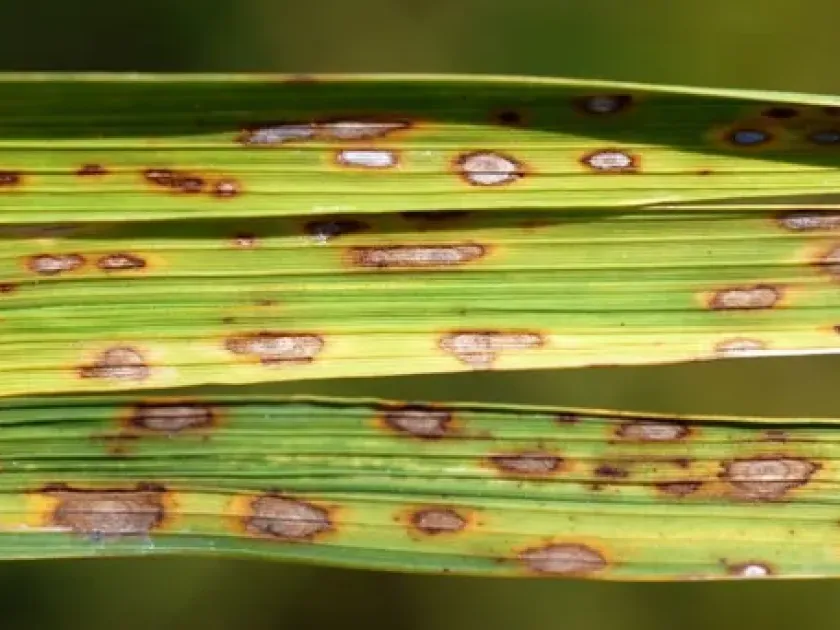
Description
How to identify
The causative agent of the disease is the fungus Alternaria porri, belonging to the Kingdom Fungi. It is a pathogenic fungus that produces multicellular, dark-colored conidia with both transverse and longitudinal septa, facilitating its wide dispersal.
The mycelium of the pathogen penetrates plant tissues, degrading cell walls and disrupting vital metabolic processes. The fungus persists in the soil, on crop residues, and within infected bulbs, allowing it to survive adverse environmental conditions.
Optimal development occurs in warm and humid environments. Conidia are easily disseminated by wind currents, rain splashing, and insect movement, enabling rapid colonization of onion fields during the growing season.
The fungus exhibits high host specificity, primarily targeting species within the Allium genus. It is particularly aggressive toward plants already weakened by environmental stress or secondary pest damage.
Laboratory diagnosis typically involves culturing the pathogen on specialized media, where it forms distinct, dark, velvety colonies, allowing for accurate identification and further analysis of its virulence.
What it damages
The disease affects a wide range of Allium crops, including bulb onions, leeks, shallots, and garlic. It causes significant economic losses, especially in regions with high seasonal humidity and temperature fluctuations.
Damage occurs on both aerial parts, such as leaves and flower stalks, and on bulbs during storage. The destruction of leaf tissue severely inhibits photosynthesis, leading to stunted plant growth and reduced bulb size.
Infected bulbs often develop bulb rot during storage, rendering them unmarketable. The presence of the fungus leads to tissue softening, discoloration, and increased susceptibility to secondary soft rot bacteria.
Seed crops are particularly vulnerable; infection of the flower stalks (scapes) can cause them to collapse, leading to significant seed yield losses and reduced germination rates for subsequent plantings.
Overall damage results in lower yields, poor bulb quality, and significantly shortened storage shelf life. Severe outbreaks can lead to yield losses exceeding 50% in untreated or susceptible varieties.
When it appears
Symptoms typically appear during the mid-to-late growth stages of the crop. Warm temperatures (20°C to 30°C) combined with high relative humidity are the primary drivers for disease outbreaks.
The presence of free moisture (dew or rain) on the foliage is essential for spore germination and penetration. Consequently, weather patterns involving frequent rain or heavy fog are critical windows for infection.
Insect activity, particularly that of onion thrips, exacerbates the spread of the pathogen. Thrips cause physical wounding to the foliage, providing entry points that facilitate the infection process for the fungal spores.
In controlled greenhouse environments, the disease can persist year-round if proper ventilation and moisture management protocols are not followed, leading to stagnant, humid air which supports fungal growth.
The biological life cycle involves repeated cycles of conidial production, allowing the pathogen to increase its population density exponentially within the crop canopy as long as favorable weather conditions persist.
Signs of infestation
Initial symptoms consist of small, white lesions on the leaves, which eventually expand into larger, elongated, or oval-shaped spots. These lesions often exhibit concentric rings, giving them a distinct target-like appearance.
Under humid conditions, the centers of the lesions turn dark, olive-brown to black, due to the mass production of conidia and conidiophores. This velvety layer is a diagnostic feature of active infection.
Severely infected leaves become chlorotic, eventually turn brown, and wither, starting from the leaf tips. In advanced stages, large portions of the field may appear as though they have been scorched by chemical or environmental factors.
Bulbs affected by the disease exhibit water-soaked, softened tissue, which eventually decays. Upon cutting, the internal scales often reveal brownish or yellowish discoloration accompanied by fungal growth between the layers.
- Small white spots expanding into oval lesions.
- Concentric target-like zoning on foliage.
- Dark olive-brown fungal sporulation on lesions.
- Premature leaf tip dieback and yellowing.
- Internal bulb decay and discoloration.
Control measures
Cultural practices are the foundation of management. These include strict crop rotation (at least 3-4 years away from Allium crops), the use of certified pathogen-free seeds or sets, and proper field hygiene to remove crop debris.
Managing the plant canopy is crucial; ensuring proper spacing allows for adequate airflow and faster drying of foliage, which reduces the time available for fungal spores to germinate and infect the plant.
Integrated Pest Management (IPM) focusing on onion thrips is essential. Reducing thrips populations minimizes physical damage to leaves, thereby decreasing the potential for successful fungal colonization.
Chemical control involving the timely application of fungicides is necessary during favorable weather for disease. Copper-based products, strobilurins, and triazoles are effective in suppressing the growth and spread of the pathogen.
Post-harvest management is vital to preventing storage losses. Proper curing of bulbs, combined with cool (near 0°C) and low-humidity storage conditions, significantly inhibits the progression of the disease in stored inventory.
Causes diseases · 1
Discussion
No discussions yet — be the first.