
Alternaria blight of flax
Alternaria linicola
Description
How to identify
The causative agent of the disease is the imperfect fungus Alternaria linicola (synonym Alternaria linicola Groves & Skolko). It belongs to the kingdom Fungi, phylum Ascomycota.
This phytopathogen is a specialized parasite that primarily affects fiber and oilseed flax during all stages of plant development.
The fungus survives in seeds and crop residues in the soil as mycelium or conidia, serving as the primary source of inoculum for the next season.
Microscopically, the pathogen is identified by the presence of olive-brown conidiophores producing chains of multi-celled, pigmented conidia.
The spread of the infection within the field occurs primarily through wind, rain splashes, and insect vectors that transport spores between plants.
What it damages
The disease attacks all above-ground parts of the flax plant, including seedlings, stems, leaves, flower buds, and bolls, causing significant yield losses.
Seed infection leads to reduced germination energy, poor field emergence, and the death of young seedlings before they reach the soil surface.
When stems are affected, the fungus degrades the fiber tissue, resulting in decreased quality, brittleness, and loss of fiber elasticity.
Damage to the generative organs during the flowering phase causes the blackening of bolls, leading to shriveled seeds and potential rotting of the entire capsule.
The overall impact includes reduced crop uniformity, lower fiber yield, and a significant decrease in the market value of both seeds and fiber.
When it appears
The disease often initiates at the seedling stage, particularly if the soil remains moist for extended periods during germination and early growth.
The most favorable conditions for the development of the fungus are high relative humidity (above 85%) and moderate temperatures ranging from +18°C to +25°C.
The flowering and bolling stages are critical, as the fungus easily colonizes the reproductive parts when free moisture or high humidity is present.
Rainy weather during the maturation phase contributes to secondary infections, causing widespread discoloration and decay of the bolls.
The fungus can produce multiple generations of conidia within a single growing season, leading to rapid disease development under favorable weather patterns.
Signs of infestation
Seedlings typically show dark brown lesions on the hypocotyl, which often cause the plant to collapse and die shortly after emergence.
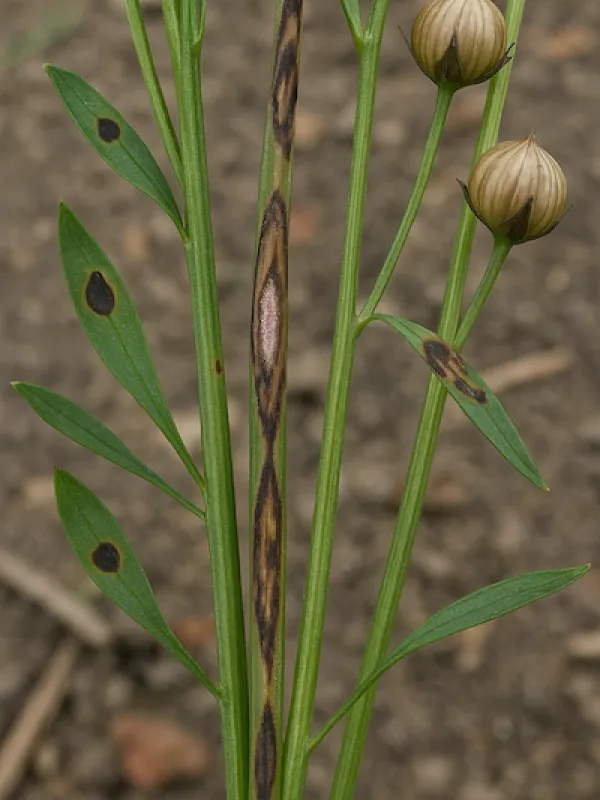
Leaves develop small, irregular or circular dark brown spots that may merge over time, eventually leading to chlorosis and premature leaf drop.
Stems display elongated dark streaks or necrotic spots, which, in humid conditions, become covered with a faint, olive-black velvety layer of fungal spores.
Infected bolls turn black or dark brown, often appearing scorched, and the capsules may crack prematurely, exposing the deteriorating seeds inside.
Seeds within infected bolls lose their luster, show signs of shrinkage, and are often covered with a visible fungal mass, making them unfit for sowing.
Control measures
The cornerstone of management is the use of high-quality, certified seeds that are tested for the presence of seed-borne pathogens.
- Seed treatment with systemic and contact fungicides is essential to eliminate internal and external infection.
- Implementation of a proper crop rotation, avoiding flax cultivation on the same field for at least 5 to 6 years.
- Deep autumn plowing to bury crop residues, which helps break the disease cycle and reduces the primary inoculum in the soil.
- Balanced nutrient management, avoiding excessive nitrogen fertilization that can make the plants more susceptible to fungal attacks.
Foliar application of fungicides during the vegetative period (especially at the bud formation stage) is crucial for controlling the spread of the pathogen.
Causes diseases · 1
Discussion
No discussions yet — be the first.