
African cereal rust
African cereal
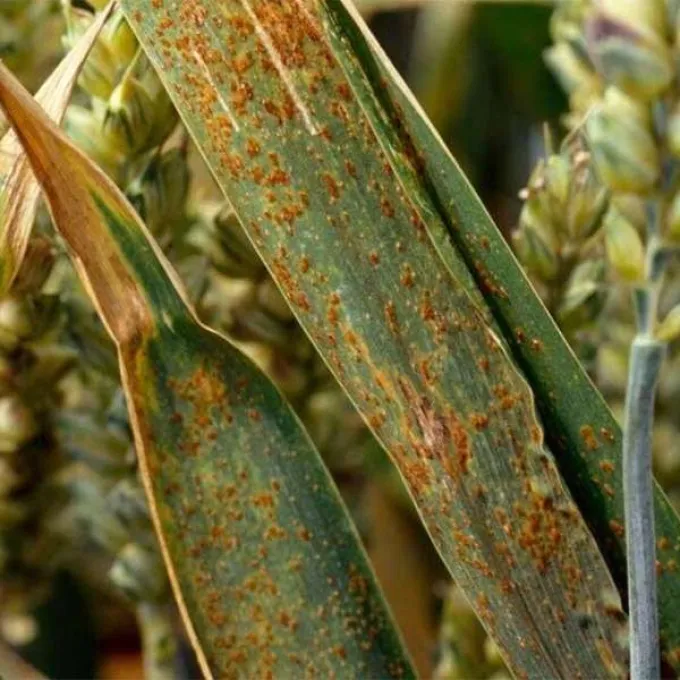
Description
How to identify
The causative agent of the disease is the specialized fungus Puccinia striiformis f. sp. tritici (African race). It belongs to the kingdom Fungi, phylum Basidiomycota. This pathogen is an obligate parasite that relies entirely on living host plant tissues for nutrition.
The pathogen is highly adapted to changing environmental conditions. It spreads mainly through urediniospores, which are easily transported by wind currents over long distances, potentially affecting large agricultural areas in a short time.
The mycelium develops within the leaf tissues, progressively degrading plant cells. Optimal growth of fungal colonies occurs under moderate temperature conditions, allowing the pathogen to colonize new fields rapidly.
Laboratory identification involves molecular genetic analysis to distinguish specific races of the pathogen. Morphologically, the spores have a characteristic yellowish-orange tint, which helps differentiate them from other rust species at early stages.
The life cycle includes the formation of uredinia and teliospores. In regions with mild winters, the fungus can survive as urediniomycelium on winter crops or volunteer plants, ensuring the continuity of the infection cycle.
What it damages
The primary host is wheat (soft and durum). The pathogen can also partially affect barley and certain wild cereal grasses, which serve as reservoirs for the infection during the off-season.
The disease affects all aerial organs of the plant, including leaves, stems, and glumes. Damage to the leaf surface significantly reduces the overall photosynthetic capacity of the crop.
The economic impact manifests as a sharp decrease in 1000-kernel weight and grain shriveling. Impaired metabolism in the plant slows down grain filling, leading to yield losses of up to 50% or more under severe infestation.
Infected plants become more susceptible to lodging and secondary pathogens. A weakened immune system makes the crop less resilient to adverse abiotic factors such as drought or temperature stress.
Economic damage includes both lost grain production and the high cost of emergency fungicide applications. Heavy development of the disease during the flowering stage poses the greatest risk to grain quality.
When it appears
Primary symptoms typically appear early in the season, especially during years with cool and wet spring conditions. The optimal temperature range for spore germination is between 5 and 15 degrees Celsius.
A second wave of pathogen development often occurs during the tillering and stem elongation stages. High relative humidity (above 85%) and leaf wetness are critical catalysts for the rapid spread of the rust.
During the summer, if temperatures rise above 25 degrees Celsius, disease development usually slows down as the pathogen is sensitive to heat stress. However, overnight dew can maintain fungal activity even during hot days.
In the autumn, the fungus infects emerging winter crops, establishing foci for overwintering. This continuity makes African cereal rust difficult to eradicate in regions with favorable climates for the pathogen.
Field monitoring should start as soon as spring vegetation resumes. Early detection of the first pustules allows for timely chemical intervention before mass sporulation begins.
Signs of infestation
The key sign is the appearance of characteristic lemon-yellow pustules (uredinia) arranged in strict parallel lines along the leaf veins. This creates a striped effect, which is the hallmark of this disease.
When mature, the spores detach easily upon contact, leaving a yellow powdery residue on clothing or tools. As the leaf ages, these pustules can merge, causing premature yellowing and tissue death.
- Yellowing of leaf blades in infection foci.
- Pustules appearing on stems and glumes.
- Curling and wilting of infected leaves.
- Stunted growth of the entire plant.
Unlike brown rust, stripe rust often appears earlier and develops more aggressively. The initial patchy distribution in the field can quickly evolve into a uniform infection under favorable conditions.
At the final stages of the infection, dark brown teliospores may form under the epidermis. This process marks the end of the parasite's cycle for the current season as it transitions into resting structures.
Control measures
The primary control measure is the use of genetically resistant wheat varieties. Breeding for resistance against stripe rust is a top priority in cereal crop protection programs.
Agronomic practices include strict crop rotation and the elimination of volunteer plants, which act as a green bridge for the infection. It is also important to avoid overcrowding and excessive nitrogen fertilization, which promotes rapid but vulnerable tissue growth.
Fungicide application remains the most effective method during epiphytotic years. Products based on triazoles and strobilurins are recommended for their curative and preventive effects.
The timing of applications must be based on phytosanitary monitoring. It is crucial to prevent the infection from reaching the top three leaves, as these provide the majority of the nutrients for grain filling.
An integrated protection system combines regular monitoring, the selection of resistant genotypes, and targeted chemical applications. This approach minimizes pesticide load on the soil while maintaining high yields.
Causes diseases · 1
Discussion
No discussions yet — be the first.