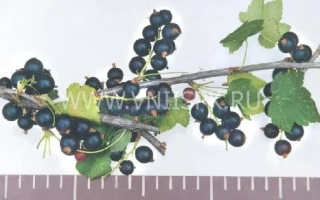
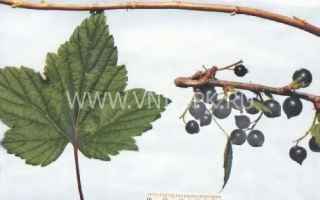
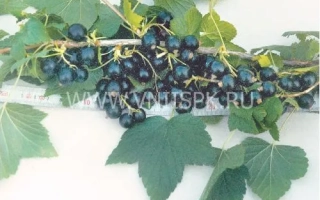
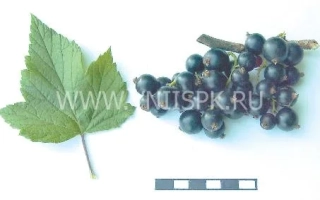
Mid-season variety, developed at the South-Urals Research Institute of Fruit and Vegetable Growing and Potato Cultivation by crossing the varieties 'Bredtorp' and 'Seyanets Golubki'. Author: V.S. Ilyin. Included in the State Register of Selection Achievements approved for use in the Urals region in 2004.
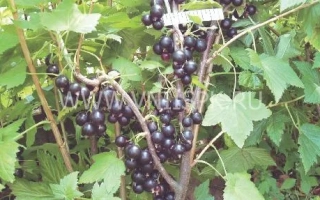
Medium-height, medium-spreading, medium-density bush. Growing shoots are medium-thick, light green, with a pink coating on the upper third, curved, hairless. Buds are medium-sized, egg-shaped, with a pointed tip, placed singly at a 30° angle to the shoot.
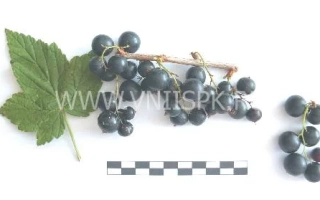
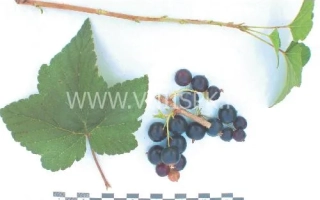
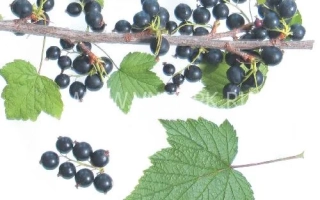
Leaf is five-lobed, medium-sized, green, weakly shiny, medium-creased, hairless, with a concave midrib and wavy margins. Lobes are sharp, the central lobe is longer than lateral ones with additional protrusions. Lateral lobes are broad, medium-length, sharp, directed outward, with a straight angle between their veins. Basal lobes are clearly defined, their midribs are angled outward from the petiole. Leaf base has a deep notch. Leaf blade is bent downward at shoot tips. Teeth are sharp, medium-sized, not curled, with a noticeable 'claw'. Petiole is long, medium-thick, hairless, positioned at a 45° angle to the shoot.
Flowers are medium-sized, pale pink, calyx lobes are egg-shaped with a pointed tip, separate, matte, slightly hairy, positioned on thin, medium-length, light-green pedicels. Inflorescences are medium-length (4.5–7 cm, 7–11 flowers), solitary, with medium or thick, light-green or pinkish, curved, hairless axes.
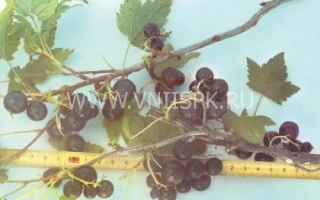
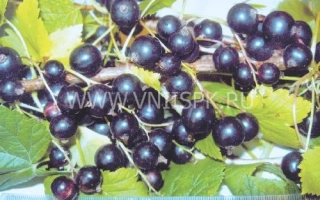
Berries are very large (2.2–5.7 g), round, one-dimensional, nearly black, with thin skin, sweet taste (5 points), universal use. Chemical composition: total sugars — 7.2%, titratable acidity — 2.9%, ascorbic acid — 95.0 mg/100 g.
Cold-hardy, high-yielding variety; average yield is 7.0 t/ha, maximum — 17.0 t/ha (2.1–5.1 kg/plant), self-fertile (56.3%), weakly susceptible to powdery mildew and anthracnose.
Advantages of the variety: high cold resistance and yield, very large berries, dessert taste, low susceptibility to powdery mildew and anthracnose.
Disadvantages of the variety: medium resistance to septoria and bud mite.