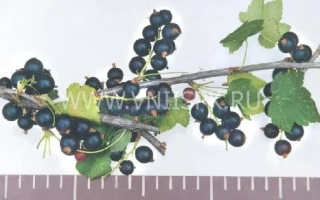
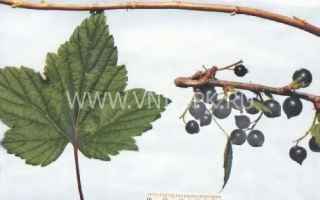
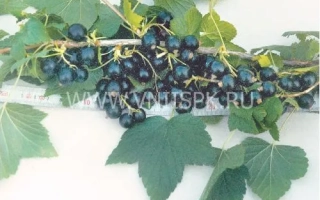
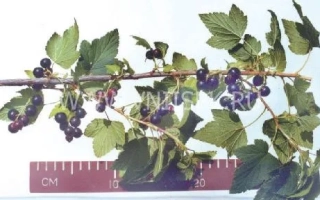
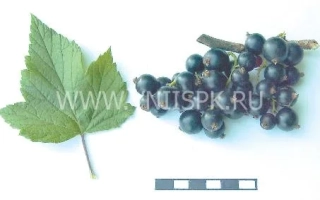
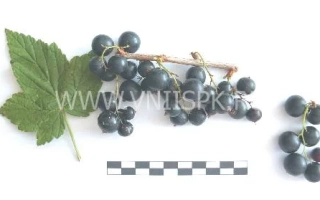
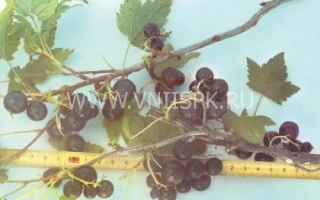
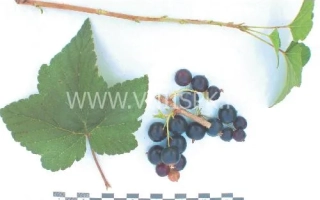
Mid-late maturing variety, developed at Pavlovsk Experimental Station of the All-Union Institute of Plant Industry named after N.I. Vavilov from crossing of Leningrad Giant and Ojebyn. Breeders: E.V. Volodina, S.P. Khotimskaya, N.N. Khabarova. Included in the State Register of Varieties for use in the Northern, North-Western and Central regions in 1993.
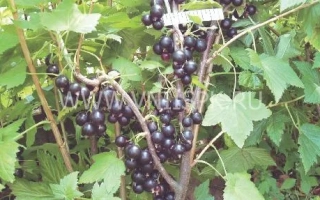
Medium-sized, semi-spreading bush with moderate density. Growing shoots are thick, weakly unevenly colored, pinkish, hairy, woody — thick, straight, gray-brown or beige with brown tips, hairy, with slight gradual thinning toward the tips. Buds are single, double, and triple, medium-sized, thick, short, egg-shaped, pointed at the apex, pink or pink-purple, densely hairy, arranged parallel to the shoot — with bases pressed against the shoot and apexes angled outward. Apical bud is non-free, short, cylindrical or egg-shaped, pointed at the apex. Leaf scar shape is round.
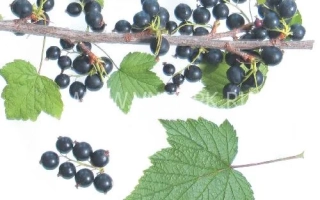
Leaf is five-lobed, large, dark green with bronze tinge, matte, hairy along veins on both upper and lower surfaces of leaf blade and with dense woolly hairs in the midrib notch on upper side of leaf; wrinkled or blistered, rough. Leaf blade is convex, with curled tips of lobes, slightly folded along central vein, positioned at acute angle to shoot. Main veins are predominantly uncolored. Central lobe is large, broadly triangular with slightly elongated, pointed and curled apex, with well-developed additional projections, but degree of expression may vary on different sides of lobe. Side lobes are short, fairly wide, triangular, blunt or slightly pointed, with tips curled downward, angle between their veins is obtuse. At boundary between central and side lobes, noticeable folding — "catch". Basal lobes are moderately expressed, their veins directed toward petiole. Base has deep heart-shaped notch, often with "button". Teeth are wide, large-toothed or double-toothed, shallow, blunt, with short whitish "claw". Petiole is thick, medium length, hairy, predominantly green or weakly unevenly colored at base of petiole and leaf base. Upper shoot leaves' petioles may be colored along entire length.
Flowers are large, cup-shaped, low, greenish-white with faint pinkish-violet tinge, heavily hairy. Sepals are broadly egg-shaped, rounded, with very pale, blurred uneven anthocyanin coloration, hairy, curled, freely positioned. Petals are egg-shaped, whitish, separate, slightly inclined toward pistil. Stigma of pistil is positioned at same level as anthers or slightly above them. Ovary is uncolored, hairy, with numerous glands. Inflorescences are short (1.7–3.8 cm) and medium (5.8 cm), contain 5–8 berries. Inflorescence axis is thick, strong, hairy, with even berry distribution, no pedicel.
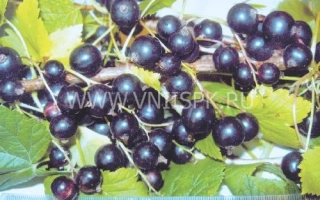
Berries are large (1.6–1.8 g) and very large (over 3.5 g), round and flattened-round, black, medium-shiny, thin-skinned, with semi-dry detachment, containing large number of seeds (59 pcs) of small and medium size. Pedicel is thick, medium length, hairy. Calyx is small, closed, semi-deciduous. Flavor is dessert (5 points). Berries are universal use. Chemical composition: dry soluble substances — 18.6%, total sugars — 9.9%, titratable acidity — 3.0%, ascorbic acid — 102.7 mg/100 g, P-active substances — 288.5 mg/100 g, pectin substances (on fresh weight) — 0.9%.
Winter-hardy, early-bearing (due to formation on root shoots of 65–91% mixed buds, ability to branch root shoots in first year of life, and presence of double and triple buds at node), self-fertile (50.5%), resistant to powdery mildew and bud mite, large-fruited, productive (3.0–4.0 kg/plant).
Advantages of variety: high winter hardiness and productivity, large-fruitedness, early-bearing, excellent berry flavor, high resistance to fungal diseases.
Disadvantages of variety: skin of large berries may rupture during harvest when overripe, uneven ripening of berries.