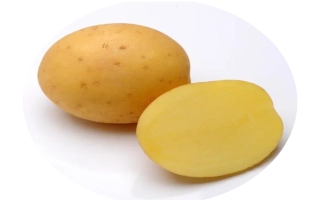
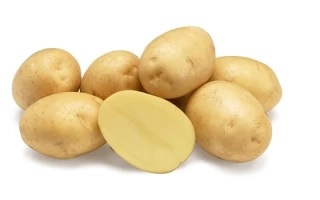
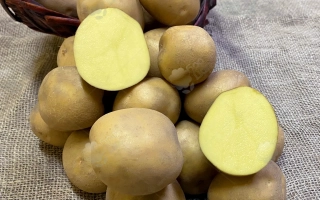
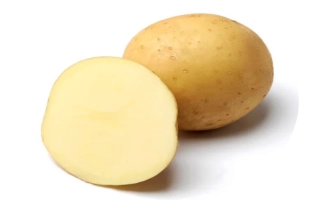
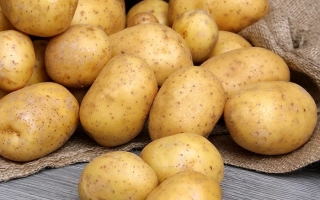
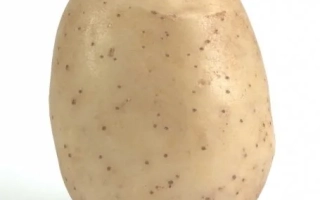
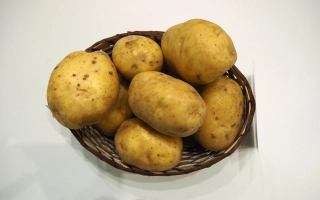
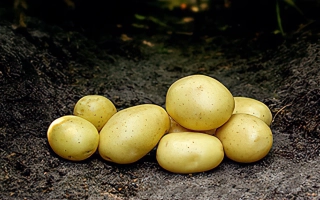
Ludmilla potato — an early-maturing table variety developed by German breeding, intended for cultivation in moderate climate regions, including the Volga and Central Chernozem regions of Russia. The vegetation period is 65-75 days, with the first harvest possible as early as day 45 after emergence. The plant is of medium height, stem-type, with upright to semi-upright growth habit. Leaves are large, intermediate type, green or dark green, flowers are white with medium or large corollas. Tubers are elongated with small surface eyes, yellow skin, light-yellow flesh. The mass of one marketable tuber varies from 111 to 280 grams, and the number of tubers per plant reaches 7-14.
The variety Ludmilla has high and stable yield: marketable yield ranges from 188 to 430 centners per hectare, with maximum yields reaching 447 centners. The first harvest on day 45 after emergence yields 99-124 centners per hectare, while the second harvest on day 55 yields 119-186 centners. Starch content in tubers is 13.3-16.9%, ensuring excellent taste and versatility in cooking. Suitable for baking, frying, boiling, and mashing, it belongs to the culinary type SV.
Ludmilla variety exhibits high resistance to major diseases: resistant to potato scab and golden potato cyst nematode, moderately susceptible to late blight of foliage and tubers. Tubers have 94% storability, allowing long-term storage, including cold storage at approximately 4°C. These features make Ludmilla a reliable choice for farmers and gardeners seeking early, tasty, and disease-resistant potatoes.