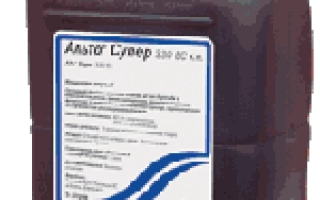
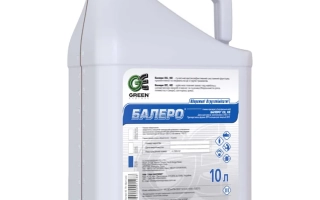
JAGUAR SUPER 100
Manufacturer: Berluga Kft, Hungary
Systemic herbicide for the control of annual grassy weeds in cereal crops after emergence
Active ingredient: fenoxaprop-P-ethyl, 100 g/l + antidote cloquintoset-mexyl, 27 g/l
Formulation: concentrate emulsion
Packaging unit: canister, 5 L
Mode of action
The active ingredient is absorbed by the above-ground parts of weeds, rapidly translocated through the plant to growing points, where it blocks the synthesis of lipids and fatty acids necessary for membrane construction during cell division.
The antidote accelerates in crop plants the breakdown of the active ingredient into non-toxic metabolites that do not adversely affect the crop.
Visual signs of herbicide action
Initial visual signs of herbicide action, such as plant suppression, browning, and anthocyanin coloration in some weeds, appear within 5-7 days after application under favorable weather conditions for plant growth and development.
Final weed death occurs over 10-15 days after application.
Recommendations for application
Crop growth stage
The product is applied during the period from the 2nd to 3rd leaf stage up to the flag leaf stage in winter wheat. The most optimal timing is from the 2nd to 3rd leaf stage until the end of crop tillering, since at later stages crop plants develop vegetative mass that hinders full and even coverage of weeds with herbicide solution during application.
Weed growth stage
The product acts only on weeds that have emerged at the time of application. Maximum efficacy is observed when applied during the 2nd to 3rd leaf stage up to mid-tillering. From mid-tillering to the end of tillering of grassy weeds, the product should be applied at the maximum recommended rate.
Personnel performing mechanized work may enter the area 3 days
after application.
Maximum number of applications — 1 application per season
Pre-harvest interval 60 days.
Rate of working solution
The product is applied at a rate of 150-200 L/ha. In dense stands, the product should be applied at a rate of no less than 200 L/ha.
The rate of working solution should ensure complete and even coverage of weeds with herbicide solution during application.
Weather conditions
Air temperature of +12…+22°C during application is optimal. Lower temperatures (below +12°C), drought, frost, and other stress factors for plant growth and development may slow down the herbicide's effect on weeds and reduce its efficacy.
Rainfall within 2 hours after application may reduce herbicide efficacy on weeds.
Application is performed at wind speeds up to 4-5 m/s.
Compatibility with other products
Do not use this product in tank mixtures with herbicides based on 2,4-D, dicamba, florasulam, fluroxypyr, or bromoxynil.
When using this product in tank mixtures with herbicides based on MCPA, the amount of MCPA-containing product should not exceed 400 g/ha of active ingredient.
Compatibility of components in tank mixtures should be checked beforehand.
Preparation of working solution
Fill the sprayer tank with water to 1/3 of its volume. Activate the mixing mode and add the required amount of product. Fill the sprayer tank to full capacity while the mixing mode is active. The mixing mode must be active during application to maintain the working solution in homogeneous state.
Warnings
— Do not apply the product when crop plants are under stress (low (below +12) or high (above +22) air temperatures, drought, frost, etc.), as this may cause crop toxicity.
— During rainy periods, and when annual grassy weeds are in the tillering stage, apply the product at a rate of no less than 0.75 L/ha. If annual grassy weeds are in the mid-tillering stage, apply the product at a rate of 0.7…0.9 L/ha.
— Bee protection zone is 2…3 km, bee flight restriction is 6…12 hours.
— Do not use vegetative mass of crops treated with this product for feeding livestock within 25 days after application.