

SKU #23357
·
38 views
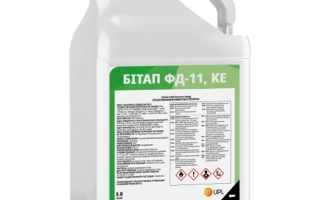
Bitap FD – 11
Herbicides, Desiccants
ЗАТ «Юнайтед Фосфорус Лімітед», РосіяUser rating
0 votes0% positive reviews
No ratings yet — be the first.
Form of the preparation
Emulsion concentrate
Danger Class
3
By type of action
Contact herbicide
By application method
Foliar herbicide
Prices in stores
from10.5 €per 1 l
pack from 11.2 € per 1 l
3 offers from 3 stores
Store offers · 3 from 3 stores
Prices are updated on loadLoading offers…
Available at: АгроАнталь · Agrolike · Аграрна Платформа · Kurkul
Aggregator catalog: prices are collected automatically from store websites, normalized by AI and converted at the current exchange rate. Before ordering, confirm the price and availability on the store's website. This block is not indexed by search engines — the data is loaded after the page opens.
About product
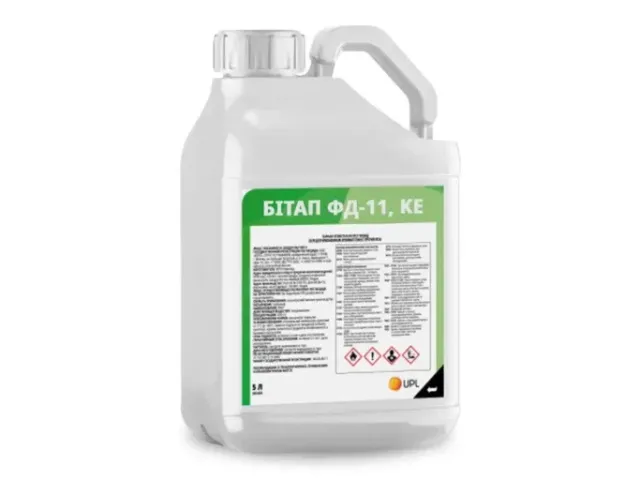
A selective post-emergence herbicide designed for controlling annual broad-leaved weeds in fodder beet crops.
Form of the preparation
Emulsion concentrate
Danger Class
3
By type of action
Contact herbicide
By application method
Foliar herbicide
Description
Bitap FD – 11: Targeted Weed Control for Fodder Beet
In the cultivation of fodder beet, managing competition from broad-leaved weeds during the early vegetative stage is essential for maintaining crop vigor. Bitap FD – 11, produced by ZAO United Phosphorus Limited (Russia), serves as a specialized post-emergence herbicide. Its efficacy is based on a dual-active formulation of desmedipham and phenmedipham, both belonging to the carbamate chemical family.
Key Features and Field Application
This product is categorized as a selective, contact-type herbicide. Unlike systemic solutions, Bitap FD – 11 acts directly upon contact with the foliage of target weeds. Its selectivity is fine-tuned for fodder beet, ensuring that once the guidelines are followed, the crop remains unaffected while the weed pressure is significantly reduced.
- Chemical Composition: Based on proven carbamates, ensuring a reliable mode of action.
- Flexibility: With a recommendation of up to 3 applications, farmers can effectively target consecutive flushes of weed emergence.
- Dosage: Depending on the weed growth stage and density, the application rate ranges from 1 to 3 liters per hectare.
- Safety and Management: Rated as Class 3 hazard, it adheres to standard agricultural handling safety protocols. The pre-harvest interval is set at 60 days.
Bitap FD – 11 remains a standard tool for agronomists seeking predictability. While the chemical market constantly evolves, the carbamate-based approach provided by this product continues to offer a stable and effective solution for cleaning up fodder beet fields from annual broad-leaved competition.
Composition
Active ingredients
- Desmedipham гербицид Карбаматы
- Phenmedipham гербицид Карбаматы
Application
Used on crops
Against weeds
Specifications hover over for a hint about the specification
| Form of the preparation | |
|---|---|
| Danger Class | 3 |
|
By type of action
By type of action
Depending on their ability to move through living tissues, herbicides are divided into contact and systemic. Contact herbicides cause local damage to plant tissue upon contact, which dies or gradually degrades. This action does not always completely destroy the plant; often, its... |
|
|
By application method
By application method
Based on the method of application, herbicides are divided into foliar, soil, and root herbicides. Foliar herbicides are applied to vegetative plants and act through their above-ground organs. The main method of application for such preparations is spraying using sprayers or airp... |
|
|
By Mode of Action
By Mode of Action
Herbicides are divided into two groups according to their mode of action: Non-selective herbicides — intended for the destruction of all plant species. They are applied in agricultural fields during the absence of the main crop (after harvest, before crop emergence, on fallow lan... |
|
|
By Application Timing
By Application Timing
Herbicides are classified according to application timing into pre-emergent and post-emergent herbicides. Pre-emergent herbicides are mostly soil-applied or granular formulations applied before the emergence of crop plants. They are applied either pre-sowing (during pre-sowing cu... |
|
|
Drug Consumption
Drug Consumption
Mass of the preparation per unit of treated area. It is customary to express the dosage rate in kilograms per hectare. The dosage rate is most often given in terms of 100% active ingredient, although sometimes it is calculated based on the preparation in the form of application w... |
1-3 |
|
Maximum number of treatments
Maximum number of treatments
Maximum recommended number of treatments per vegetation period. |
3 |
|
Last Processing Date, Days
Last Processing Date, Days
Number of days from processing to harvest cleanup |
60 |
| Registration year | 2012 |
| Catalog | Catalog → Herbicides, Desiccants |
| Manufacturer | ЗАТ «Юнайтед Фосфорус Лімітед», Росія |
| Country | India |
Not yet комментариев. Be the first!
Alternatives
Herbicides, Desiccants · similar preparations
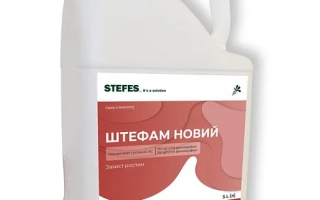
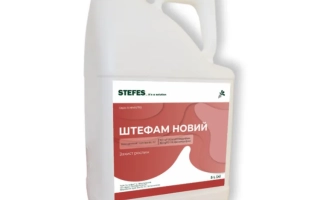
Stefam Noviy, KS (fenmedifam, 160 g/l + desmedifam, 160 g/l)
ДДЕ Фарм АГ, Тризен, Ліхтенштейн
022 2 offers
13.2 €per 1 l ≈ 679 ₴




See also
Often considered together with this product



Gerositol w.r.g., (tribenuron-methyl, 750 g/kg)
Sunrise Agrochemical Co., Ltd.
029 2 offers
22.19 €per 1 l ≈ 1 142 ₴





Recently viewed
Products you’ve viewed on this site
Reviews · 0