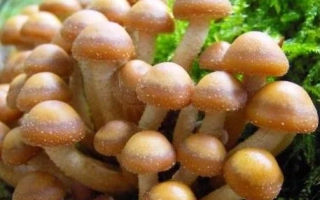
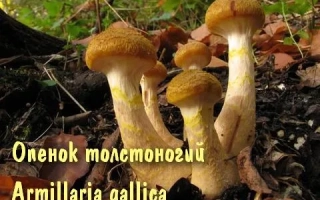
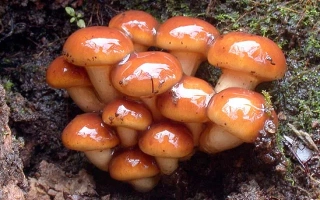
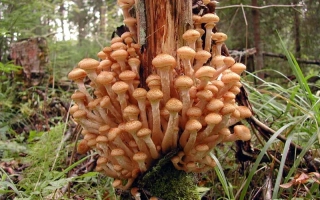
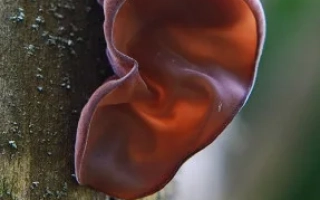
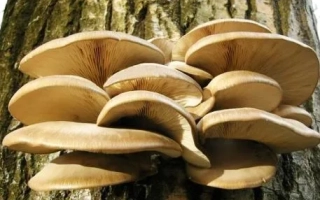
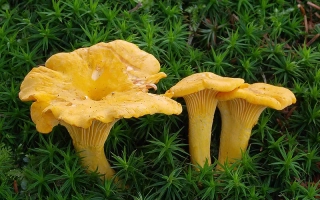
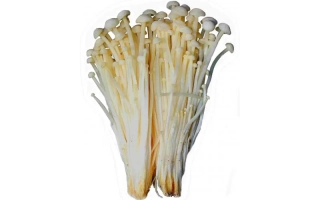
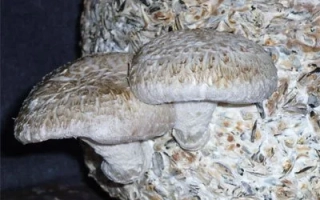
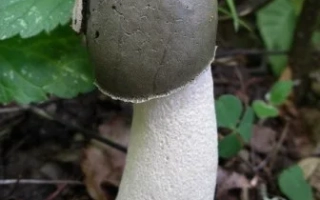
Winter Oyster / Flammulina velutipes — edible mushroom of the family Strophariaceae. The fruiting body is a cap-stalked structure, central or slightly eccentric. Cap 2-10 cm, flat (convex in young specimens), yellow, honey-brown, orange-brown. Edges of the cap are usually lighter than the center. Flesh thin, from white to light yellow, with a pleasant taste. Stalk 2-7 cm × 0.3-1 cm, tubular, firm, characteristic velvety-brown color, reddish-brown at the top. Gills attached, sparse, with shortened gills. Color — from white to ochre. Remnants of veil absent. Spore powder white.
Fruits in dense clusters, often fused. Common in the northern temperate zone. Season: autumn — spring. Continues fruiting during winter thaws, often found under snow.
Edible mushroom (4 category). Used fresh (boiling about 20 minutes), marinated, and salted. In young specimens, the dark part of the stalk is trimmed; in older ones, only caps are collected. When boiled, it remains slippery, which not everyone likes. Tolerates frost well, without losing its flavor, so can be harvested frozen or thawed. Especially popular in Japanese cuisine.
Scientists have determined that Winter Oyster produces flammulin — a substance active against sarcoma.
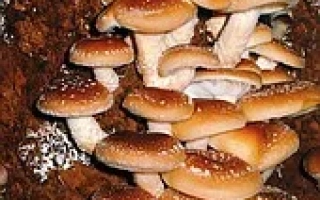
Cultivated in Japan, Korea, and other countries on an industrial scale. As a substrate, specially moistened wood (moisture 50-70%) or wheat straw is used. Harvest is obtained almost year-round. Global production — up to 100,000 tons per year.
Cultivating Winter Oyster on wood: can be done on logs or stumps of deciduous trees (ash, oak, birch, beech, etc.) with bark, without signs of decay, diameter 20-50 cm and length 30-50 cm. If dry logs are used, they must be soaked in water for 2-3 days. Then drill 12 holes 1 cm in diameter and 5-10 cm deep along the log in a checkerboard pattern. Insert mushroom "chopsticks" into the holes with clean (wiped with alcohol or cologne) hands until they reach the end. Place the log (stump) in a plastic bag with small holes for air access. Optimal germination temperature 20-22°C. Logs are colonized when white mycelium with a pleasant mushroom odor is visible at infection sites. Infected logs (stumps) should be placed in a shaded, wind-protected area in the garden (under trees, near fences, on the north side of buildings). Avoid direct sunlight. Place the log (stump) vertically and bury it 10-15 cm deep, or horizontally, burying it halfway. Compact and moisten the soil around the log. In dry weather, regularly moisten the soil and wood; to retain moisture, cover with straw or twigs. Optimal fruiting temperature 14-18°C, humidity not less than 85%. Yield of oysters usually amounts to 30-40% of the wood mass. Start of fruiting: 8-10 months after infection.
Cultivating Winter Oyster on nutrient substrate: wheat straw or sunflower husks are poured with boiling water and left for 7-8 hours, then the water is drained. Before sowing, the substrate moisture should be 70%, temperature 20-30°C. Once cooled, the substrate is mixed with mycelium and placed in a transparent bag. Germination lasts 15-18 days at 14-18°C. In areas where the first fruiting bodies appear, carefully make incisions in the film. Fruiting occurs in cycles every 5-7 days.
Fruiting duration: 5-10 years depending on tree species. In the garden, it does not harm fruit trees or garden buildings. For balcony cultivation, after infection, the log should be placed in a pot with soil in a shaded, ventilated area. Maintain temperature 14-18°C and regularly moisten the soil.