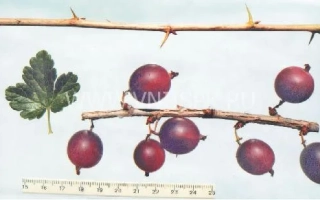
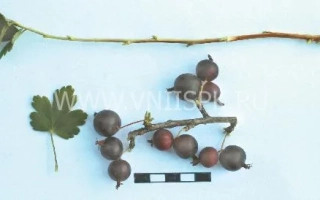
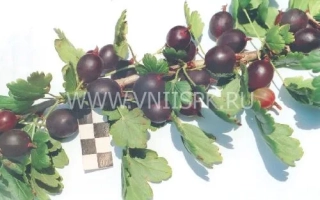
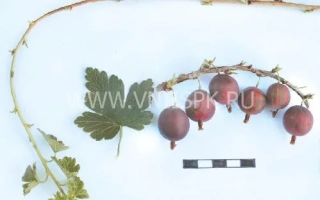
Mid-early maturing variety, obtained at the VNIIS (Institute of Horticulture named after I.V. Michurin) from open pollination of the 'Besshipny-3' variety. Breeders: K.D. Sergeeva, T.S. Zvyagina, E.Yu. Koveshnikova. Since 2006, it has been included in the State Register of Breeding Achievements approved for use in the Central Chernozem region.
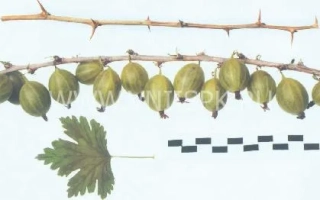
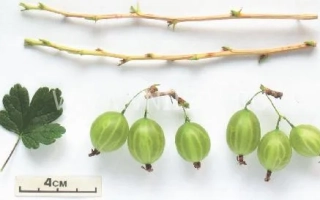
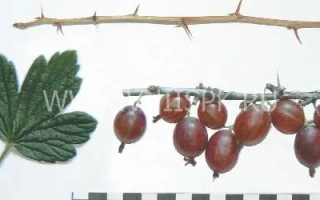
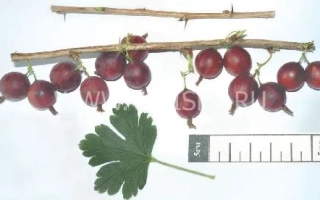
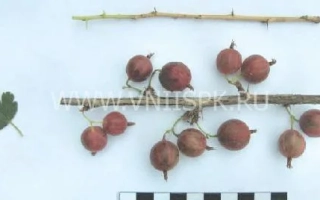
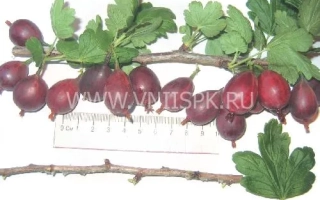
Medium-sized, spreading bush with medium density. Growing shoots are medium thickness, straight or slightly curved, light green, sometimes with weak anthocyanic coloring, glabrous. Woody shoots are thick and light-colored. Shoots have medium thorniness; thorns at nodes are single, medium length and thickness, straight, light-colored, oriented upward and distributed along the entire length of the shoot. Lower internodes are covered with thorns. Buds are elongated, medium size, with pointed tips, dark brown, glabrous, deviated from the shoot. Leaf scar is round.
Leaves are medium or large, light green, shiny, glabrous, with smooth or slightly wrinkled surface, tender, concave. Teeth are medium, blunt. Main vein coloring is absent. Leaves are three- to five-lobed, lobes with deep narrow notches, central lobe exceeds lateral ones, its lateral edges slightly rounded. Lateral lobes are medium-sized, pointed, with upward-pointing tips, acute angle between lateral lobe veins. Basal lobe veins are spreading. Leaf base has a small or medium indentation, angle between leaf blade base and petiole is acute, rarely right. Petiole is long, thick, with sparse glandular hairs, positioned at 45° angle to the shoot.
Flowers are medium-sized, elongated, pale. Sepals are pale, separate, positioned horizontally, rarely slightly bent upward. Inflorescence is one- or two-flowered. Ovule is glabrous or very slightly covered with glandular hairs.
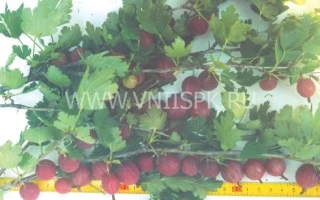
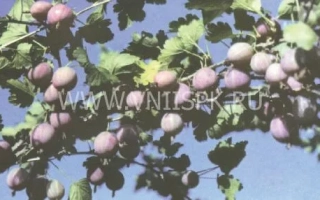
Berries are medium-sized (2.9–4.0 g), oval or slightly conical, dark purple, nearly black when fully ripe, single-seeded, glabrous, with waxy coating. Moderate seed count. Skin is medium thickness with weak venation, veins weakly branched, lighter than main color. Calyx is large, half-open or closed. Peduncle is medium length and thickness, green, base color matches berry. Flavor is tart-sweet, dessert type (4.8 points). Chemical composition: dry solids — 15.1%, total sugars — 12.2%, titratable acidity — 1.9%, ascorbic acid — 32.3–37.4 mg/100 g, catechins — 265 mg/100 g, pectins — 0.6%. Berries are versatile.
Highly winter-hardy, drought-tolerant, average yield 7.0–14.0 t/ha (2.1–4.2 kg/plant), characterized by good self-fertility and high resistance to American powdery mildew.
Advantages of the variety: high resistance to sphaceloma, winter hardiness, taste and chemical-technological qualities of berries.
Disadvantages of the variety: spreading bush habit, thorniness of shoots, in some years — smaller berry size.