Medium-ripening variety, obtained at the Siberian Institute of Horticulture named after M.A. Lisavenko by selection among hybrid seedlings from the 1939 cross. Breeders: M.A. Lisavenko, N.I. Kravtseva, Z.S. Zotova. Since 1974, included in the State Register of Breeding Achievements approved for use in the West Siberian region.
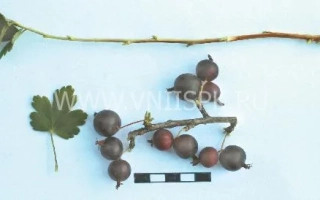
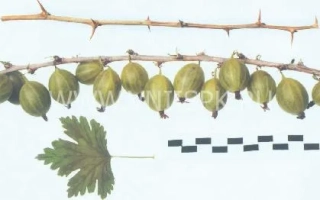
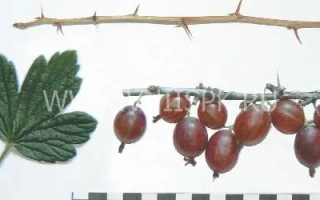
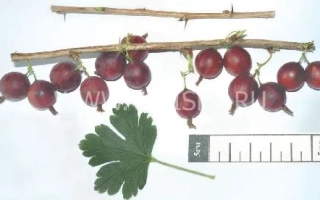
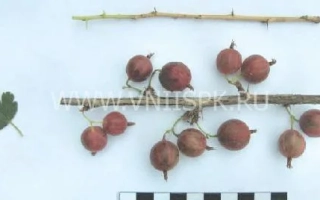
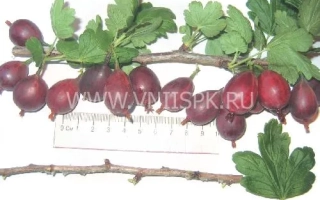
Low-growing, spreading bush with weak regenerative ability. Branches are arching, weakly hairy, with reddish tips. Thorns are thick, long, 1-3-cleft, directed downward at an angle. Thorns on 3-4-year-old branches often fall off. Young shoots in the lower part are covered with small thorns.
Large, dark green leaves, glossy on young shoots, matte on older ones, hairy underneath. Lobes are short, narrow, closely spaced. Base is straight or slightly notched.
Small flowers, pale pink sepals, reflexed. Ovule is elongated, weakly hairy, with a half-open calyx.
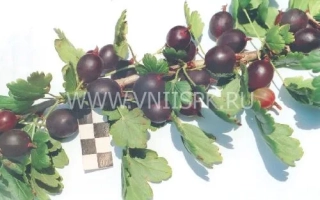
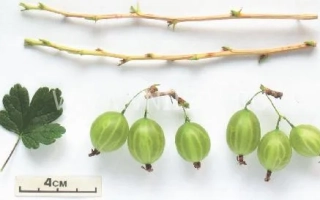
Berries of medium size (2.0-3.0 g), elongated-oval or bottle-shaped, dark red, with a waxy coating. Taste is sweet-sour, pleasant. Chemical composition: dry matter — 12.8%, sugars — 8.4%, acidity — 2.1%, ascorbic acid — 27.2 mg/100 g, vitamin P — 178.0 mg/100 g. Berries are of universal use.
Winter-hardy, productive — average yield 5.0 t/ha (1.5 kg/plant), maximum 21.7 t/ha (6.5 kg/plant), characterized by high self-fertility. Highly resistant to powdery mildew, moderately resistant to anthracnose and septoria.
Advantages of the variety: high winter hardiness and resistance to powdery mildew, good berry taste.
Disadvantages of the variety: moderately affected by anthracnose and septoria.