
Daffodils in the Matla Flowers Catalog: Bulbs for March and April Flower Beds
Only a few crops open the spring season in the garden, and the daffodil holds its ground firmly among the first. The plant overwinters in open ground, does not require annual digging, and returns to the same spot for years.
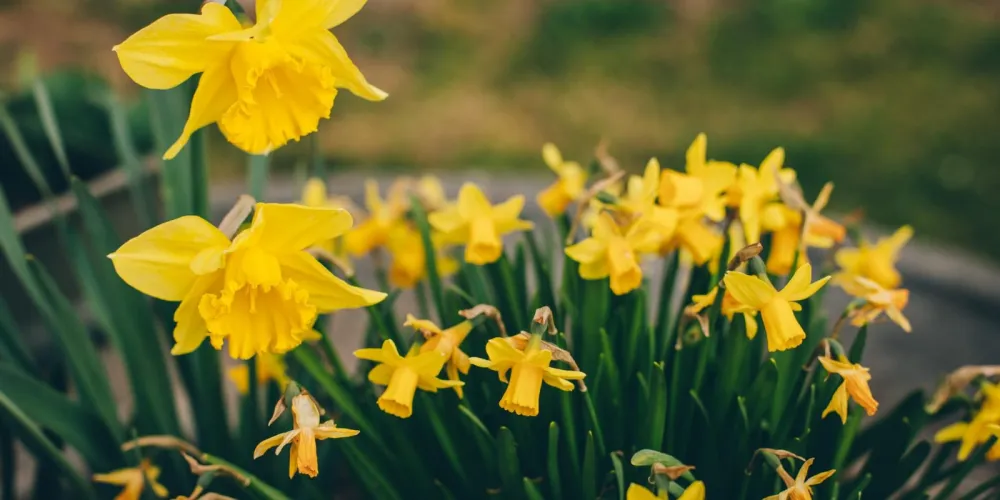
Only a few crops open the spring season in the garden, and the daffodil holds its ground firmly among the first. The plant overwinters in open ground, does not require annual digging, and returns to the same spot for years. It is precisely because of this hardiness that they are planted even by those who rarely visit the countryside.
Matla Flowers has been working with planting material since 2007, and it all started with Dutch tulip bulbs. Now, a dedicated section https://matla-flowers.com.ua/bulbs/narcissus/ has gathered eight subcategories, divided by color and flower structure. This division saves time: the buyer immediately goes to the desired shade instead of scrolling through the entire assortment.
Why This Crop Is Convenient for the Garden
The main advantage is predictability. A bulb planted in autumn produces a flower stem in spring without any extra effort from the owner. Watering is only needed in a dry spring, and fertilization twice a season.
The second reason for popularity is resistance to rodents. Mice and voles bypass such plantings because the plant tissues contain bitter alkaloids. Tulips do not have this advantage, so experienced gardeners often alternate the two crops on the same bed.
The third argument is durability. The clump grows independently and produces more flower stems year after year. Transplanting will be needed about once every four to five years when the planting becomes crowded.
How the Catalog Section Is Structured
The subcategories are built on two principles. The first is color: white, yellow, pink, and purple items are listed separately. The second is the structure of the inflorescence along with the plant's size.
The second group includes multi-flowered and dwarf selections, as well as peony-flowered varieties with a dense center. Standing apart is the narrow-leaved species—compact, small-flowered, close to the natural form.
Filters in the left column refine the query further. There, you can set the stem height, flower diameter, planting period, planting depth, and size of the planting material.
Flower Forms: From Trumpet to Tazetta
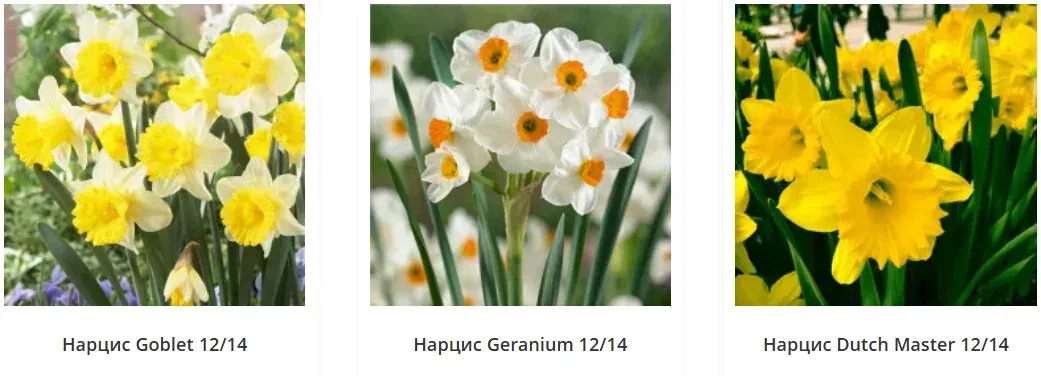
Trumpet varieties remain the most recognizable. Their corona is elongated and equal to or longer than the petals, and a single flower forms on the stem. A classic example of this structure is 'Dutch Master' with its golden-yellow coloring.
Tazetta and Jonquilla groups behave differently: from two to five buds appear on a single flower stem. Because of this, the planting looks lusher, and the aroma is stronger. The 'Geranium' variety with cream petals and an orange corona is a typical representative.
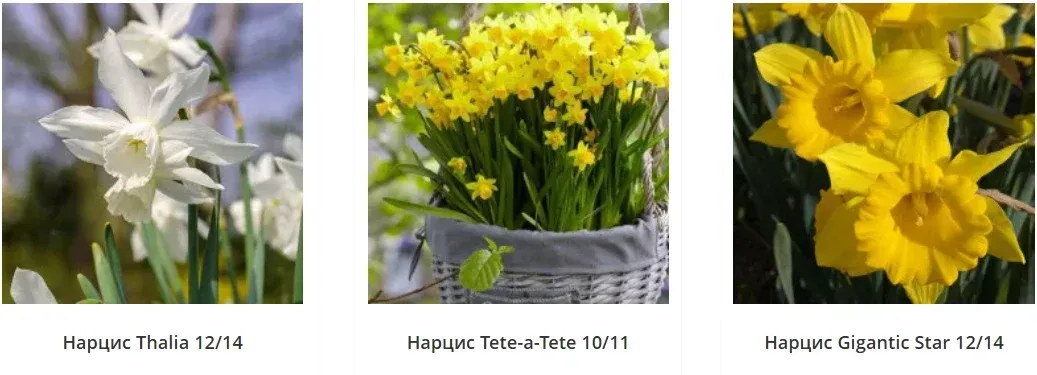
Triandrus varieties produce drooping flowers on thin stems. 'Thalia' with its pure white tone creates the effect of a light, almost wild meadow.
Peony-Flowered, Dwarf, and Narrow-Leaved
Peony-flowered items have a dense double center. The flower looks voluminous, resembles a miniature peony, and attracts attention even from a distance of several meters.
Dwarf varieties rarely exceed twenty centimeters. They are planted at the front edge of a border, in planters, and on alpine coasters where a tall plant would lose its proportion. 'Tete-a-Tete' is the most common variant of this group.
The narrow-leaved daffodil has narrow leaves and small flowers. Plantings with it look natural, which is why such material is often scattered in groups across the lawn.
Colors That Make Up the Selection
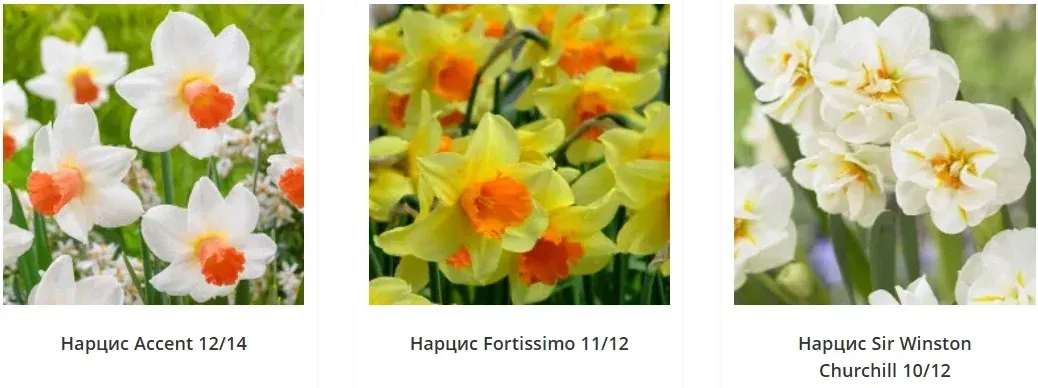
White and yellow remain the basics. They form the bulk of the offering and easily combine with any neighbors in the spring garden.
Pink varieties are valued for the atypical tone of the corona. The coloring appears gradually: the first days after opening, the center is lighter, then it acquires a warmer shade.
Two-color options provide the greatest effect up close. An orange or pinkish corona on a light background is noticeable even on a cloudy day when the rest of the flower bed seems gray.
Timing: When the First Buds Appear
Flowering occurs in March and April. The exact date depends on the region, weather, and planting depth, so a variance within two weeks is considered normal.
Early items open along with crocuses, medium ones in the middle of April. Such a start is valued for the contrast with the bare ground. If you take a few packs from both groups, the plot stays colorful for almost a month and a half.
After flowering, the foliage works for several weeks more. You shouldn't cut it off immediately: it is during this period that the plant accumulates reserves for the next year.
Signs of a Quality Bulb
The first season depends on the condition of the planting material. Before paying, it is worth checking a few points.
Density. A healthy specimen is firm to the touch, with no soft areas on the side.
Husk. The dry scales are intact, with no wet spots or traces of mold.
Bottom plate. The basal part is dry, and roots have not yet sprouted.
Fraction. Sizes 12/14 and 14/16 produce a larger flower stem as early as the first spring.
Smell. A sour extraneous odor indicates the onset of decay.
A smaller fraction of 8/10 also has a right to exist. It is cheaper and suitable for mass plantings, although it reaches full strength only in the second year.
Autumn Planting Technology
The optimal window is from September to November. The soil must have time to warm the roots, and frosts should not catch the plant off guard.
Choose a plot with sun or light partial shade.
Dig up the soil to a depth of two spade blades and add compost.
Make holes about ten centimeters deep.
Maintain an interval of ten to fifteen centimeters between specimens.
Cover with soil and water if the autumn has been dry.
Mulch the bed with peat or shredded bark.
Sand is added to heavy loams, as stagnant moisture is more harmful than frost. A plot with a high groundwater level is best raised by at least fifteen centimeters.
Care from Sprouting to Yellowing Foliage
In spring, it is enough to remove the mulch and loosen the surface. The first feeding is given with nitrogen fertilizer at the beginning of regrowth, the second with a complex fertilizer during the budding phase.
Watering is needed in dry weather while flowering is underway. Later, the crop enters a dormant state, and excess moisture becomes unnecessary.
When the leaves turn yellow, they are cut off at the base. The clump is divided every four to five seasons: dug up in July, dried in the shade, and returned to the soil in autumn.
What the Buyer Gets at Matla Flowers
The store's assortment is not limited to bulbs. Nearby in the catalog are vegetable and flower seeds, rose seedlings, conifers and fruit crops, perennials in pots, seedlings, as well as fertilizers and hand garden tools.
Delivery is carried out by Nova Poshta and Ukrposhta throughout Ukraine. You can pay for the purchase online or upon receipt, and the store provides a quality guarantee for the planting material.
A bonus program is available for regular customers. The New Arrivals, Promotions, Reviews, and F.A.Q. sections help you navigate, and the mobile app for iOS and Android keeps the entire list at your fingertips.
A Flower That Returns Every Spring Without Reminders
Autumn work takes one evening, and the result lasts for several consecutive seasons. For an ornamental crop, this is a rare ratio of effort to reward.
The Matla Flowers catalog allows you to assemble a kit for a specific task: a border, a planter, a meadow, or for cutting. Therefore, it is worth placing an order in advance, in September, while all fractions and shades are available.
Editorial team agronom.info
Materials are prepared by the portal's agronomists and editors. We use only trusted sources: Ukrainian agricultural universities, variety registries, open scientific publications.
Related articles
Not yet comments. Be the first!
Comments · 0