
Cultivator or Walk-Behind Tractor: Fundamental Differences and Technical Distinctions
When choosing soil tillage equipment, gardeners and farmers often confuse the terms "motor cultivator" and "walk-behind tractor", considering them synonyms or simply power variants.
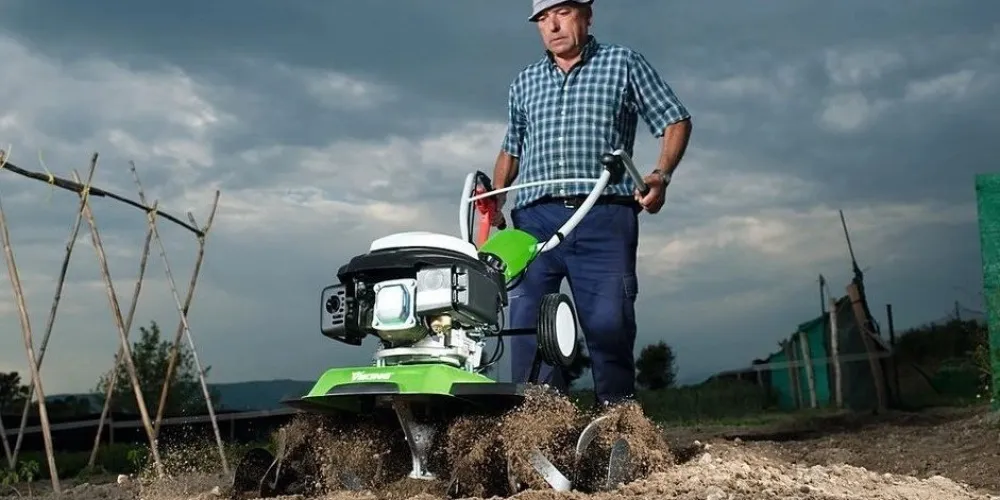
: fundamental differences, technical distinctions, and selection criteria
When choosing soil tillage equipment, gardeners and farmers often confuse the terms "motor cultivator" and "walk-behind tractor", considering them synonyms or simply power variants. However, from an engineering perspective, these are two fundamentally different types of machines with distinct kinematic schemes, transmissions, and functional purposes.
A mistake in selection leads either to purchasing a machine that is too heavy and unmaneuverable for flower beds and greenhouses, or to the premature failure of a light cultivator on heavy loam or virgin soil. Below is a detailed technical breakdown of the differences between these classes of equipment.
Fundamental Difference: Concept and Traction Scheme
The main difference lies in the method of transmitting force to the soil and the purpose of the machine:
What is a cultivator (motor cultivator)
A cultivator is a highly specialized unit created exclusively for surface soil cultivation: loosening, seedbed preparation, weed destruction, and fertilizer incorporation.
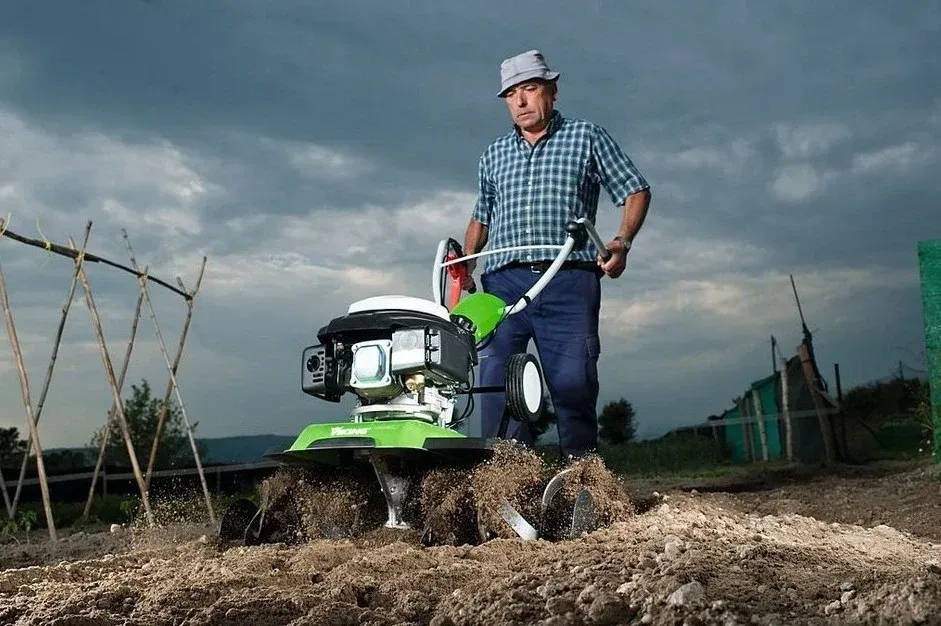
Propulsion and working tool: most cultivators lack drive wheels. Forward movement is achieved directly by the rotation of the rotary tillers mounted on the output shaft of the gearbox.
Tillage depth: regulated by a depth gauge (braking bar) that plunges into the soil at the rear of the unit.
What is a walk-behind tractor
A walk-behind tractor is a universal self-propelled two-wheeled chassis based on a traction power module.
Propulsion: the machine constantly rests on pneumatic wheels with a tractor tread (or metal lugs) that transmit tractive effort.
Aggregation principle: working equipment (plow, tiller, mower) is attached via a hitch or driven by the transmission. The walk-behind tractor acts as a compact tractor.
Wide selection of garden equipment in our store
1. Transmission, Gearbox, and Clutch
In cultivators: the design is maximally simplified to reduce weight. Most often, a worm or single-stage chain gearbox in a stamped housing is used. The clutch is usually implemented as a tension roller of a V-belt drive. Light models lack a gearbox (1 forward speed), while medium models provide 1–2 forward speeds and reverse.
In walk-behind tractors: durable multi-stage gear or gear-chain gearboxes in cast iron or aluminum crankcases are used. The clutch is a full-fledged disc clutch (dry or in an oil bath) or a reliable dual-disc system. Walk-behind tractors are equipped with a gearbox (from 2+1 to 6+2 speeds with a lower range), allowing you to choose the optimal speed: low for plowing and potato digging, high for driving with a trailer.
2. Presence of a Power Take-Off Shaft (PTO)
This is the defining assembly that separates a full-fledged walk-behind tractor from a motor cultivator:
Cultivators do not have a PTO. Their functionality is limited to rotating tillers instead of wheels.
Walk-behind tractors (medium and heavy classes) are equipped with a power take-off shaft (keyed or splined) or an additional pulley channel to transmit torque to active attachments: rotary mowers, vibratory potato diggers, auger snow blowers, or water pumps.
3. Mass and Tractive Effort
The physics of soil tillage cannot be bypassed: sinking a plow or hiller requires surface adhesion force.
Mass of cultivators: from 15 to 55 kg. A light weight is sufficient to sink sharp tillers into already cultivated soil, but such equipment is unable to pull a plow — light wheels will simply slip in place.
Mass of walk-behind tractors: from 75 to 250+ kg (water-cooled diesel models). Their own mass provides the necessary soil grip for plowing virgin soil, cutting furrows, and towing a cargo trailer weighing up to 400–800 kg.
4. Power Plants
Cultivators: equipped with electric motors (1.0–2.5 kW), batteries, or compact 4-stroke gasoline engines with a capacity of 3.5 to 6.5 hp.
Walk-behind tractors: equipped with durable engines featuring high torque at low speeds: gasoline (7–16 hp) or diesel (6–12 hp with air or water cooling), often with an electric starter.
Comparative Table of Capabilities
Parameter | Motor Cultivator | Walk-Behind Tractor |
Main function | Loosening and milling | Complex farm mechanization |
Tiller drive | Installed instead of wheels | Separate active tiller via PTO or instead of wheels |
Plowing with a plow | Impossible or extremely inefficient | Full-fledged (if weight is 90 kg or more) |
Working with a trailer | Not provided | Yes (transportation of goods up to 800 kg) |
Grass mowing / snow removal | No | Yes (via power take-off shaft) |
Maneuverability | High, suitable for narrow rows | Requires space to turn around |
What to Choose for Your Needs?
When it is advisable to choose a cultivator:
Plot area up to 10–15 acres, where the land is cultivated annually and there is no virgin soil.
Working in confined spaces: soil cultivation in greenhouses, hotbeds, around trees and berry bushes.
Limited physical capabilities of the operator: women or elderly people can easily handle a light model weighing 25–40 kg.
Transportation requirements: the cultivator easily fits into the trunk of a passenger car.
When a walk-behind tractor is necessary:
Plot area from 20 acres to several hectares.
Full cycle of root crop cultivation: plowing, planting with a potato planter, inter-row hilling, harvesting with a potato digger.
Need for utility and transport work: regular mowing of the plot for hay, snow clearing in winter, hauling firewood or construction materials.
Heavy clay soils or development of virgin lands.
A wide selection of garden equipment on our website Roco.com.ua
Editorial team agronom.info
Materials are prepared by the portal's agronomists and editors. We use only trusted sources: Ukrainian agricultural universities, variety registries, open scientific publications.
Related articles
Financial instruments for updating the agricultural technology fleet: choosing an optimal strategy
Cargo lashing straps: reliable fixation for transport and storage
Maintenance and Repair of Hydraulic Systems for Agricultural Machinery: Extending Component Lifespan
Not yet comments. Be the first!
Comments · 0