
Which diesel two-wheel tractor should you choose?
A two-wheel tractor is a mobile machine on a single-axle chassis with two wheels. It looks like a small tractor without a cab and can travel both forwards and backwards. It is in high demand on farms, in landscaping and…
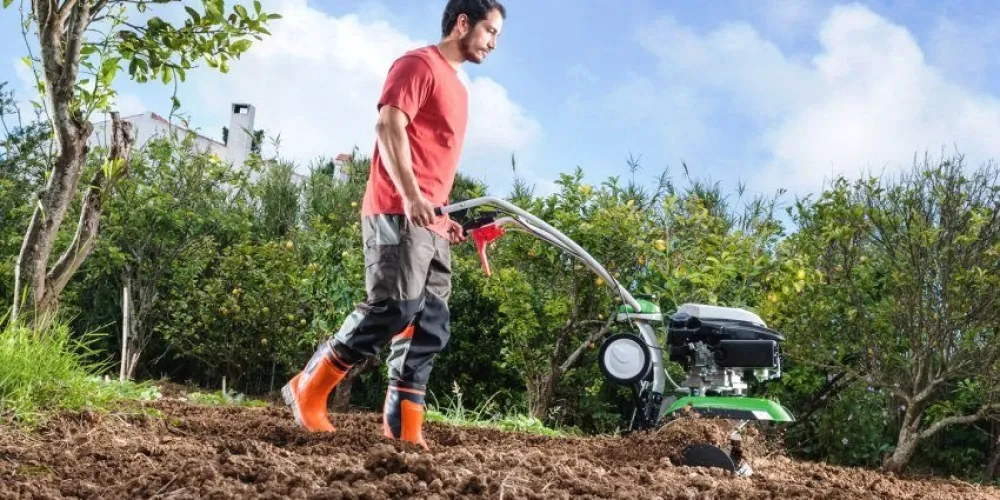
A two-wheel tractor is a mobile machine on a single-axle chassis with two wheels. It looks like a small tractor without a cab. It can travel not only forwards but also backwards. The machine is in high demand on farms, in landscaping and in agriculture. With it you can work the soil safely and quickly. A two-wheel tractor accepts the following attachments:
- plough;
- cultivator;
- sickle-bar or rotary mower;
- rotary tiller;
- potato digger;
- snow blower and trailer.
Turning the machine takes physical effort. It is steered by long handlebars. The engine is started by sharply pulling a cord (the same principle as on a chainsaw). There is also a gearbox that lets you select the tillage speed.
Two-wheel tractors are classified in several ways. By fuel type, for example, there are petrol and diesel models. The second group is preferable because it delivers more power.
Any diesel two-wheel tractor copes with plots of 1 to 7 hectares. In its engine the fuel-air mixture is ignited not by a spark plug but by strong compression inside the cylinder.

Key advantages of a diesel two-wheel tractor
At equal power to petrol-driven self-propelled equipment, a diesel machine uses fuel more sparingly (at most 9 litres per 100 km). Diesel is also cheaper than petrol at the pump. Other advantages of a diesel two-wheel tractor:
- Better traction.
- Longer uninterrupted operation, because the engine has a water cooling system (at least on most models in this group).
- A longer service life — roughly 3,000 engine hours (or six years).
- A dependable engine that runs without breakdowns provided the oil filters are changed on time and good-quality fuel and lubricant are used.
- Easy and simple to service and repair, because a diesel two-wheel tractor has no carburettor and no spark plugs needing constant adjustment.
- No extra ballast weights are required. The machine's own weight is enough to load the soil fully and guarantee deep tillage.
Buying a diesel two-wheel tractor pays off when you plan to use it regularly, because over the long run such a machine saves on fuel.
How to choose a diesel two-wheel tractor
If the soil is worked constantly and does not become compacted, light diesel models are ideal. If it is dug rarely and compacts heavily, choose a heavy model. Other criteria:
- dimensions (it matters what kind of plots the machine will be used on);
- power (the volume of work depends on it);
- a quality certificate for the engine;
- engine cooling type (water cooling is preferable to air);
- number of gears.
A differential makes the machine noticeably easier to use: you no longer have to force it round a turn. It also improves manoeuvrability and the speed of work.
An electric starter makes starting a diesel two-wheel tractor much easier. Models fitted with one cost more, but it is better to pay extra than to crank the engine by hand every time.
It also matters whether attachments can be connected and driven by the power take-off. If only a rotary tiller can be fitted, the machine will handle a limited range of jobs.

Which is better to buy — a diesel or a petrol two-wheel tractor?
It depends on the conditions of use and the volume of work. A petrol two-wheel tractor suits ploughing on small plots. It handles stone-free soil better, can run at high revolutions and is quieter than a diesel machine.
Only diesel-powered equipment will cope with more difficult soil types. It is also used on large areas. Keep this in mind when buying.
Which diesel two-wheel tractor is best to choose in Ukraine?
The Kentavr M/B/2012D-4 with a rotary tiller has air cooling and a generous 5.5-litre fuel tank. One fill-up lasts a full day's work. It reaches 13 km/h in second gear and reverses at 3 km/h. The machine belongs to the heavy class.
The Kentavr MB1010D-6, supplied with a rotary tiller, closely resembles a compact tractor. It can work up to 5 hectares. Its engine has an efficient water cooling system. Large wheels, high ground clearance and a powerful 10 hp engine give it excellent off-road ability. A power take-off and belt drive make it more versatile and more widely usable.
The DTZ 510DN with a rotary tiller weighs 125 kg and therefore loads the soil well during tillage. Engine output is 10 hp. It does not overheat thanks to air cooling. The tiller is adjustable in 2+1+1 sections. The wheels provide excellent traction. This machine performs a wide variety of jobs well — working the soil between planting and sowing, harrowing, gathering lifted root crops, ploughing and more.
The Kentavr MB2060D-4 with a rotary tiller is ideal for weeding, ploughing and cultivating small plots. It has a dependable single-cylinder 6 hp engine and a bevel gear reduction unit. The machine can be fitted with an electric starter for quick, convenient starting. It stands out for excellent manoeuvrability, adjustable working width, safe operation and a low centre of gravity.
The Kentavr MB2091D-3 with a rotary tiller is a three-speed machine (two forward, one reverse) with a top speed of 13 km/h. It suits large areas of soil and can take additional attachments for a wide range of jobs. The fuel tank holds 5.5 litres. It uses diesel sparingly even under intensive work, and it is easy to repair and service.
Conclusions
Diesel two-wheel tractors cost more than petrol ones, yet they last longer and use less fuel. They are better suited to difficult soil types and can work very large areas. Thanks to the power take-off, a range of equipment can be mounted on diesel machines to extend what they do.
Diesel two-wheel tractors are also larger and heavier than their petrol counterparts. They are noisier but break down less often. Their engines are protected from overheating by an air or water cooling system. In Ukraine it is worth choosing the models listed above: they have proved themselves in the field, have plenty of positive reviews and are not afraid of hard working conditions.
Editorial team agronom.info
Materials are prepared by the portal's agronomists and editors. We use only trusted sources: Ukrainian agricultural universities, variety registries, open scientific publications.
Related articles
Not yet comments. Be the first!
Comments