
How to Choose a Pump for Pumping Viscous Products at an Agricultural Processing Enterprise
How to select screw pumps for viscous products at an agricultural processing plant: viscosity, flow rate, cleaning, and costs. Check the criteria before purchasing equipment.
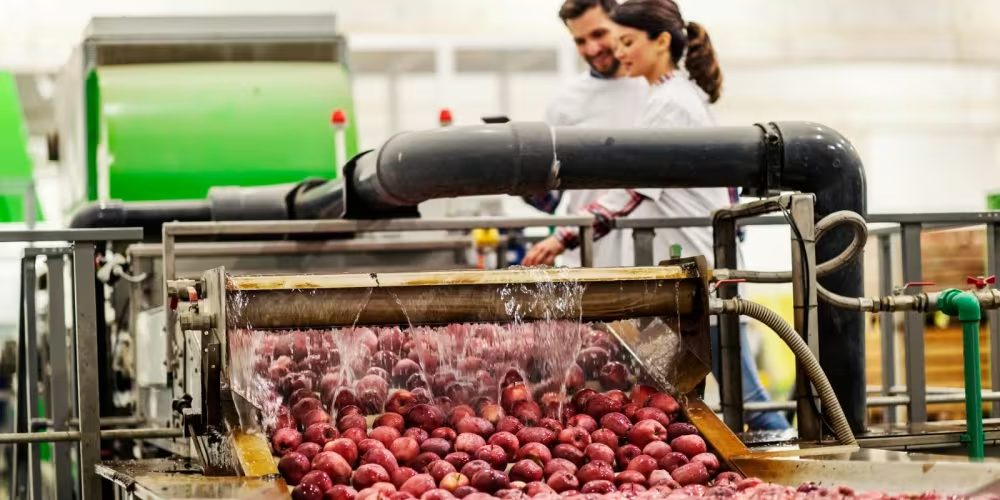
During the processing season, a pump can become a bottleneck for the entire line. Puree flows slowly to the next operation, thick paste does not exit the tank well, and after a recipe change, the equipment operates under overload. Increasing the motor power does not always eliminate the root cause: the problem may lie in the product properties, the suction pipeline, or the raw material feed method.
For an agricultural processing plant, proper selection begins with a description of the technological process. The pump must provide the required flow rate, maintain acceptable product quality, and fit into the cleaning and maintenance regime. The price of the unit is important, but it does not reflect how much its operation will cost throughout the season.
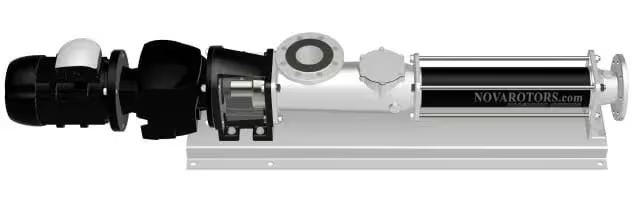
Table of Contents
What product properties determine the choice
When to consider a screw design
How to match the pump with the pipeline and raw material supply
What to check regarding hygiene and protection
How to estimate costs and accept equipment
Frequently Asked Questions
What Product Properties Must Be Known Before Selection?
Selection requires the viscosity at operating temperature, product composition, characteristics of inclusions, and requirements for preserving structure. The name "fruit puree" or "molasses" by itself does not determine the required model.
Start with the temperature range. Raw materials may arrive warm after pretreatment but cool down during storage. For many products, this means increased viscosity and a more difficult start-up. Selection based solely on comfortable conditions can leave the enterprise without sufficient flow rate under the most severe operating mode.
For pastes and purees, the flow behavior is also important. Their viscosity can depend on the intensity of mixing and mechanical impact. Therefore, the laboratory value must be provided along with the temperature and measurement conditions. If there is no data, it is worth discussing research or sample testing.
Describe the inclusions separately: size, concentration, hardness, and permissible degree of damage. Soft fruit pieces and hard pits create different challenges. The ability of a pump to pass particles does not guarantee the preservation of their shape or the absence of wear.
When Is a Screw Pump a Justified Solution?
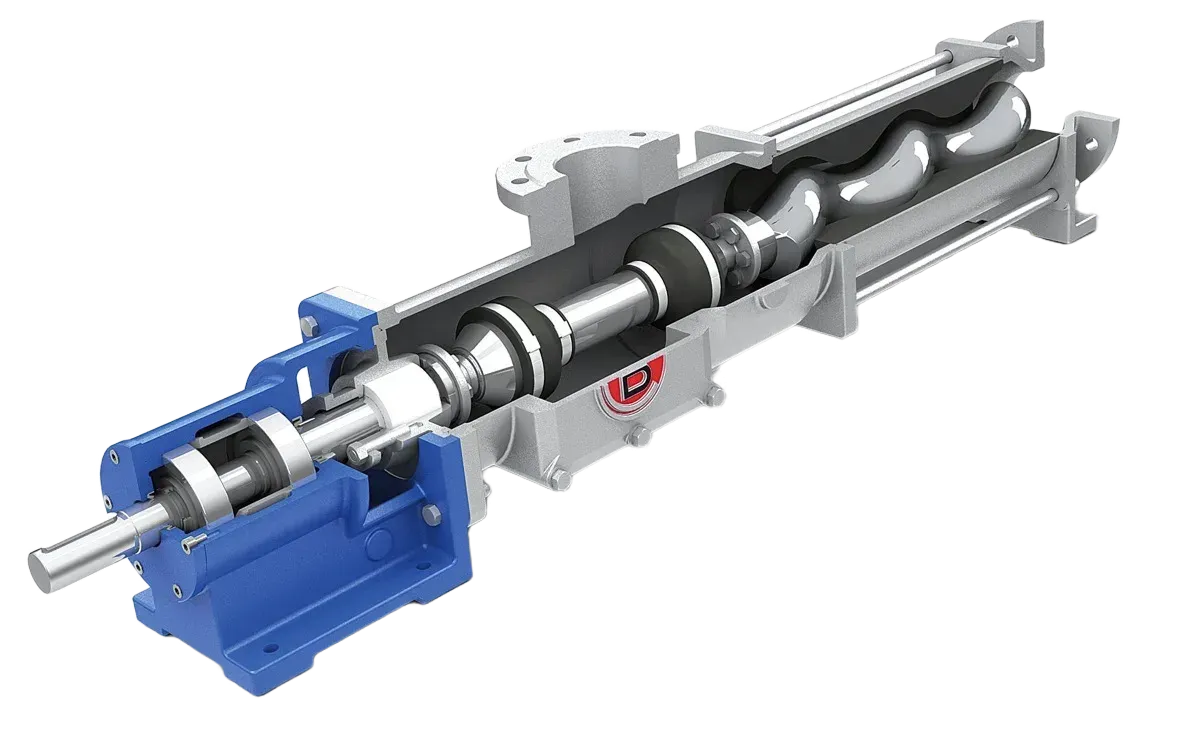
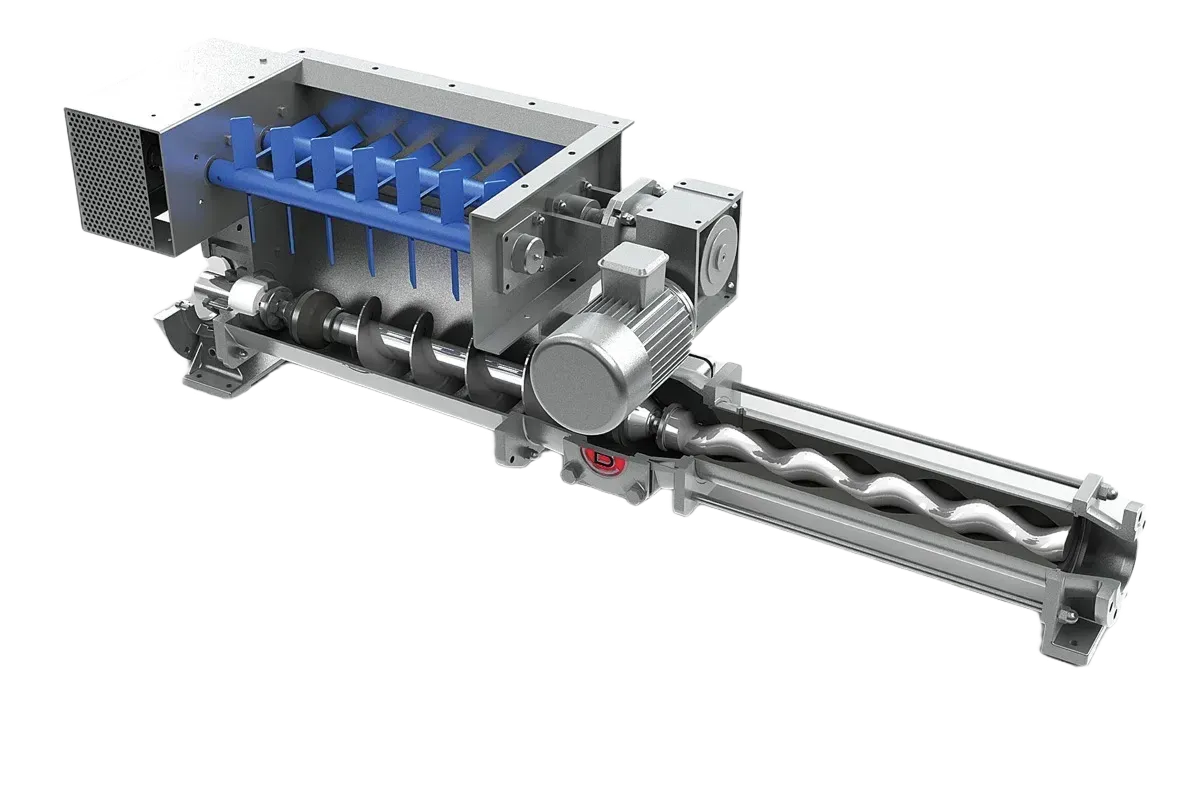
A single-screw design with an eccentric rotor should be considered for thick media when uniform feeding and operation with paste-like products are required. The final choice depends on the properties of the raw material, pressure, sanitary requirements, and operating mode.
Such a pump is of the positive displacement type: the rotor rotates inside the stator, forming cavities that move the product along the working part. The flow rate is usually regulated by changing the rotation speed, but the actual performance also depends on the pressure drop, medium properties, and the condition of the working pair.
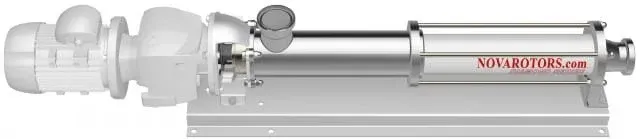
When considering screw pumps for viscous products, clarify the design. A single-screw pump with an elastomer stator and a twin-screw pump are different technical solutions. Their cleaning capabilities, permissible operating modes, and maintenance costs cannot be automatically equated.
Design | When to consider | What to check before selection |
Single-screw with eccentric rotor | Thick pastes, purees, uniform feeding | Stator material, product intake, dry-running protection |
Lobe | Products for which gentle handling is important | Permissible inclusions, impact of speed and pressure on the product |
Twin-screw hygienic | Various products and working with cleaning solutions using a single pump, if provided by the model | Operating range, seals, cleaning parameters |
Centrifugal | Less viscous food liquids at the appropriate operating point | Characteristics on real product and viscosity corrections |
The table helps build a list of options for engineering comparison. It does not replace calculation and does not establish a universal winner.
Interesting fact. Self-priming and dry running are different properties. The ability of a pump to create a vacuum at the inlet does not mean that a single-screw design with an elastomer stator can safely operate without product.
How to Match the Pump with the Pipeline and Raw Material Supply?
The required performance should be checked together with pressure and inlet conditions. The pump will not provide the calculated flow rate if the thick mass does not have time to flow to its working part.
Provide the supplier with the line layout: length and inner diameter of pipes, height difference, number of bends, fittings, and equipment downstream of the pump. The resistance of a filter or heat exchanger also affects the required pressure. The same flow rate in two different pipelines may require different pump designs.
Pay special attention to the section from the tank to the inlet. A long, narrow hose, low product level, or unfavorable unit location can limit raw material intake. Increasing the speed in such a situation does not eliminate the cause of the supply deficit.
If the mass does not flow well under its own weight, discuss a feed hopper with an auger. For products that form bridging or cavities above the inlet, it is necessary to separately check the method for breaking them down and the stability of the pump feed.
In the technical specifications, you must indicate the minimum, normal, and maximum flow rate. This is important for lines where recipes, batch sizes, or packaging speeds change.
Expert View
I would start the selection with the most difficult expected operating mode: cold start, low level in the tank, and the thickest recipe. If you discuss only average indicators, it is easy to get a pump that works well during a demonstration but limits the line during the season. For me, a convincing proposal contains the conditions under which the flow rate is confirmed, a list of limitations, and maintenance procedures. When this data is missing, I would first clarify the initial parameters or arrange product testing, and only then compare prices.
What to Check Regarding Hygiene and Protection?
For a food process, confirmed suitability of all product-contact materials and a clear cleaning procedure are necessary. A stainless steel housing does not confirm that the stator, seals, and the entire design comply with the enterprise's conditions.
Coordinate the material compatibility with the raw materials and cleaning agents. Check whether the equipment matches the temperatures of the production and cleaning cycles: they may differ.
If CIP (Clean-in-Place) is provided, specify the required flow rate, temperature, duration, and washing sequence. The designation CIP in a catalog does not replace verifying the cleaning result on a specific line. This is especially important when changing recipes and working with allergens.
For a single-screw pump with an elastomer stator, dry-running protection must be provided. A solution is also required in case of discharge line blockage: a positive displacement pump can create a dangerous pressure rise. The protection method is coordinated with the manufacturer and integrator.
A typical mistake is to use a throttled discharge valve as the main method for regulating the flow rate of a positive displacement pump. The operating mode should be changed using the method provided by the design and control system.
How to Estimate Costs and Accept Equipment?
Compare proposals based on identical operating conditions and complete equipment sets. The price of a unit without protection, control, or necessary connections is not equal to the cost of a ready-to-use solution.
The calculation should include installation, electricity consumption, cleaning, spare parts, personnel labor, and potential downtime. For a seasonal enterprise, the delivery time for the stator and seals and the ability to perform quick repairs are especially important.
Pre-agree on acceptance criteria: flow rate at a specific product and temperature, working pressure, start-up stability, acceptable condition of inclusions after pumping, and cleaning results. Testing on water alone does not confirm operation with thick raw materials.
A universal savings percentage without enterprise data has no practical value. Benefits should be evaluated through the actual reduction of operational time, product losses, repair costs, and downtime.
Frequently Asked Questions
Can molasses and fruit puree be pumped with a single pump?
Sometimes yes, if both products fall within the agreed operating range. It is necessary to check viscosity, inclusions, material compatibility, flow control, and cleaning between batches.
How to choose a pump if the viscosity is unknown?
Provide a sample and a description of temperature conditions. Ask to determine the characteristics sufficient for selection or to conduct tests. Guessing based on the product name is unreliable.
Can pumping be facilitated by heating?
For many products, heating reduces viscosity. However, the permissible temperature is determined by technology: heating can affect raw material quality, process safety, and pump materials.
Will fruit pieces remain intact after pumping?
This depends on the size and strength of the inclusions, pump geometry, speed, and pressure. If particle integrity affects commercial quality, it should be tested on a sample.
Is a frequency converter necessary?
It is advisable when you need to change the flow rate or match the pump to the line. The permissible speed range and drive capabilities are matched to the specific load.
What is more important: power reserve or proper pump feeding?
Both parameters must match the process. A more powerful motor will not compensate for a situation where the product does not flow well from the tank to the working part.
Start your selection with the technical specifications. Record the product, temperatures, required flow rate, pipeline layout, and cleaning method. Send this data to the specialists at Emerem Tehnik for evaluation of possible designs and ask for a justification of the choice. This will help compare equipment based on compliance with the production process and expected costs.
Editorial team agronom.info
Materials are prepared by the portal's agronomists and editors. We use only trusted sources: Ukrainian agricultural universities, variety registries, open scientific publications.
Related articles
Why a good walnut harvest does not yet mean good earnings
How can a farm diversify its income and avoid depending on selling a single type of product?
A New Era of Agricultural Packaging: How the PPWR Regulation Gives the Green Light to Paper Bags from "Paper Pak"
Not yet comments. Be the first!
Comments · 0