
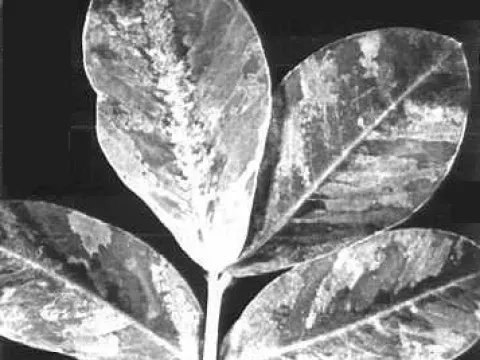
Abelmoschus mosaic
Tymovirus abelmoschi
The causative agent of this disease is the Abelmoschus mosaic virus (AbMV), which belongs to the Tymovirus genus. It is a single-stranded RNA virus that specifically infects members of the Malvaceae family.
What the section contains
Abelmoschus mosaic
The virus exhibits high virulence and efficiently exploits the host's vascular system, making it a significant threat to commercial production of susceptible crops.
Transmission occurs primarily through mechanical injury of tissues during cultivation and via sap-feeding insect vectors, which move the virus from infected to healthy plants.
Viral particles are relatively stable in the environment and can persist in crop debris or alternative host plants for extended periods.
The genetic variability of this virus suggests that it can evolve into new strains, potentially overcoming the resistance mechanisms of currently available varieties.
The most prominent symptom is a characteristic mosaic pattern on the leaf blades, defined by a contrast between light and dark green areas.
Affected leaves often display severe deformation, becoming crinkled or puckered, with margins that frequently curl, leading to a stunted plant appearance.
Internode shortening is commonly observed in infected plants, giving the entire crop a dwarfed and weak structural phenotype.
Fruit production is significantly impacted; the fruits develop slowly, exhibit stunted growth, and often show irregular shapes and poor internal quality.
As the infection advances, chlorosis may spread across the foliage, eventually leading to premature senescence and leaf drop, further reducing plant vitality.
The disease spread is closely linked to the population density of insect vectors like aphids and whiteflies, which facilitate the rapid transmission of the virus.
Warm and humid weather conditions are optimal for both host plant growth and insect vector proliferation, thereby accelerating the onset and spread of the disease.
Poor agricultural practices, such as using unsterilized tools for pruning, provide an easy pathway for the mechanical transmission of the virus through plant sap.
High planting density increases the probability of virus spread through direct physical contact between foliage during windy weather or routine maintenance operations.
Wild plants belonging to the Malvaceae family act as crucial reservoirs, allowing the virus to survive and persist in the field environment throughout the year.
The primary economic impact is a dramatic reduction in harvestable yield, as the systemic infection severely impairs the plant's ability to produce viable fruit.
Infected crops suffer from reduced metabolic efficiency, making them more susceptible to secondary infections by fungi, bacteria, and environmental stresses.
The produce from symptomatic plants is often unmarketable due to severe deformation, small size, and inferior texture, leading to significant financial losses for growers.
Management costs are inflated by the need for continuous and intensive pest control programs aimed at minimizing the population of potential virus vectors.
In regions where the virus becomes endemic, agricultural sustainability is threatened, often requiring a shift to different crops to maintain economic viability.
Preventative measures are the cornerstone of management, including the use of virus-free seeds and establishing adequate spatial isolation from other malvaceous crops.
Integrated Pest Management (IPM) is essential to suppress insect vectors like whiteflies and aphids through timely and targeted insecticide applications.
Rigorous sanitation protocols should be implemented, including the prompt removal and destruction of all symptomatic plants to eliminate the source of inoculum.
Regular disinfection of all agricultural equipment and tools used during harvest or pruning is critical to prevent mechanical spread across the field.
- Use of disease-free planting material
- Consistent weed control
- Sterilization of pruning tools
- Monitoring of vector populations