
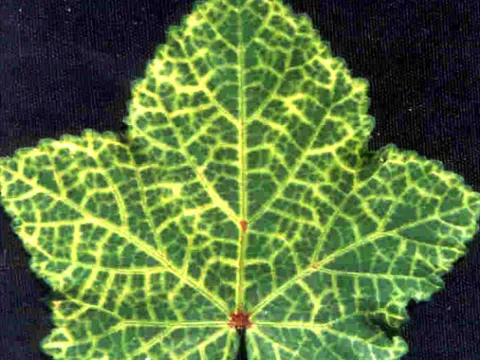
Abelmoschus yellow vein mosaic
Begomovirus abelmoschusflavi
The hallmark symptom of this disease is a prominent yellowing of the leaf veins, which eventually spreads to the entire leaf blade, creating a mosaic or reticulate pattern.
What the section contains
Abelmoschus yellow vein mosaic
As the infection progresses, the leaves become stunted, distorted, and curled. The overall plant growth is severely restricted, resulting in a bushy, dwarf-like appearance that is easily recognizable in the field.
Flower development is severely impacted; infected plants produce fewer flowers, and many of these drop off prematurely before developing into fruit, leading to a drastic reduction in yield.
The fruits that do manage to develop are usually undersized, misshapen, and exhibit chlorotic patches, rendering them unfit for market consumption or commercial processing.
These systemic symptoms appear throughout the plant, starting from younger leaves and gradually spreading to older foliage as the viral concentration increases within the host tissues.
The disease is caused by several species of Begomovirus, a genus within the family Geminiviridae. These are circular, single-stranded DNA viruses that replicate within the plant's cell nuclei.
The virus is transmitted in a persistent, circulative manner by the whitefly Bemisia tabaci. This insect is the primary and essential vector responsible for spreading the infection in agriculture.
Upon feeding on an infected plant, the whitefly acquires the virus, which circulates through its body and enters the salivary glands. This ensures that the insect remains a vector for the duration of its life.
The viral particles, known as virions, have a unique twin-particle (geminate) structure, which is diagnostic for the Geminiviridae family and aids in their transmission stability.
The virus has a wide host range among the Malvaceae family, allowing it to persist in various wild plant species that serve as reservoirs between cropping seasons.
The proliferation of the virus is inextricably linked to the population dynamics of the whitefly vector, which thrives in hot and dry climatic conditions.
High temperatures accelerate the life cycle of the whitefly, leading to exponential population growth and increased movement of vectors from surrounding weeds into okra fields.
Dry weather stress makes host plants more susceptible to infection and secondary damage, while the absence of rain prevents the natural washing away of whitefly populations from the leaves.
The presence of perennial weeds near the crop field provides a continuous bridge for the virus, allowing it to survive and jump to new crops whenever planting occurs.
Poor agricultural practices, such as lack of crop rotation and improper irrigation, further stress the plants and create a perfect microclimate for the whitefly to flourish.
Abelmoschus yellow vein mosaic is considered one of the most destructive diseases for okra production worldwide, often causing yield losses ranging from 50% up to 100%.
The disruption of photosynthesis in chlorotic leaf areas leads to poor carbon assimilation, causing the plant to weaken and become susceptible to secondary opportunistic pathogens.
Economic losses are compounded by the total loss of marketable fruit quality, as the cosmetic appearance and physiological health of the harvest are entirely degraded by the virus.
The systemic nature of the infection means that once a plant is infected, it cannot be cured, necessitating the removal of the plant to prevent further transmission.
Management of this disease consumes significant resources, including the repeated application of insecticides and the constant need for vigilant field scouting.
Successful management requires an integrated approach centered on the suppression of the whitefly population and the exclusion of viral sources.
- Planting resistant or tolerant cultivars as the primary defensive strategy.
- Using yellow sticky traps to monitor and reduce adult whitefly density.
- Implementing rogueing by removing and destroying symptomatic plants immediately upon detection.
- Maintaining field hygiene by clearing weeds that serve as alternate hosts.
- Application of systematic insecticides to break the transmission cycle by the vector.