
Abutilon vein yellowing virus
Crinivirus abutilonis
The causative agent of the disease is the Abutilon mosaic virus (AbMV), which is a member of the Begomovirus genus within the Geminiviridae family. The virus consists of small geminate particles containing single-stranded circular DNA.
What the section contains
Abutilon vein yellowing virus
This is a systemic disease that infects the vascular tissues of the plant. It does not spread mechanically through touch or via seeds, which is a critical aspect of its pathology that helps differentiate it from other infections.
The primary vector for the virus is the tobacco whitefly (Bemisia tabaci). The insect acquires the virus while feeding on the phloem sap of an infected plant and becomes a persistent carrier, capable of transmitting the pathogen for the rest of its life.
Because the virus is persistent within the vector, whiteflies can effectively transmit the infection even after long periods of not feeding on the host. Inside the plant, the virus moves rapidly through the phloem to colonize new growth.
Viral particles are relatively stable within the host but degrade quickly outside the plant or insect vector. Therefore, active reservoirs of the virus are strictly living plant hosts or infected insect populations.
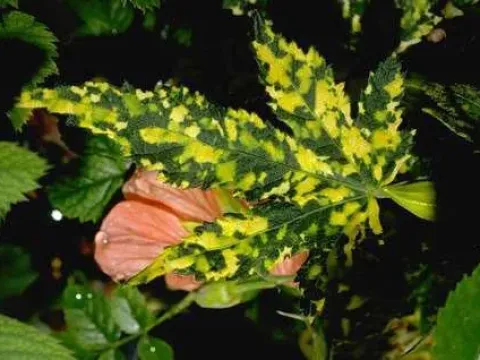
The primary symptom is a distinct chlorosis, or yellowing, of the leaf veins. In typical cases, this manifests as a bright, mosaic-like pattern where the veins turn cream-white or bright yellow against the green leaf blade.
As the disease progresses, irregular chlorotic spots may develop across the leaf surface. Severely affected plants often show leaf deformation, with leaves becoming smaller than normal and exhibiting curling along the margins.
The visual appearance of the plant changes dramatically, becoming variegated. This is often confused with natural variegation; however, unlike genetic variegation, the viral pattern is asymmetrical and lacks structural uniformity.
Flowering is significantly impaired. Buds may form but often drop prematurely before blooming. Flowers that do open are frequently deformed and show loss of color intensity, appearing washed out compared to healthy blooms.
The overall plant vigor declines as the virus disrupts normal development. Internodes become shortened, the plant becomes stunted, and it exhibits a general failure to thrive, making it more susceptible to environmental stressors.
The spread of the disease is directly correlated with the activity of whitefly populations. In greenhouse environments, warm temperatures and high humidity provide ideal conditions for the rapid multiplication of the vector.
Poor air circulation within enclosed spaces fosters the development of microclimates where whiteflies thrive. These conditions allow insects to move efficiently between healthy and infected plants, spreading the virus throughout a collection.
The introduction of the virus usually occurs through the acquisition of new, already infected stock. Because the virus can remain latent for some time, infected plants may appear healthy upon purchase, masking the potential threat.
Seasonal patterns also dictate infection rates, with the spring and summer months witnessing peak whitefly activity. During these times, the risk of a widespread outbreak in a decorative plant collection increases exponentially.
Overcrowding of plants limits the efficacy of insecticide applications, allowing whiteflies to hide in dense foliage and continue their feeding cycles, thereby perpetuating the viral transmission chain.
Abutilon vein yellowing virus poses a major threat to commercial floriculture as it is incurable. Infected plants lose their aesthetic market value and are rendered essentially worthless for retail purposes.
The systemic nature of the virus leads to long-term physiological stress. Photosynthetic efficiency is reduced due to the destruction of chloroplasts in yellowed tissues, causing chronic nutrient and energy deprivation.
The economic impact is high due to the speed of infection. In a greenhouse setting, one infected plant can trigger an outbreak that ruins an entire crop, leading to significant financial losses for producers.
Furthermore, affected plants become weaker and less resistant to secondary pathogens. This necessitates additional chemical treatments and increased labor, further raising the cost of maintenance and production.
The virus necessitates strict quarantine measures, which restrict the trade and movement of plant materials. This can result in long-term disruptions for nurseries and professional growers dealing with ornamental collections.
The most important control strategy is strict quarantine for all new acquisitions. New plants should be isolated for 30–45 days to monitor for any symptoms before being introduced into the main collection.
Effective management of whitefly populations is essential to prevent viral transmission. Yellow sticky traps should be deployed to monitor for the presence of adult insects, enabling early intervention with systemic insecticides.
Once a plant is confirmed to be infected, it must be immediately removed and destroyed. Since there is no cure, total removal is the only reliable method to prevent further spread within a greenhouse or garden.
- Regular inspections of the underside of leaves for whitefly eggs and nymphs.
- Use of biological control agents, such as parasitoid wasps (e.g., Encarsia formosa).
- Disinfection of pruning tools after each individual plant is handled.
- Maintaining a clean growing environment by removing weeds that may act as alternative hosts.
Integrated Pest Management (IPM) practices, combining cultural controls, monitoring, and targeted chemical applications, provide the most sustainable defense against the spread of the virus.