
Setaria streak
Setaria streak
The causal agent of Setaria streak is the Setaria streak virus (SSV), a member of the Sobemovirus genus. This virus primarily infects plants within the Poaceae family.
What the section contains
Setaria streak
The virus particle consists of a single-stranded RNA molecule protected by an icosahedral protein coat. It is highly adapted to replicate within the cytoplasm of host plant cells.
Transmission of the virus occurs naturally through insect vectors, specifically leafhoppers (Cicadellidae). These insects acquire the virus while feeding on infected plant sap.
Perennial grasses serve as crucial natural reservoirs for the virus during the winter months. These weeds allow the pathogen to persist in the environment until the next growing season.
Although mechanical transmission through sap contact is theoretically possible, it plays a minor role in field outbreaks compared to insect-mediated transmission.
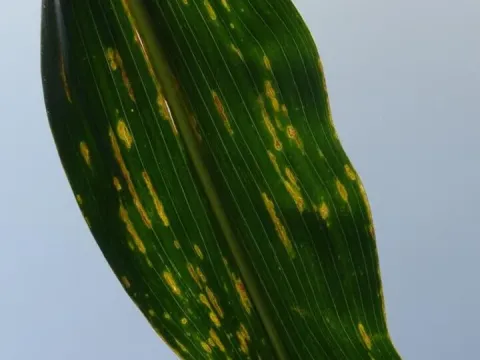
The hallmark symptom of Setaria streak is the appearance of chlorotic stripes on the leaf blades. These stripes run parallel to the leaf veins, characteristic of many cereal viruses.
Early infections often present as broken, intermittent streaks. As the disease progresses, these streaks lengthen and coalesce into continuous stripes covering much of the leaf.
The color of the affected tissue typically turns from pale green to bright yellow. In advanced stages of infection, necrotic lesions may appear along the edges of the yellow stripes.
Infected plants exhibit stunted growth and reduced vigor. The development of the entire plant is compromised, leading to shorter internodes and smaller leaf surfaces.
Reproductive organs are often malformed, with panicles or heads failing to develop properly. This directly leads to reduced seed set and impaired grain filling.
The development of Setaria streak epidemics is heavily dependent on the population density of leafhoppers. Warm and dry conditions favor the rapid multiplication of these vectors.
The proximity of fields to weed-infested edges, particularly those containing Setaria species, creates a persistent source of inoculum for the crop.
Environmental stress, such as drought, can exacerbate the impact of the virus on the plant, leading to more severe symptom expression and faster disease progression.
The peak migration period of leafhoppers usually coincides with the seedling and vegetative growth stages of cereal crops, marking the time of highest infection risk.
Poor field management, including the failure to control weeds in fallow areas or nearby headlands, significantly increases the likelihood of an outbreak.
Setaria streak causes significant yield losses by disrupting essential physiological processes, most notably photosynthesis and nutrient translocation.
The reduction in grain weight and quality is substantial. Grain often becomes shriveled or lightweight, decreasing its overall market value and processing quality.
Stunted plants are more susceptible to secondary infections by various fungal and bacterial pathogens, which further complicates the health of the crop.
The disease limits the plant's ability to withstand environmental stressors, such as water deficit or nutrient imbalances, leading to a reduced overall harvest stability.
Increased field variability caused by localized infections can complicate harvesting operations and lead to uneven maturity across the field.
Weed control is the primary strategy for managing Setaria streak. Eradicating reservoir grasses like Setaria around fields is essential to reduce the inoculum pressure.
Application of insecticides to control leafhopper populations can effectively interrupt the transmission cycle, especially if applied during the early migration stages.
Selecting and planting resistant or tolerant crop varieties provides a sustainable solution that minimizes reliance on chemical control methods.
Adjusting planting dates to ensure that the crop's most susceptible growth stages do not coincide with peak leafhopper activity can significantly lower infection rates.
Regular monitoring of field margins allows for early detection of the disease, enabling targeted measures to contain outbreaks before they spread throughout the entire crop.