
Radish downy mildew
Radish leaf
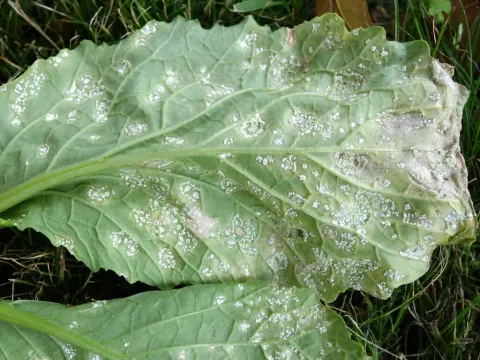
The first symptoms of downy mildew appear on cotyledons and true leaves of radishes as yellowish or light green spots with irregular shapes.
What the section contains
Radish downy mildew
On the underside of the leaf, within the affected areas, a specific grayish-violet or whitish downy growth forms, consisting of the pathogen's sporulation.
As the disease progresses, the spots gradually turn brown, covering a significant area of the leaf blade, leading to premature drying of the tissue.
Severely infected leaves curl, turn yellow, and die off, which significantly weakens the overall development and vigor of the entire plant.
When the root is affected during the growing season, dark depressed spots may form on it, reducing the quality and marketability of the produce.
The causative agent of the disease is the oomycete Peronospora brassicae, which belongs to the group of downy mildew fungi.
This pathogen infects almost all cruciferous crops, including radishes, turnips, daikon, as well as various weeds within the Brassicaceae family.
The infection persists in the soil on plant debris and can also be seed-borne, requiring strict attention to the quality of the seed material used.
The fungal mycelium develops inside the leaf tissues, emerging through the stomata only for the formation of reproductive organs, the sporangiophores.
The spread of spores occurs through wind, rain splashes, or irrigation, ensuring rapid infection of neighboring healthy plants in the field.
The development of downy mildew is favored by cool and humid weather conditions with air temperatures in the range of 15 to 20 degrees Celsius.
High relative humidity (above 80%) is a critical factor that promotes the active germination of the pathogen's zoospores on the leaf surface.
Frequent fog and heavy dew in the morning hours create ideal conditions for the colonization of leaves by the downy mildew pathogen.
Inadequate ventilation in greenhouses or excessive plant density in open fields contribute to stagnant air and increased local humidity levels.
Failure to follow crop rotation, particularly planting radishes on the same plot earlier than every 3–4 years, significantly increases disease risk.
The main damage consists of a significant reduction in the photosynthetic leaf area, which leads directly to a decrease in root weight and size.
The disease significantly impairs the commercial quality of the produce: roots become flaccid, less succulent, and lose their characteristic flavor.
With early infection of seedlings, complete crop failure is possible, requiring replanting and incurring additional agricultural production costs.
Downy mildew weakens the plant's immune system, opening the way for secondary bacterial and fungal infections that cause root rot.
Economic losses are composed of reduced yields, the need for expensive fungicide applications, and storage losses of damaged vegetables.
The foundation of prevention is maintaining spatial isolation between plantings of different cruciferous crops to break the disease cycle.
It is important to perform deep plowing and thorough incorporation of plant debris, which serve as the primary reservoir for the infection.
To combat the disease, contact and systemic fungicides approved for use on radish crops during the growing season are applied.
- Selection of resistant or tolerant cultivars and hybrids.
- Maintaining optimal plant spacing to promote airflow.
- Seed treatment prior to sowing to reduce initial inoculum.
- Effective control of cruciferous weeds in and around the field.
- Regular ventilation of greenhouses to keep foliage dry.
If the first symptoms of the disease are detected, overhead irrigation must be stopped immediately in favor of drip or root-zone watering.