
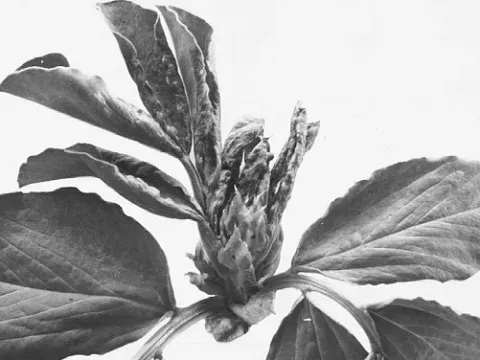
Broad bean stain virus
Fabavirus alphaviciae
The causative agent is the Broad bean stain virus, a member of the genus Fabavirus within the Secoviridae family. These viruses possess isometric particles and a bipartite single-stranded RNA genome.
What the section contains
Broad bean stain virus
The host range is primarily restricted to members of the Fabaceae family, with Vicia faba (faba bean) serving as the main economic host for this specific viral pathogen.
Transmission occurs through mechanical means, often facilitated by agricultural practices or leaf-to-leaf contact during windy conditions when leaf tissues are abraded.
Insect vectors, particularly weevils such as Apion species, play a critical role in the transmission of the virus within and between bean fields, serving as primary mobile reservoirs.
Seed transmission is a significant factor in the long-distance spread of the disease, making the use of infected seeds the most dangerous method of introducing the pathogen to clean fields.
Initial symptoms are usually characterized by chlorotic spots that appear on young leaves, often progressing into distinct mosaic patterns as the plant matures.
The name of the disease comes from the characteristic broad spots or ring patterns that develop on the leaf surface, which can cause severe discoloration of the foliage.
Stunting is a frequent observation; infected plants often appear shorter with shortened internodes, and the overall canopy development is markedly reduced.
Leaf distortion, including curling and narrowing, frequently occurs in more advanced stages, hindering the photosynthetic capacity of the plant.
When the plant enters the reproductive phase, symptoms may appear on the pods, showing patches or discolorations that reduce both the yield and the aesthetic quality of the harvest.
The primary economic impact of the virus is a significant reduction in grain yield, directly caused by fewer pods and smaller seed size per plant.
Viral infection disrupts the plant's metabolism, leading to premature senescence and reduced nutrient accumulation in the maturing seeds.
Infected crops are significantly weakened, becoming more prone to secondary infections by pathogenic fungi or bacteria that thrive on stressed tissues.
The quality of the grain is compromised, and seeds harvested from symptomatic plants carry a high risk of transmitting the virus to the subsequent cropping season.
Widespread outbreaks can disrupt the uniformity of the field, leading to management difficulties and higher losses during harvest time.
The most effective strategy for managing the disease is to ensure the use of certified, virus-free seeds sourced from regions with established disease-free status.
Integrated Pest Management (IPM) is essential to control populations of vector insects, particularly weevils, using timely insecticide applications during the early growth stages.
Crop rotation protocols should be strictly followed, ensuring a break of at least 3–4 years between legume crops to reduce the survival of the virus in the soil or local environment.
Maintaining a weed-free environment around the crop is crucial, as various leguminous weeds can act as secondary hosts and survival reservoirs for the pathogen.
- Use of resistant or tolerant cultivars where available in the market.
- Spatial isolation of seed production fields from commercial crops.
- Strict sanitation protocols for farm machinery and equipment.
- Roguing symptomatic plants early in the season to limit initial spread.