
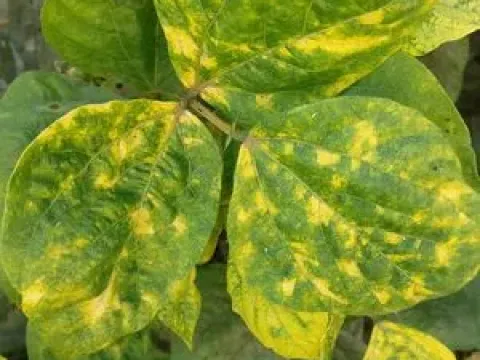
Mungbean yellow mosaic virus
Begomovirus vignaradiatae
The causal agent is the Mungbean yellow mosaic virus (MYMV), a member of the genus Begomovirus within the family Geminiviridae. It is a bipartite DNA virus that primarily affects various legume crops, with mung bean being the most susceptible host.
What the section contains
Mungbean yellow mosaic virus
The virus replicates within the host plant cells, causing severe physiological disruption. The viral particles are characterized by a unique geminate (twinned) structure typical of this viral family.
Transmission occurs exclusively through the whitefly Bemisia tabaci in a circulative, persistent manner. The insect acquires the virus while feeding on infected sap and retains the ability to transmit it for a long period.
Mechanical transmission via sap contact is generally not observed in field conditions. The virus does not typically transmit through seeds, though the severe stunting of plants often leads to poor seed development.
The high genetic diversity of this virus makes it a complex pathogen, as different strains may cause varying degrees of severity in different legume varieties.
The most diagnostic symptom is the development of a distinct yellow mosaic pattern on the leaves, featuring irregular patches of yellow or pale tissue interspersed with green areas.
Infected leaves exhibit significant malformation, often becoming wrinkled, curled, or puckered. The foliage density increases due to the shortening of internodes, resulting in a stunted, bushy appearance.
Flowering and pod formation are severely impaired. Infected plants may produce very few or no pods at all, and the pods that do form are often shriveled, malformed, and contain few seeds.
Early-stage infection leads to profound plant stunting, where the entire plant remains significantly smaller than healthy counterparts, reducing the overall biomass.
In the field, the disease usually appears in patches, corresponding to the movement and feeding patterns of the whitefly population across the cropping area.
The prevalence of the disease is highly correlated with the population density of the whitefly vector. Outbreaks are most common during periods of warm and dry weather.
Optimal temperatures for viral replication and whitefly activity range from 25°C to 30°C. These conditions accelerate the life cycle of the vector, leading to rapid exponential growth of the pest population.
Weed hosts, such as various leguminous weeds, serve as reservoirs for both the virus and the whitefly, facilitating the transition of the pathogen between cropping seasons.
Poor crop rotation practices and the presence of susceptible legume crops in adjacent fields significantly increase the infection pressure.
Delayed planting during the peak season of whitefly migration often results in a higher incidence of the disease as plants are exposed to the vector at their most vulnerable early developmental stages.
Mungbean yellow mosaic virus is considered a major limiting factor for legume production, causing yield losses that can range from 30% to nearly 100% in severe cases.
The virus severely inhibits photosynthetic capacity, which directly translates into reduced pod count, lower seed weight, and poor grain quality, rendering the harvest commercially unviable.
The economic impact is aggravated by the persistent need for chemical control measures against the vector, which increases production costs and may lead to environmental concerns.
Seed production fields are particularly affected, as infected plants produce low-vigor seeds, potentially leading to poor germination rates in subsequent seasons.
Global food security, particularly in tropical regions where mung bean is a primary protein source, is directly threatened by the continued spread and evolution of this virus.
The primary control strategy involves managing the whitefly population using a combination of systemic insecticides applied at the initial stages of crop growth.
The use of resistant or tolerant cultivars is the most sustainable and effective approach to managing the disease in endemic areas.
- Maintaining field hygiene by removing alternative weed hosts.
- Adopting early planting to avoid peak whitefly activity periods.
- Using yellow sticky traps to monitor and reduce adult whitefly populations.
- Implementing appropriate crop rotation to break the virus life cycle.
- Ensuring geographical isolation from heavily infested legume crops.
Integrated Pest Management (IPM) practices should be implemented to balance chemical control with biological approaches, including the protection of natural enemies of the whitefly.
Constant surveillance and early detection of initial infection foci are crucial to implementing containment measures before the virus spreads across the entire field.