
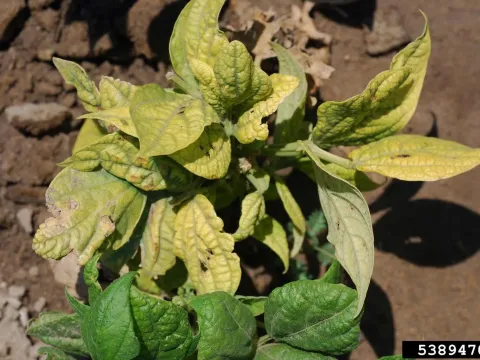
Bean curly top virus
Begomovirus mestae
The causal agent of this disease is the Bean curly top virus (BCTV), which belongs to the Curtovirus genus within the Geminiviridae family.
What the section contains
Bean curly top virus
It is a single-stranded DNA virus that exclusively relies on insect vectors, specifically the beet leafhopper (Circulifer tenellus), for transmission.
The virus does not spread through mechanical contact or seed transmission, but rather through the salivary glands of the feeding leafhopper.
A broad range of weed species serves as a persistent reservoir for the virus, allowing it to survive through seasons when host crops are absent.
Once inside the plant, the virus moves through the phloem, causing systemic physiological changes that impact plant development.
Typical symptoms include the curling and yellowing of the upper leaves, which often appear thickened and leathery.
Plants exhibit severe stunting, with shortened internodes that result in a compact, bushy, or rosette-like appearance.
Vein clearing is a common early indicator, which eventually progresses to necrosis of the vascular tissues in severe cases.
Flowering is significantly disrupted, leading to bud drop and failure of the plant to produce a viable pod yield.
Roots of infected beans become necrotic and underdeveloped, making the plants unable to cope with heat or soil moisture fluctuations.
BCTV development is strongly correlated with the migration patterns of the beet leafhopper, which thrives in arid and semi-arid environments.
Hot, dry weather conditions promote both the rapid increase of leafhopper populations and their movement from desert areas toward agricultural fields.
Environmental stress, such as drought, exacerbates the severity of the symptoms and accelerates the systemic spread of the virus within the host.
The proximity of uncultivated lands or pasture areas containing susceptible weed hosts provides a constant source of viral inoculum.
Peak infection periods typically occur when weather patterns align with the life cycle and flight activity of the primary insect vector.
The economic impact of the virus is significant, as it can cause complete crop failure if plants are infected at an early growth stage.
Infected plants serve as a source of the virus for further spread, creating a cumulative effect of damage across the entire field.
The reduction in photosynthetic capacity due to leaf damage leads to lower overall vigor and decreased biomass production.
Harvesting efforts are often wasted on fields with high incidence rates, as the fruits are either absent, deformed, or of very poor quality.
Management is complicated by the virus's ability to infect a wide range of secondary crops, making rotation a limited strategy.
The primary control strategy involves the aggressive management of leafhopper populations through the application of systemic insecticides.
Sanitation practices, including the removal of host weeds from field perimeters, are essential to minimize the local reservoir of the virus.
Planting resistant or tolerant cultivars is the most sustainable approach to mitigating the damage caused by BCTV outbreaks.
Adjusting planting dates can help avoid the synchronization of young, vulnerable bean stages with peak leafhopper migration events.
Implementing physical barriers or row covers can be effective for small-scale operations to exclude the vectors from reaching the plants.