
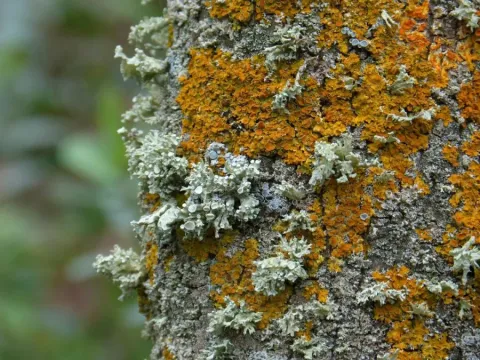
Xanthoria
Xanthoria
Xanthoria is a genus of foliose lichens characterized by its bright orange or yellow pigmentation. It is an epiphytic organism, not a true plant pathogen, but it often serves as an indicator of an orchard's health status.
What the section contains
Xanthoria
The lichen consists of a symbiotic relationship between a fungus and algae. While it does not derive nutrients directly from the host tree's sap, it relies on the tree surface for anchorage and physical stability.
Biologically, Xanthoria is highly resilient, surviving through specialized reproductive strategies including wind-dispersed spores and vegetative fragments. It thrives in environments where competition for space is low.
In agronomy, the presence of Xanthoria is interpreted as a sign of slow bark growth. It typically colonizes trees that have reached a stage of physiological maturity or decline, where the bark remains undisturbed for long periods.
Understanding the biology of this organism is essential for orchard management, as it helps agronomists distinguish between harmless epiphytes and signs of significant tree senescence.
The primary sign of Xanthoria presence is the appearance of vivid orange or yellow patches on the trunk and primary branches. Over time, these patches form rosette-like structures that may coalesce into large, dense mats.
Unlike parasitic fungi that cause lesions or wood rot, Xanthoria simply adheres to the outer layer of bark. However, it can visually obscure the natural color and texture of healthy bark tissue.
Close inspection often reveals that beneath the dense lichen crust, the bark may be damp or harbor organic debris, providing a moist habitat for various micro-organisms.
Identification is straightforward due to the distinct orange hue caused by parietin, a pigment unique to this genus. It is easily distinguished from gray or white crustose lichens common in orchards.
In neglected trees, Xanthoria can colonize virtually the entire surface of the bark, significantly altering the visual appearance of the tree and hindering proper inspection of the bark surface.
Xanthoria favors well-lit and well-ventilated areas, which is why it often dominates the south-facing sides of trunks where photosynthesis of the lichen's algal component is maximized.
High humidity and poor air circulation in the crown are critical factors that promote its establishment. Neglected orchards with thick, unpruned canopies provide the stable moisture levels required for colonization.
Older trees are significantly more susceptible than young ones. The slow growth of bark in mature trees provides the necessary permanent substrate for the lichen to develop into extensive colonies.
Local climatic conditions, specifically prolonged periods of high humidity and rainfall, facilitate the rapid expansion of Xanthoria spores throughout an orchard.
The lack of standard maintenance, such as bark cleaning or thinning, allows the lichen to accumulate over several years, leading to dense populations that are harder to eradicate later.
The main danger posed by Xanthoria is its role as a refuge for orchard pests. Scales, mites, and various insect eggs often find shelter within the complex, folded structures of the lichen thallus.
A dense layer of Xanthoria can impede normal gas exchange through the lenticels of the bark. This reduction in air exchange can lead to a slight decline in tree vigor and overall physiological health.
Xanthoria acts as a physical barrier that prevents contact between chemical treatments and the bark surface. During spraying, fungicides and insecticides run off the lichen without reaching the pests beneath it.
Long-term colonization contributes to premature bark aging. This can lead to the decline of productive branches, ultimately necessitating structural pruning to maintain the orchard's yield.
By providing a hidden environment for pests and pathogens, Xanthoria indirectly increases the disease pressure in the orchard, making integrated pest management more difficult.
Mechanical removal is the most effective method for controlling Xanthoria. Using stiff brushes or wooden scrapers, growers should carefully strip the lichen from the bark during the dormant season.
Following mechanical removal, it is recommended to apply a 3-5% iron sulfate solution. This treatment effectively cleans the bark, eliminates residual lichen spores, and discourages future colonization.
Annual thinning and pruning are crucial for long-term prevention. Improving airflow and light penetration throughout the crown creates an environment that is unfavorable for lichen development.
Whitewashing trunks with lime-based mixtures containing copper salts serves as a protective barrier, preventing the re-establishment of Xanthoria and promoting bark health.
Good agricultural practices, such as proper fertilization and irrigation, stimulate tree growth. Vigorous trees produce new bark faster, which naturally prevents the permanent settling of epiphytic lichens.