
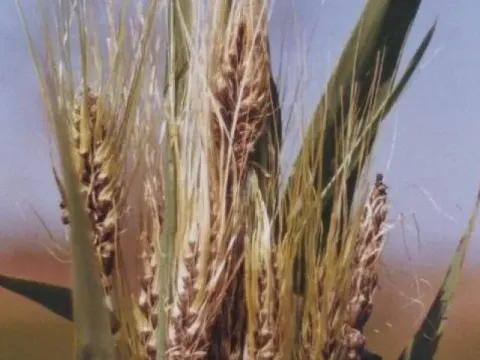
Covered smut of barley
Ustilago hordei
The disease is caused by the basidiomycete fungus Ustilago hordei. It is a highly specialized pathogen that primarily infects barley, though it can occasionally affect oats and certain wild grass species.
What the section contains
Covered smut of barley
The infection is transmitted mainly through spores adhering to the surface of the grain during the threshing process. Soil-borne transmission is also possible if viable teliospores from a previous infected harvest remain in the field.
The fungal life cycle begins when the grain germinates. Spores germinate to form basidia, which then infect the seedling before the first leaf stage. Once inside, the fungal mycelium develops systemically within the plant tissue.
Inside the host plant, the fungus grows slowly toward the growing point. It remains latent throughout the plant's vegetative development, showing no visible external signs of infection until the heading stage begins.
As the plant heads, the mycelium invades the developing kernels and ovaries. It proliferates rapidly, replacing plant tissues with a mass of black teliospores encased in a thin membrane that remains intact for a long time.
The first symptoms of covered smut become visible only when the plant reaches the heading stage. Affected heads often appear deformed and may fail to fully emerge from the sheath of the top leaf.
Instead of healthy grains, the head contains smut sori (or balls) filled with a black powdery mass of spores. Unlike loose smut, the membrane of these sori is tough and stays intact until the harvesting and threshing process.
The kernels are entirely replaced by fungal mycelium, turning them into dense clumps of spores. Externally, an infected head may appear shorter and more compact than healthy heads in the same field.
The color of the infected area is dark gray or brownish due to the dark pigmentation of the spores. Inside the smut ball, some plant tissue remnants may be present, but most reproductive organs are replaced by the pathogen.
At maturity, the smut sori often retain their shape, which leads to the contamination of thousands of healthy grains with spores during the mechanical harvesting process.
Optimal conditions for seedling infection occur when seeds are sown at a shallow depth with soil temperatures ranging between 15 and 20 degrees Celsius. Cool and moist weather at the time of sowing promotes rapid spore germination.
High soil moisture during seed germination is a critical factor, as this is the narrow window of time when the plant is most susceptible and the pathogen actively penetrates the seedling tissues.
Soil temperature plays a decisive role. Any delay in seed germination, caused by temperatures outside the optimal range, increases the duration of contact between the seedling and the spores present in the soil.
The agricultural background significantly impacts infection spread. Using infected seed material without prior chemical treatment is the primary source of annual disease accumulation in the fields.
Spores remaining in the soil from previous seasons create an additional reservoir of infection. However, the use of resistant barley varieties can significantly slow down the development of the disease even if spores are present.
The economic impact of the disease stems from direct yield loss, as infected heads produce no viable grain. Instead of the expected agricultural product, the farmer harvests a mass of fungal spores.
In addition to volume loss, grain quality is severely degraded. Spores present in the harvested grain mass lower its market value, imparting a characteristic smell and dark discoloration to the product.
Infected plants often show stunted growth and development. If the infection occurs in the early stages, the plants may become more susceptible to other pathogens, further reducing the overall stand density.
Contamination of seed lots requires additional investment in cleaning and fungicide treatment for the following season. If ignored, the rate of field infection can grow exponentially over time.
Massive outbreaks of covered smut make the produce unsuitable for food purposes and require strict monitoring during storage to prevent the further spread of spores through storage facilities.
The primary method of protection is mandatory seed treatment with systemic fungicides before sowing. This effectively eliminates external infection and protects seedlings during the critical early growth stages.
It is important to adhere to recommended sowing dates, avoiding windows where soil temperatures are most conducive to spore activity. Proper agricultural timing allows the plant to pass through the susceptible phase quickly.
Cultivating locally adapted, smut-resistant barley varieties is strongly recommended. Breeding programs play a vital role in minimizing the risk of large-scale disease outbreaks in commercial production.
Following proper crop rotation practices helps reduce the infectious load in the soil. Regular cleaning of seed lots to remove organic debris and damaged grains also significantly reduces the spore count.
- Use of seed dressings based on tebuconazole, difenoconazole, or other modern systemic fungicides.
- Timely culling of infected fields intended for future seed production.
- Thorough cleaning of harvesting machinery after operation in infected fields.