
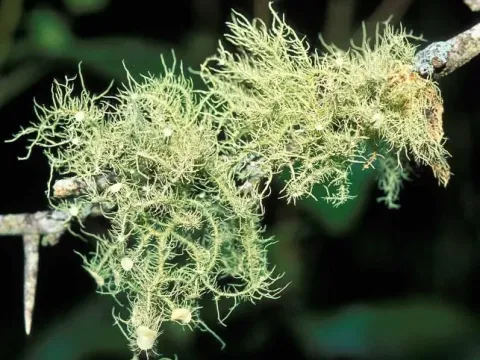
Usnea
Usnea
Usnea is not a plant pathogen or a disease-causing agent, but rather a genus of lichen, which is a symbiotic organism composed of fungi and algae.
What the section contains
Usnea
In botanical terms, Usnea is classified as an epiphyte; it utilizes the bark of trees strictly as a substrate for physical support rather than as a nutrient source.
The fungus provides the structure and anchorage, while the algae produce nutrients through photosynthesis, using moisture and gases from the surrounding atmosphere.
While Usnea is not a parasite, its presence often serves as a bioindicator that the host tree is aging, stressed, or lacks proper light and airflow.
It is commonly found in environments with clean air, as most Usnea species are highly sensitive to sulfur dioxide and other air pollutants.
The most recognizable sign of Usnea is the presence of hanging, tufted, or thread-like structures that resemble a shaggy beard growing from the branches.
The color of the lichen ranges from grey-green to pale yellow, and it feels soft and pliable when moist, becoming brittle when dry.
The lichen establishes a holdfast on the bark, extending into dense mats that can sometimes obscure the tree's natural bark texture.
As the lichen matures, it forms disc-shaped fruiting bodies at the ends of its branches, which are used for reproduction via spores.
- Long, hair-like strands hanging from branches.
- Shaggy, bushy appearance on tree limbs.
- Pale green to greyish coloration throughout the growth.
The development of Usnea is strictly dependent on high ambient humidity and frequent exposure to moisture, such as fog or mist.
These lichens thrive in cool to moderate climates where they can maintain steady hydration throughout the growing season.
Low light levels, combined with poor crown ventilation in unpruned trees, provide an ideal microenvironment for Usnea to colonize.
Older trees with rougher, weathered bark provide more surface area and better attachment sites compared to the smooth bark of young saplings.
Stability in the environment is key; as long as the host branch remains stationary and the air remains clean, the colony can grow for many years.
The primary concern regarding Usnea is that dense colonies can create an environment favorable for pests, such as scales, mites, and various insect larvae.
Excessive moisture retention by the lichen mats can promote the growth of unwanted mosses or provide conditions for certain fungal spores to germinate.
If the coverage is sufficiently thick, it may physically restrict the gas exchange of the bark, causing minor stress to the tree's surface layers.
The presence of significant lichen populations acts as a warning sign that the tree is in decline or that the canopy is too congested for optimal health.
While the lichen itself is harmless, its accumulation often correlates with a lack of vigor, which may lead to reduced yields over time.
The most effective strategy for managing lichen growth is to maintain tree vigor through proper pruning, which improves airflow and light penetration.
Mechanical removal using soft brushes or plastic scrapers can clear large colonies; this should be done during the dormant season to avoid damaging the tree.
Applying a horticultural dormant oil or a copper-based fungicide can help disinfect the bark and discourage the regrowth of lichen spores.
Good orchard management, including consistent fertilization and pest control, will help the tree remain resilient and less attractive to epiphytic colonization.
For very old or heavily burdened trees, selective branch removal might be necessary to rejuvenate the canopy and reduce the surface area available to the lichen.