
Usnea barbata
Usnea barbata
Description
Symptoms
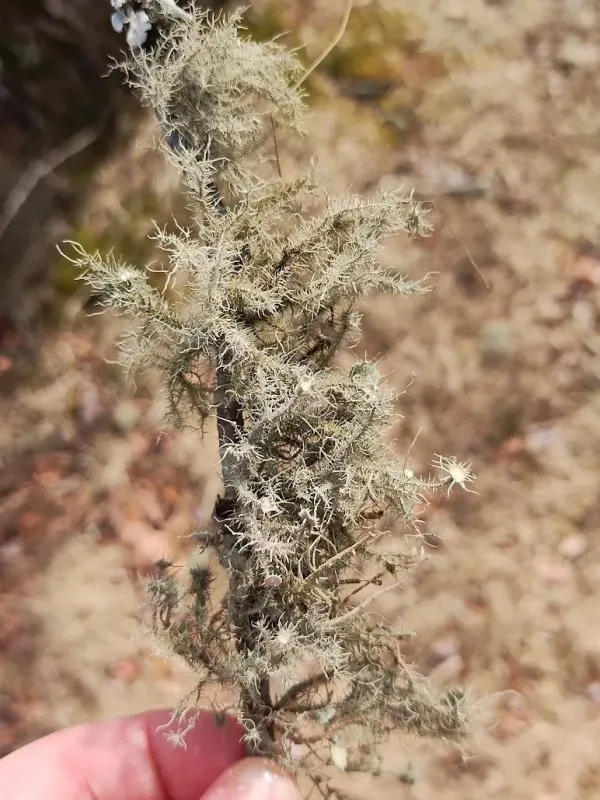
Usnea barbata, commonly known as beard lichen, appears as a bushy thallus hanging from branches and trunks, forming long, thread-like structures.
The primary visual sign is the presence of grayish-green or yellowish-green hair-like growth that covers the bark of the host tree.
The lichen has a branched structure that becomes soft and flexible when wet, and brittle when dry, often giving the tree a disheveled appearance.
Large colonies can be seen draped over the canopy, which may obscure the natural bark surface and affect the aesthetic appearance of the plant.
Close inspection reveals the attachment points of the lichen, which can sometimes create localized damp patches on the tree bark surface.
Pathogen
The organism is Usnea barbata, a symbiotic lichen formed by an association between a fungus and photosynthetic algae or cyanobacteria.
It is not a parasitic pathogen; it uses the tree only as a substrate for physical anchorage, deriving its nutrients solely from the atmosphere and rainwater.
The lichen does not penetrate the cambium or vascular tissues of the tree, meaning it is biologically classified as an epiphyte rather than a disease agent.
Propagation is mainly vegetative, through the dispersal of thallus fragments by wind, birds, or heavy rain, allowing it to colonize suitable bark surfaces.
Its presence is considered a sign of high air quality, as species of the genus Usnea are notoriously sensitive to atmospheric pollutants.
Conditions for development
The growth of Usnea barbata is strictly dependent on high ambient humidity and moderate temperatures, which are necessary for its metabolic activity.
It thrives in shaded, sheltered environments where canopy density prevents rapid evaporation of moisture after rainfall or fog.
Mature, slow-growing trees with rough bark textures provide the ideal structure for the lichen to gain a foothold and expand its colony.
Poor orchard management, characterized by lack of pruning and excessive density, contributes significantly to the proliferation of the lichen.
The absence of industrial pollution in the vicinity allows the lichen to flourish, as it cannot survive in environments with high sulfur dioxide levels.
Why it matters
While not directly feeding on the tree, thick mats of Usnea can impede gas exchange by covering the bark lenticels, which are essential for aeration.
The moisture retained by the lichen creates a micro-environment that can harbor wood-boring insects, scale insects, and mites during the dormant season.
Prolonged dampness at the bark interface may encourage secondary fungal infections, leading to local necrosis or soft rot of the cortical tissues.
Excessive accumulation of the lichen adds weight to smaller twigs, potentially causing them to break during storms or under the pressure of snow.
Overall, a massive presence of the lichen indicates that a tree is likely in a state of physiological stress or has a stagnant, low-vigor canopy.
Protection
Mechanical removal is the most effective approach; using soft-bristled brushes to scrape off the lichen during dormant periods is recommended.
Following manual cleaning, the bark should be treated with a copper-based fungicide to sanitize the area and prevent spores from re-establishing.
Regular crown thinning and pruning are essential to increase sunlight exposure and airflow, making the habitat less suitable for the lichen.
Maintaining tree vigor through proper fertilization and irrigation helps the bark remain healthy and more resistant to epiphytic colonization.
- Applying a lime wash to trunks to create an unfavorable surface for lichen attachment.
- Conducting annual sanitary inspections to remove heavily infested branches.
- Monitoring the orchard for secondary pests that often hide under lichen layers.
Discussion
No discussions yet — be the first.