
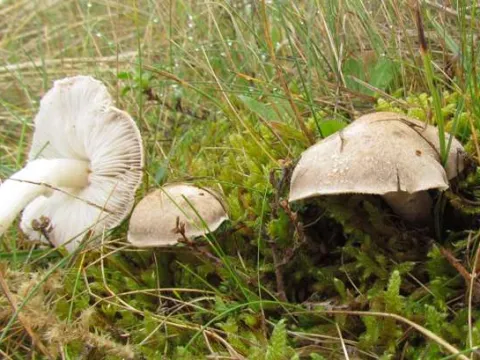
Girdled knight
Tricholoma cingulatum
The Girdled knight, scientifically known as Tricholoma cingulatum, is a basidiomycete fungus in the Tricholomataceae family.
What the section contains
Girdled knight
It is critical to note that this organism is not a plant disease, pathogen, or agricultural pest.
It acts as a mycorrhizal fungus, establishing a mutually beneficial symbiotic relationship with specific tree species.
Its biological cycle is focused on soil nutrient cycling and association with willow roots rather than parasitism.
Therefore, Tricholoma cingulatum should not be classified as a harmful agent in agricultural or horticultural studies.
The cap of the fungus is typically greyish or dirty white, often featuring a small, characteristic umbo in the center.
The most distinctive morphological sign is the presence of a persistent, scaly ring on the stem, from which the name is derived.
The gills are white to light grey, crowded, and often show darker spotting as the fruit body ages.
A white spore print is a key diagnostic feature for confirming the species identity during examination.
Fruit bodies emerge from the forest soil mainly during autumn, following periods of consistent moisture.
Development of the fungus requires a suitable habitat, specifically areas where willow trees provide a mycorrhizal host.
It favors sandy or well-drained soils, often found in riverbanks, floodplains, or wet woodland edges.
Optimal growth occurs during cool, moist autumn weather, which triggers the production of macroscopic fruit bodies.
Spore dispersal occurs naturally through wind and water, ensuring the spread of the mycelium within the vicinity of the host.
The health of the soil ecosystem is vital for the long-term persistence of the fungal network.
In the context of agriculture and crop management, the Girdled knight poses zero risk to crops or plants.
It does not cause rots, blights, wilting, or any necrosis of plant tissues associated with pathogenic fungi.
The fungus provides ecological benefits by improving nutrient uptake for associated tree species through mycorrhiza.
Economic damage is non-existent, and it is not a subject of plant pathology or crop protection programs.
The only potential issue is the misidentification of fungi by foragers, which is unrelated to plant health.
Since Tricholoma cingulatum is not a plant disease, there are no control measures or prevention strategies required.
Management efforts in agriculture should be focused on actual pests and pathogens, rather than benign mycorrhizal species.
No chemical, biological, or mechanical intervention is needed for the removal of this fungus from a landscape.
It is regarded as a natural component of the local mycoflora and should be left undisturbed as it supports soil biodiversity.
No documentation or monitoring of this species is necessary for commercial crop protection guidelines.