
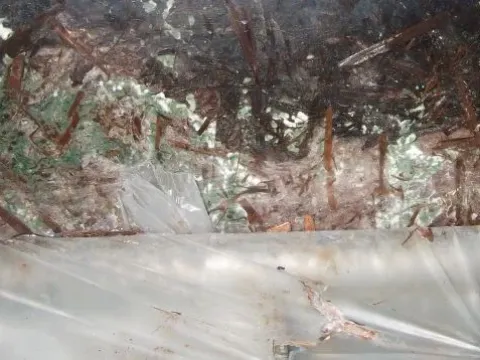
Green mould of mushroom
Trichoderma aggressivum
The causative agent of the disease is the soil-borne fungus Trichoderma aggressivum (formerly Trichoderma harzianum Th2 strain). It is a highly aggressive microfungus specifically adapted to colonize mushroom compost and mycelium.
What the section contains
Green mould of mushroom
The disease is classified as a mycoparasitic infection, where the mould acts as a fierce competitor for nutrients. The pathogen colonizes organic matter rapidly, effectively displacing the cultivated mushroom mycelium from the substrate.
The biology of the fungus involves the production of massive quantities of conidia — spores that are easily dispersed by air currents, agricultural tools, and personnel. Unlike many other saprophytic moulds, this species shows extreme virulence in industrial mushroom facilities.
The mycelium of Trichoderma grows significantly faster than that of Agaricus bisporus, allowing it to occupy the niche before mushrooms can form fruiting bodies. It produces various secondary metabolites that are toxic to mushroom spawn.
In nature, Trichoderma species are common saprobes, but in the sterile-like environment of a mushroom farm, they turn into dangerous parasites capable of destroying a crop within several weeks.
Early symptoms appear as dense, white, cobweb-like mycelial mats on the casing surface, which quickly turn bright green or olive-colored due to the massive development of spores.
Upon closer inspection of the compost, one may notice dark, decaying patches accompanied by a specific sweet, musty, or mouldy odor, which differs significantly from the earthy smell of healthy mushroom compost.
The mushroom mycelium in affected zones becomes weak, stops growing, and eventually degrades. Fruiting bodies that manage to form near these patches are often deformed, discolored, or covered in brown spots.
- White mycelial spots turning into green sporulating patches.
- Rapid suppression of healthy mushroom mycelium growth.
- A distinct, unpleasant musty odor within the growing room.
- Widespread spore dispersal across the casing soil surface.
It is essential to distinguish Trichoderma aggressivum from other common moulds due to its rapid growth rate and aggressive colonization, as it can often infect the deeper layers of the substrate before becoming visible on the surface.
Favorable conditions for Trichoderma development include high humidity, both in the substrate and the air, and a temperature range of 20–25°C, which precisely matches the requirements for mushroom growth.
Infection is often introduced via improperly pasteurized compost where fungal spores have survived. Poor fermentation technology and inadequate sanitation of equipment are the primary risk factors for outbreaks.
Disruption of the ventilation regime and high concentrations of carbon dioxide in the growing rooms facilitate the growth of spores and their transmission across the shelves of the facility.
Damage to the casing layer, caused by excessive or uneven watering and mechanical work, provides entry points for the pathogen, allowing the fungus to establish itself deep within the substrate.
Lack of hygiene protocols regarding personnel, such as contaminated clothing or unsterilized tools, allows the fungus to spread instantly to neighboring blocks, creating new infection epicenters throughout the farm.
The primary harm is the complete loss of yield in the affected areas. The mould physically blocks the mushroom mycelium's access to nutrients, leading to the total destruction of the spawn.
The toxins released by the fungus poison the substrate, rendering it unusable for further production. Even if the infection is successfully localized, overall crop yields drop due to the degradation of the surrounding mycelium quality.
Economic losses include the cost of disposing of infected compost, the expense of extensive room disinfection, and the downtime of production capacity, which significantly impacts farm profitability.
Due to the high volatility of the spores, the fungus often becomes a permanent resident of the farm, lingering in ventilation systems and increasing the risk of recurring outbreaks in future cultivation cycles.
Beyond direct yield loss, the presence of mould spores in the air can reduce the quality of harvested mushrooms, leading to faster post-harvest decay and reduced shelf life during transport.
The main method of control is strictly maintaining proper temperatures during compost pasteurization, ensuring that all Trichoderma spores are destroyed before the spawn is inoculated.
It is vital to maintain impeccable hygiene in growing rooms, regularly disinfecting all surfaces, shelving, and watering systems using approved fungicides and industrial-grade disinfectants.
When spots are discovered, they should be isolated immediately: cover the area with a damp cloth or treat it with salt or lime, then carefully remove the infected material from the facility for disposal.
Monitoring the pH level of the casing material is recommended, as acidic environments favor mould growth; proper preparation with chalk is essential for keeping the substrate healthy.
Implementing a rigorous monitoring system for early detection is crucial, allowing for swift intervention before spores can be carried by ventilation fans to other areas of the farm.