
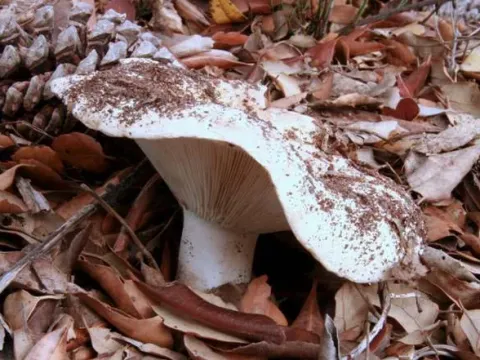
Green-fringe russula
Russula chloroides
The green-fringe russula (Russula chloroides) is a sturdy mushroom belonging to the Russulaceae family. It is known for its firm, dense flesh, making it much more resilient than other brittle-gilled species.
What the section contains
Green-fringe russula
The cap typically measures between 5 and 15 cm in diameter. Initially convex, it flattens and becomes funnel-shaped as the specimen matures, showing a matte, often cracked surface in whitish or dull green shades.
The gills are narrow and decurrent (running down the stem). A distinct feature is a subtle greenish tint at the point where the gills attach to the stem, which helps distinguish it from similar-looking russulas.
The stipe is short, thick, and cylindrical. It is usually white, although it may develop brownish spots near the base in older mushrooms, providing a solid support for the cap.
The spore print is white. The taste is generally mild or slightly peppery, and the mushroom lacks a significant or distinct aroma, which is characteristic for the species.
It is crucial to note that the green-fringe russula is not a plant pathogen or a disease agent. It is a beneficial mycorrhizal fungus that lives in symbiosis with forest trees.
Unlike parasitic fungi that cause diseases in agricultural crops, Russula chloroides supports the health of its host trees by facilitating nutrient uptake from the soil.
This species is purely a wild forest macrofungus and has no relevance to plant pathology, crop management, or agricultural disease control protocols.
The misunderstanding of its role in an agro-ecological context is unfounded, as it neither infects plant tissues nor competes for space in agricultural fields.
Scientific literature confirms its ecological classification as a saprotrophic and mycorrhizal organism, which is essential for healthy forest soil maintenance.
The green-fringe russula favors coniferous and deciduous woodland habitats. It is most commonly found in pine forests or areas with a mix of birch and oak, where it forms essential symbiotic relationships.
The peak fruiting period occurs from mid-summer through autumn. High humidity in the forest floor and moderate temperatures are essential for the mycelium to produce fruit bodies.
This species thrives in well-drained sandy or loamy soils. It is frequently seen near forest paths or on edges where the soil structure is stable and moisture is conserved.
Symbiosis with a live tree host is a biological requirement for this fungus. It cannot survive or propagate in environments where its host tree species is absent.
Sporulation is driven by atmospheric factors, allowing the spores to disperse via wind and settle into favorable, moist niches within the forest substrate to continue the life cycle.