
Tephromela atra
Tephromela atra
Tephromela atra (black-disk lichen) is a common crustose lichen often found growing on the bark of deciduous and coniferous trees. It is not a parasitic pathogen that infects living tissue, but rather an epiphyte that uses the bark as a surface for attachment.
What the section contains
Tephromela atra
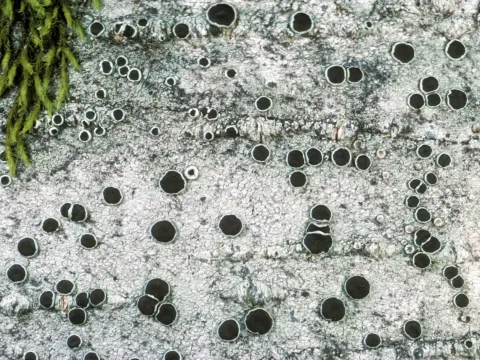
The organism consists of a symbiotic relationship between a fungus and an alga. The thallus, or the body of the lichen, appears as a thin, cracked, greyish-white crust dotted with characteristic black fruit bodies known as apothecia, which give it its distinctive appearance.
While Tephromela atra does not derive nutrients from the tree itself, its presence is significant in an agricultural context. It typically colonizes the bark of older, slower-growing, or stressed trees.
It is widespread in many environments, from temperate forests to managed gardens and orchards. It is widely recognized by botanists for its resilience and ability to thrive on relatively stable surfaces over long periods.
From an agronomic perspective, it acts as an indicator species. Its abundant growth often suggests that a tree has had stagnant or humid conditions on its surface for a prolonged period, warranting closer inspection by the gardener.
The growth of Tephromela atra is primarily controlled by humidity and surface moisture. The lichen requires consistent moisture on the bark to hydrate and maintain its metabolic processes, making humid and poorly ventilated orchards prone to colonization.
Orchards with high planting densities or neglected canopy structures are highly susceptible. Lack of sunlight and air circulation creates a microclimate that allows the lichen to establish itself firmly on the bark.
The surface texture of the tree plays a crucial role. Older trees with deeply furrowed and rough bark provide more surface area and shelter for moisture retention, which is why this lichen is rarely seen on young, smooth-barked saplings.
Exposure to light also influences its distribution. While it can adapt to various light conditions, it often prefers branches where there is a balance between shade (to prevent desiccation) and light (for algal photosynthesis).
Atmospheric conditions, particularly the presence of moisture-laden air, are critical. In regions with high rainfall or heavy dew, the colonization rate of Tephromela atra is significantly higher than in arid regions.
The primary concern regarding Tephromela atra is not direct toxicity, but the creation of a micro-habitat for harmful pests. The dense, crusty structure of the lichen provides excellent overwintering sites for mites, scale insects, and other orchard pests.
By trapping moisture against the bark, the lichen can inadvertently promote the softening of the outermost layers of the bark. This condition can lead to secondary fungal or bacterial infections that might otherwise not penetrate healthy, dry bark.
In cases of extreme coverage, the lichen can interfere with the bark's ability to facilitate gas exchange. While the lichen itself is not heavy, a thick, persistent crust can potentially affect the tree's health by hindering normal respiration through the lenticels.
The presence of significant lichen patches can also mask early signs of tree diseases, such as bark cankers or borers, making it difficult for an agronomist to detect and treat these issues early.
Finally, a heavily colonized tree often signals that the tree’s growth rate has slowed down, which in a commercial orchard can indicate declining vigor and potential yield reduction.
Mechanical removal is the most direct and effective method for managing Tephromela atra in orchards. During the dormant season, scrubbing the bark with a stiff brush or a specialized tool can effectively remove the lichen without harming the living inner bark.
Cultural management through proper pruning is essential. By opening the canopy to light and air, the gardener reduces the localized humidity that the lichen requires, which naturally discourages its re-establishment.
Whitewashing the trunks and main scaffold branches with a mixture of lime and a copper-based fungicide serves as both a disinfectant and a barrier, making the bark surface unsuitable for new lichen spores to germinate.
Fungicidal sprays used for general disease control often have the secondary benefit of suppressing lichen growth. Strategic applications help keep the bark clean and facilitate better visual monitoring of the tree’s health.
- Mechanical scraping of bark during the dormant season
- Regular pruning to improve air circulation and light
- Application of lime-based washes with copper sulfate
- Maintaining tree vigor through proper fertilization
- Routine visual inspections to detect pests hidden under crusts