
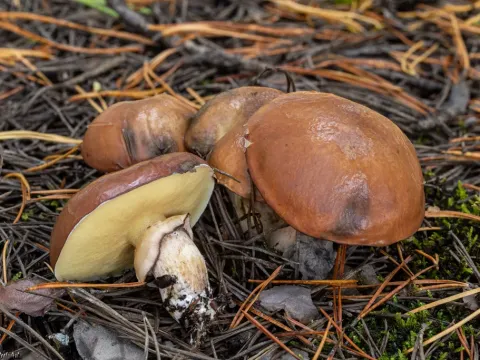
Slippery Jack
Suillus luteus
Slippery Jack (scientific name Suillus luteus) is often mistakenly categorized as a plant disease, although it is actually a beneficial fungus that forms a symbiotic relationship with pine trees.
What the section contains
Slippery Jack
The fungus functions as an ectomycorrhizal partner, connecting its mycelium with the root systems of various species of Pinus.
This symbiotic association involves the exchange of nutrients where the fungus provides the tree with water and mineral salts, while the tree provides carbohydrates.
As a mycorrhizal fungus, it lacks the parasitic enzymes and structures required to cause disease in healthy trees or other plant species.
Therefore, it is scientifically incorrect to label this species as a plant pathogen or a cause of agricultural decay.
The development of Suillus luteus fruit bodies is highly dependent on specific environmental conditions found in coniferous forests.
The mushroom thrives in acidic soils, typically sandy or sandy-loam, which are ideal for the development of its mycelial network.
Warm and humid weather conditions, especially after rain, significantly stimulate the emergence of mushrooms above the ground.
The presence of young pine plantations provides the best environment for the establishment and proliferation of the fungus in the soil.
Temperature fluctuations and moisture levels in the forest floor are the primary drivers for the seasonal growth cycles of this species.
Slippery Jack does not cause harm to agricultural crops or forestry plantations; it is essentially neutral or beneficial for forest health.
The fungus does not produce toxins that lead to tissue degradation or the inhibition of tree growth, making it a harmless forest inhabitant.
In forest management, the presence of such fungi is often a sign of a robust and healthy soil microbiome supporting young tree growth.
No agricultural economic damage can be attributed to the normal life cycle of Suillus luteus in pine-dominated ecosystems.
It poses no threat to food security or ornamental landscaping, distinguishing it sharply from real pathogenic fungi like Armillaria.
Since Suillus luteus is a beneficial symbiotic fungus, there is no justification for control measures or eradication programs.
Management practices should focus on maintaining the overall vitality of coniferous trees rather than targeting benign fungal species.
Excessive use of fungicides in forest soils can inadvertently harm the beneficial mycorrhizal relationships necessary for tree stability.
If fungal growth appears excessive, it serves as a natural indicator of high organic activity in the forest soil rather than a symptom of infection.
Producers and foresters should encourage the presence of healthy mycorrhiza as part of sustainable forest and nursery management strategies.