
Spathularia flavida
Spathularia flavida
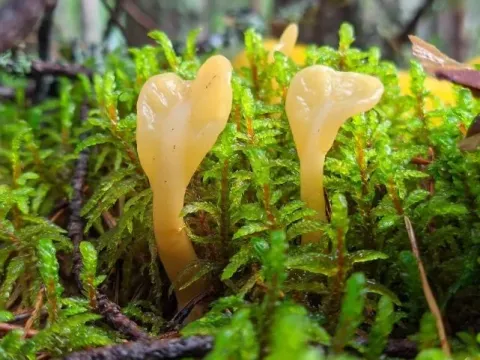
Spathularia flavida, commonly known as the yellow fairy fan, is a unique ascomycete fungus characterized by its distinct spatulate or fan-like shape.
What the section contains
Spathularia flavida
The fruit body consists of a flattened, wavy-edged head that blends smoothly into a pale, slightly wrinkled stem, giving it a very elegant appearance.
These mushrooms typically grow in groups or clusters, often forming lines along needles or mossy soil in coniferous or mixed forests.
They are generally 2 to 6 centimeters tall and possess a firm, leathery texture that helps them persist for extended periods during the fruiting season.
Unlike parasitic plant diseases, this fungus is a saprotroph, meaning it relies on dead organic matter rather than living plant tissues.
Spathularia flavida belongs to the order Helotiales and is categorized as a decomposer, playing a crucial role in nutrient cycling.
It is not a plant pathogen; it does not infect or damage agricultural crops, trees, or horticultural plants, as it lacks the mechanisms to attack living hosts.
The fungus propagates by releasing ascospores from its upper surface, which travel through the air to find suitable substrates in moist forest areas.
Its biological cycle is strictly limited to the breakdown of decaying plant matter, specifically coniferous needles and leaf litter.
Consequently, it poses no threat to farming operations and is not considered a target for plant protection products or phytosanitary measures.
The yellow fairy fan thrives in moist, shaded environments, particularly in coniferous or mixed forests with deep leaf litter.
High humidity and moderate temperatures are the most critical factors for the development of its fruit bodies, typically occurring in late summer and autumn.
The presence of well-established needles and acidic soil conditions provides the ideal substrate for its mycelium to expand.
Direct exposure to sunlight or prolonged drought can inhibit the growth of the fungus and prevent the formation of visible fruiting bodies.
Optimal conditions often coincide with high rainfall, which triggers a flush of activity in the fungal network hidden within the litter layer.
This fungus is entirely harmless to agricultural and garden crops, as it does not possess any pathogenic properties towards live flora.
It performs an essential ecological service as a recycler of nutrients, assisting in the decomposition of difficult-to-break-down woody debris and needles.
There is no record of Spathularia flavida causing disease in economically significant plants, trees, or vegetables.
The fungus does not produce toxins that would impact the soil health or the productivity of nearby agricultural vegetation.
Therefore, it should not be considered a threat to farm profitability, nor does it require monitoring or intervention.
No control or prevention measures are required for Spathularia flavida, as it is a beneficial part of the forest ecosystem.
If you encounter these mushrooms near your garden or orchard, there is no need for alarm or the use of fungicides.
The application of chemicals would be detrimental to soil biodiversity and is completely unnecessary for this harmless fungus.
Mechanical removal is only suggested if the presence of the mushroom is aesthetically undesirable in managed garden settings.
Overall, agronomists should focus their efforts on actual plant pests and diseases, ignoring this harmless woodland inhabitant.