
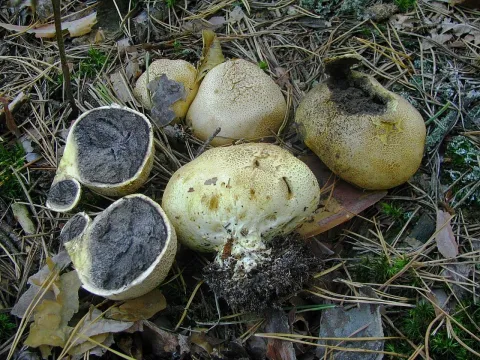
Pigskin poison puffball
Scleroderma bovista
The Pigskin poison puffball (scientific name: Scleroderma bovista) is a fungus belonging to the Sclerodermataceae family. Unlike edible puffballs, this species is known for its tough, leathery exterior and is not considered a true pathogen of plants, but rather a soil inhabitant.
What the section contains
Pigskin poison puffball
The fungus develops as a rounded, tuber-like fruit body that sits on or slightly below the soil surface. Internally, it transitions from a white fleshy interior to a mass of dark, powdery spores as it matures.
Biologically, it is a saprotroph that can form mycorrhizal associations with the roots of trees and shrubs. While often found in forested areas, it can colonize garden soil if conditions are rich in organic matter and moisture.
Reproduction is primarily through spores, which are released when the outer skin ruptures. These spores are extremely resilient and can survive in the soil for extended periods, waiting for suitable environmental triggers.
It is often mistaken for a plant disease because its mycelial network can occupy space in the root zone of garden plants, leading to an imbalance in the local soil microflora and potential competition for nutrients.
The most distinctive signs are the presence of firm, ball-shaped fruit bodies with a rough, cracked, or leathery texture. They range in color from yellowish-white to brown as they age.
They typically appear in clusters or rings in well-mulched garden beds, under trees, or on lawns with poor drainage. Their emergence is often sudden, especially after warm, rainy weather.
A tell-tale sign of maturity is the dark, soot-like spore cloud that is released when the fungus is crushed or physically disturbed. This powder can spread across a garden, covering adjacent plants and surfaces.
The soil around the fungal growth may appear slightly altered, with a denser texture due to the underlying white mycelial threads (rhizomorphs) weaving through the earth.
- Tough, leathery fruit bodies without a stalk.
- Release of dark, powdery spores upon disturbance.
- Local inhibition of plant growth due to root competition.
Scleroderma bovista thrives in high-moisture environments. Poorly drained soil that remains damp for long periods is the primary catalyst for its rapid development and colonization.
High organic matter content, particularly in the form of raw wood mulch, sawdust, or incompletely composted garden waste, provides a perfect food source for the fungal mycelium.
Soil acidity plays a significant role in its distribution. The fungus prefers acidic soil conditions, and its presence can sometimes be an indicator that the soil pH needs to be balanced for sensitive garden crops.
Warm temperatures, ranging between 15°C and 25°C, are optimal for the formation of fruit bodies. During colder or extremely dry seasons, the fungus remains dormant as mycelium deep in the substrate.
Insufficient soil aeration and lack of regular cultivation allow the fungus to establish deep roots. Once established, it can persist in the same spot for several years if the underlying conditions are not corrected.
The main harm caused by this fungus is the competition with garden crops for essential minerals and water. The mycelial mass can create a physical barrier that restricts root expansion and water uptake.
In addition, the fungus can alter the soil chemistry, which may be detrimental to delicate seedlings or young transplants. The presence of the fungus might encourage secondary pathogens to thrive in the root zone.
The dark spore powder is a nuisance, as it can stain garden equipment, clothing, and produce. It is unsightly and complicates the harvesting process for vegetables grown close to the ground.
Most importantly, the fungus is toxic if ingested. This poses a significant health risk to pets and young children who may be tempted to touch or handle the puffballs while playing in the garden.
It also indicates poor horticultural management regarding soil health and composting, which can lead to larger problems if left unaddressed, such as the buildup of other undesirable microorganisms.
The most effective control measure is improving soil drainage. Regularly tilling or aerating the soil helps break up the mycelial network and prevents moisture from accumulating at the surface.
Correcting soil acidity is crucial. Applying agricultural lime to raise the pH level can make the environment unfavorable for Scleroderma bovista, effectively discouraging its growth.
Physical removal of the fruit bodies before they rupture is essential. Always wear gloves during removal and incinerate the fungi, as they can continue to mature and release spores even after being picked.
For chemical intervention, copper-based fungicides or soil disinfectants may be used in severe cases. Always check local regulations and label instructions to ensure the chemicals are safe for nearby crops.
Preventative landscaping involves using fully decomposed compost instead of raw wood-based mulches. Ensuring that all organic amendments are aged properly will significantly reduce the risk of introducing the fungus to your garden.