
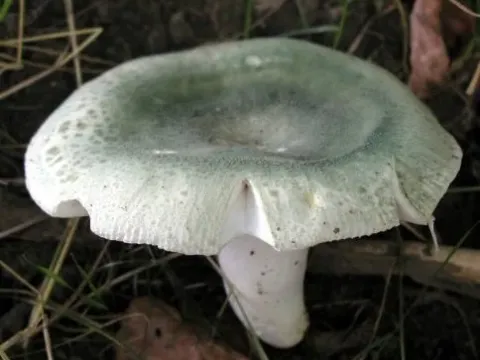
Green brittlegill
Russula virescens
The green brittlegill (Russula virescens) is not a plant disease. It is a well-known species of basidiomycete fungus belonging to the Russulaceae family and acts as a beneficial forest organism.
What the section contains
Green brittlegill
This fungus possesses no phytopathogenic properties and does not cause infections, lesions, or decay in agricultural crops or forest trees. It is essentially an obligate mycorrhizal partner.
The fungus establishes a symbiotic relationship with the root systems of various tree species, enhancing the nutrient uptake of the host plants through its extensive mycelial network.
Since it does not harm plants, it is not classified as a pathogen and requires no protective measures or control strategies in an agronomic or forestry context.
In biological terms, the organism is classified as an edible mushroom, and its presence serves as an indicator of a healthy and balanced forest ecosystem.
The primary diagnostic feature of the green brittlegill is its uniquely cracked cap, which features a greenish to bluish-green color with a matte texture.
The cap surface is composed of small, irregular patches or scales, resembling the texture of cracked leather or a mosaic pattern, distinguishing it from other Russula species.
The gills are white or creamy, quite brittle but dense, and they remain white even when handled or bruised, which is a key trait for identification.
The stem is white, solid, and cylindrical, often appearing slightly thickened towards the base, providing structural support for the cap.
- Flesh is white, firm, and does not change color when cut or damaged.
- Taste is mild and pleasant, lacking the acrid or spicy notes found in other related species.
- Spore print is white, which is a consistent taxonomic characteristic.
The green brittlegill thrives in well-drained soils within deciduous or mixed woodlands, often appearing near oak, beech, and birch trees.
Development of fruiting bodies requires stable environmental conditions, typically occurring during periods of moderate precipitation and temperatures between +15°C and +23°C.
The fungus prefers habitats rich in organic matter and leaf litter, which provide the necessary nutrients for its mycelium to remain active throughout the growing season.
High humidity levels following rainfall pulses significantly stimulate the growth of fruit bodies from the underground mycelial mass.
The organism is sensitive to soil pollution and rapid habitat changes, often acting as a bioindicator of stable and preserved forest environments.