
Green mold of citrus
Penicillium digitatum
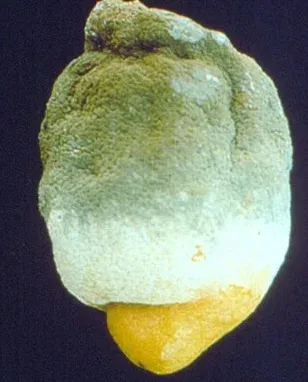
Description
Symptoms
The initial symptom is the appearance of soft, water-soaked, and pale spots on the rind of the fruit. These spots expand rapidly under favorable conditions.
As the disease progresses, a characteristic olive-green, dusty mass of spores covers the center of the infected area. This mass is highly volatile and releases spores easily.
A distinct white mycelial ring often develops around the green sporulating center. This represents the leading edge of the fungal growth as it advances into healthy tissue.
The fruit quickly loses its firmness and turns into a soft, mushy mass. A pungent, musty odor is usually associated with advanced stages of the infection.
- Water-soaked, soft lesions on the peel.
- Olive-green dusty sporulation.
- White mycelial ring surrounding the lesion.
- Rapid softening and disintegration of fruit tissue.
Pathogen
The causal agent of this disease is the fungus Penicillium digitatum, an ascomycete. It is widely recognized as one of the most aggressive post-harvest pathogens affecting citrus fruits during storage and transport.
The fungus invades fruit tissues primarily through mechanical wounds, scratches, or punctures on the peel. Once inside, it rapidly colonizes the fruit tissue by secreting enzymes that break down the cellular structure.
The fungus produces a vast quantity of conidia, which are easily disseminated by air currents or physical contact between fruits. This high sporulation rate allows the pathogen to spread throughout storage bins very quickly.
Penicillium digitatum acts as a specialized pathogen for citrus fruits. It can also persist in the environment as a saprophyte on decaying organic matter, making it ubiquitous in citrus-growing regions.
The life cycle of the pathogen is highly dependent on environmental conditions, and under ideal humidity, the fungus can produce new generations of spores in a matter of days.
Conditions for development
The optimal temperature range for Penicillium digitatum development is between 20°C and 25°C. However, the fungus remains active and can cause infection even at lower storage temperatures.
High relative humidity (above 90%) is critical for the rapid germination of spores and subsequent mycelial invasion of the fruit tissue.
Poor ventilation in warehouses promotes the accumulation of spores and increases moisture, creating the perfect microenvironment for mass infection outbreaks.
Mechanical injuries to the rind, sustained during harvesting, cleaning, or packing, act as the primary entry points for the pathogen.
Condensation on fruit surfaces, often resulting from temperature fluctuations during transport, is a major factor that facilitates spore germination and fungal establishment.
Why it matters
Green mold is the leading cause of post-harvest economic losses in the citrus industry worldwide. In uncontrolled conditions, it can destroy over 50-80% of a stored shipment in a very short time.
Infected fruits become completely unmarketable due to both the visible presence of mold and the degradation of fruit quality and flavor.
The disease causes significant indirect losses, including labor costs for sorting and discarding contaminated fruits from storage containers.
The presence of mycotoxins produced by the fungus can make the fruit unsafe for both fresh consumption and processing into juice or other citrus-based products.
Rapid spread among packed fruits makes green mold a major challenge for supply chain management, often leading to the rejection of entire shipments upon arrival.
Protection
The primary control measure is the prevention of mechanical injury during harvesting and handling. Maintaining the integrity of the fruit rind is the best defense against infection.
Strict temperature and humidity management in storage facilities, supported by adequate ventilation, is essential to inhibit fungal growth.
Post-harvest application of registered fungicides is a standard industrial practice to protect fruit surfaces from colonization by fungal spores.
Strict sanitation protocols in packing houses, including the cleaning of equipment and storage crates, are necessary to reduce the spore load in the environment.
Prompt sorting and removal of any symptomatic fruits from storage lots are crucial to limit the "nesting" effect and prevent the spread of the disease to healthy fruit.
Discussion
No discussions yet — be the first.