
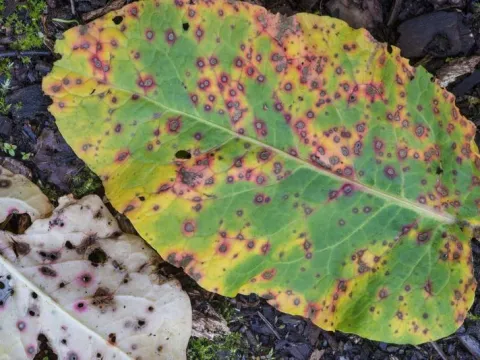
Ramularia leaf spot of sorrel
Ramularia rubella
The causative agent of this disease is the imperfect fungus Ramularia rubella (Bon.) Nannf. This pathogen belongs to the Deuteromycetes class and specifically affects plants of the Polygonaceae family.
What the section contains
Ramularia leaf spot of sorrel
The fungus survives in the soil and on crop debris as mycelium or sclerotia. These dormant structures allow the pathogen to persist through unfavorable conditions and reappear in the following season.
During the growing season, the disease is spread by conidia, which are disseminated by wind, rain splashes, or irrigation water. Infection starts when spores land on susceptible leaf tissues.
The fungal mycelium colonizes the leaf tissue, disrupting normal plant function. As the fungus spreads internally, it eventually breaks through the leaf surface to produce new spores.
The life cycle of the pathogen is closely tied to the host plant, enabling it to thrive in various agricultural settings where sorrel is cultivated intensively.
The first symptoms of Ramularia leaf spot appear as small, circular, or irregular spots on the leaves. These spots are initially reddish-brown with a distinct darker margin.
As the infection progresses, the spots expand and may coalesce, covering large portions of the leaf surface. A characteristic grayish-white powdery growth of spores appears in the center of the spots.
This fungal growth is especially visible in humid conditions. Heavily infected leaves eventually turn yellow and undergo premature senescence, leading to leaf drop.
The disease typically spreads from the lower, older leaves upwards to the rest of the plant. In severe cases, the entire foliage canopy can be affected, significantly reducing crop quality.
- Reddish-brown spots with dark margins.
- Grayish-white spore masses in the center of spots.
- Yellowing and premature death of leaf blades.
High humidity and moderate temperatures are the primary drivers of Ramularia rubella development. Extended periods of rainfall create an ideal environment for spore germination.
Overcrowded plantings that lack proper air circulation prevent leaves from drying, which significantly accelerates disease spread across the field or garden bed.
Optimal temperatures for the development of the fungus range from 15°C to 22°C. Within this range, the pathogen can complete its cycle rapidly, leading to major outbreaks.
Poor sanitation, such as leaving weeds and dead foliage in the field, helps the fungus survive and spread to new growth during the next season.
Overhead irrigation applied during the evening can exacerbate the situation, as the moisture remains on the foliage throughout the night, favoring fungal colonization.
The main impact of Ramularia leaf spot is the reduction in marketable yield. Since sorrel is a leafy green crop, even slight spotting makes the harvest unsuitable for sale.
The disease reduces the photosynthetic capacity of the plant, which weakens the entire root system and slows down the regrowth of new leaves after harvesting.
In cases of severe infection, total yield losses can reach 30–50%. The nutritional and culinary value of the leaves is severely compromised by the presence of fungal lesions.
Continued cultivation of sorrel in infected soil ensures that the disease will return every year, often appearing earlier and causing more extensive damage each time.
Economic damage is also associated with the increased costs of disease management and the potential need for field abandonment in extreme cases.
Crop rotation is the most effective cultural practice. It is recommended to avoid planting sorrel in the same area for at least 3–4 years to break the infection cycle.
Good field sanitation is essential; all infected plant debris must be removed and destroyed after harvest to reduce the inoculum level in the soil.
Ensuring proper plant spacing is vital for improving airflow and preventing the buildup of humidity around the leaf canopy. This simple measure can significantly reduce disease pressure.
Balanced fertilization, particularly with potassium and phosphorus, helps to strengthen the plant's cell walls, making them more resistant to fungal penetration.
While fungicides can be used, their application on leafy greens is strictly regulated. Always prioritize integrated pest management (IPM) techniques before turning to chemical solutions.