
Juniper Bracket
Pyrofomes demidoffii
The disease is caused by the wood-decaying fungus Pyrofomes demidoffii, which belongs to the Basidiomycota division. It is a parasite that primarily attacks the heartwood of trunks and large branches.
What the section contains
Juniper Bracket
The fungus causes intense destructive yellow-brown heartwood rot. During its life cycle, the mycelium penetrates deep into the plant tissues, decomposing both cellulose and lignin.
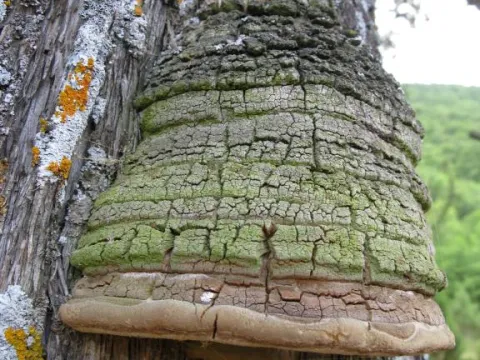
Perennial fruiting bodies of the fungus have a hoof-like or cushion-like shape with a hard, cracked surface. They develop directly on the bark of infected trees.
Fungal spores are dispersed by the wind and settle on bark injuries, mechanical cracks, or frost damages. Infection occurs under favorable humidity conditions.
The pathogen's life cycle is closely linked to old-growth stands, where it slowly but steadily compromises the structural integrity of the tree over many years.
The primary external sign of the pathogen's presence is the emergence of characteristic fruiting bodies on the juniper trunks. They are often hidden within deep cracks in the bark.
The wood in the affected area becomes brittle, develops a yellowish-brown tint, and breaks down into cubical fragments. This is a clear symptom of advanced heart rot.
In early stages, the tree crown may begin to yellow prematurely and thin out, which is associated with damage to the trunk's vascular system. However, visual changes are often noticed too late.
When tapping on the trunk in the area of suspected infection, the sound becomes hollow, indicating the presence of internal cavities and tissue decay.
Resin exudation near the sites of fruiting body formation is a secondary sign, indicating the tree's defensive response to the fungal invasion.
The development of the fungus is favored by dense juniper plantations where air circulation is restricted and humidity levels remain consistently high.
The pathogen spreads most actively in old stands, typically over 30-40 years of age. As trees age, their immune system weakens, and the number of entry points for spores increases.
Climatic factors, such as prolonged spring rains or high humidity during summer, create ideal conditions for spore germination on the bark surface.
Mechanical damage caused by pruning, gardening equipment, or wildlife significantly accelerates the process of primary infection.
The temperature regime in temperate zones supports the long-term activity of the mycelium inside the trunk, making the infestation nearly irreversible without intervention.
Juniper Bracket poses a serious threat to junipers, causing wood decay and eventual tree death. It is a slow yet inevitable process of destruction.
The infestation leads to a significant loss of ornamental value, rendering affected conifers unsuitable for landscaping and park design purposes.
Due to the destruction of heartwood, the tree loses its structural strength. In the event of strong winds or snow loads, infested specimens are prone to snapping at the decay sites.
The fungus serves as a source of infection for neighboring healthy trees, which, in plantation or park settings, can lead to widespread loss of conifer stands.
Economic losses arise from the need to remove valuable old-growth specimens and the high costs associated with clearing the site of infested timber.
The primary preventive measure is strict adherence to good horticultural practices. It is crucial to avoid any bark damage during tree maintenance and to treat wounds promptly.
Regular sanitary pruning is necessary to remove dead or diseased branches. All cut surfaces should be immediately treated with antiseptic garden sealants.
Severely infested trees must be cut down and destroyed immediately. Infested wood should never be left in the garden as it serves as a persistent source of spores.
When necessary, preventive spraying with copper-based fungicides can be conducted to inhibit spore germination on the bark surface during high-risk periods.
Maintaining tree health through proper fertilization and irrigation helps the plant activate its natural defensive mechanisms against pathogen invasion.